English
Why does an apartment building need two access systems?
One building, one manager, one app: you'd expect one system. And yet the front door runs on completely different technology from the apartment doors above it.
An apartment building looks like a single access problem: one address, one manager, residents who want one app. Then you inventory the doors and the problem splits in two, so cleanly that the industry builds different hardware, sells it through different channels, and only recently started sewing the two halves back together.
That split doesn't come from brands being scattered. It comes from the building itself: an apartment building holds two species of door with almost opposite requirements, and a technology tuned for one is mediocre on the other.
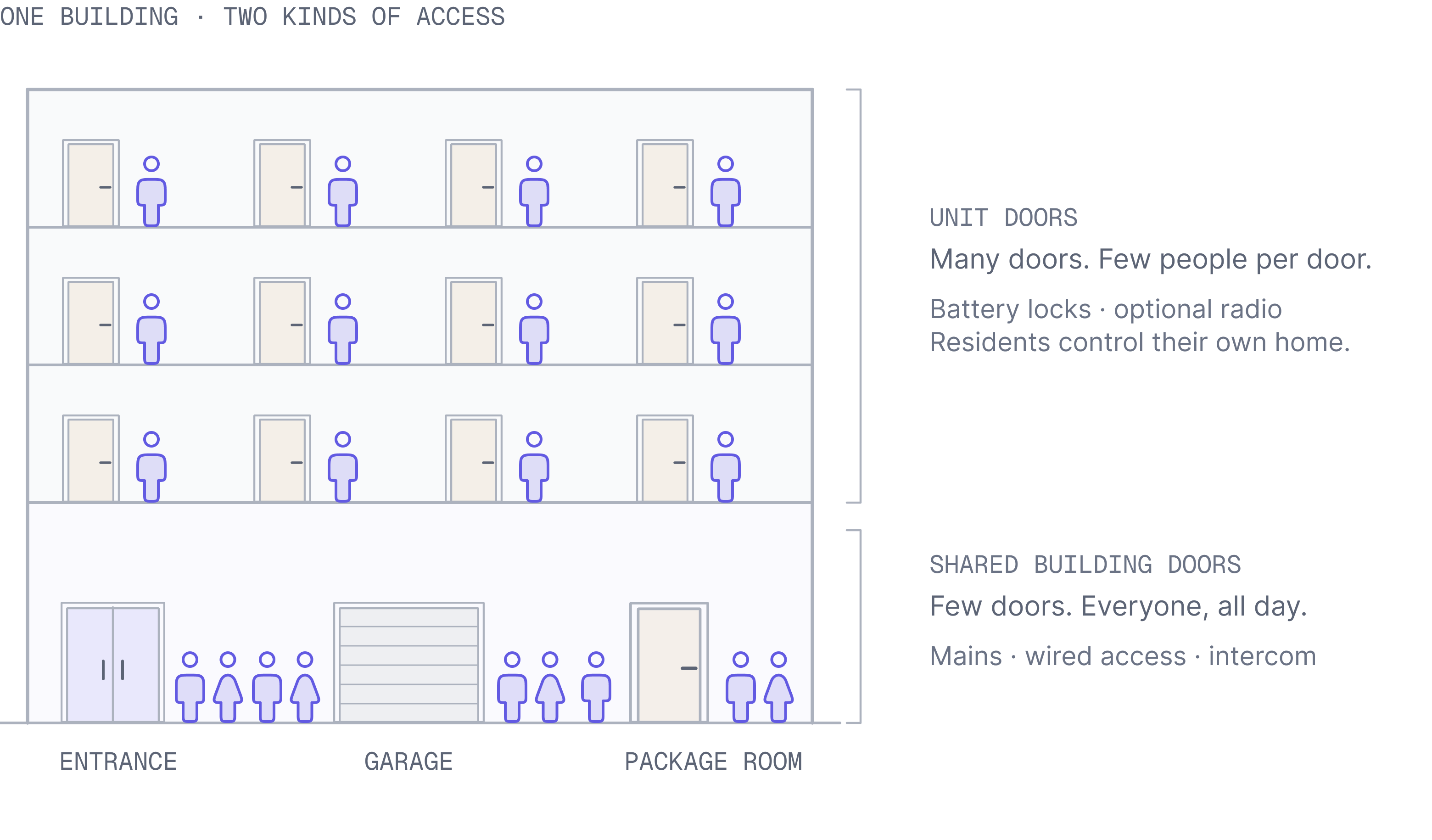
Everybody crosses the common doors, and they have mains power at hand
The first species is the entrance, the garage, the elevator, the gym, the package room. A handful of openings, each crossed by hundreds of people a day, belonging to nobody but the building.
Everything about them calls for wired access control. The traffic is heavy, so the hardware wears fast and gets replaced at the pace of the building's life. They're powered by the building and sit near the network, so nothing forces anyone to accept the compromises that come with battery life. They have to be of service to every resident, every courier, every visitor, and that's the function the intercom takes on: the common door is the one place where a stranger has to be able to ring a particular occupant, and where that occupant has to be able to open a door they can't see. And they answer to the building's rules: egress, lockdown, and the hardware of shared entrances.
It's the same supervised world as the hotel corridor, running on the same logic: doors that lock themselves, managed from one desk, because the operator carries the risk.
Wiring a thousand occupied apartment doors makes no economic sense
The second species is a hundred or a thousand apartment doors. Each is crossed a few times a day by the same few people. Each is, legally, the boundary of a home, which imports the whole autonomous-dwelling logic: residents who lose their keys at midnight, expectations of privacy, tenants who arrive and leave at the pace of leases.
So the apartment door is battery territory: connected locks, usually bored-format replacements, that the platform reaches either by speaking to them directly (the command travels all the way to the lock), over whatever radio the building's economics can afford, or through the credential they read.
And the manager's interest in that door is real but bounded. They have to handle turnover, meaning that when a lease ends, every key that household held must stop working, and they have to handle emergencies. Meanwhile the resident controls daily access. Two parties, one door, and a permission model the common doors never needed.
One credential and one revocation have to cross the seam
So the building genuinely needs both: an access control system for a handful of wired, public, heavily used doors, and a fleet of battery locks for a large number of private, quiet ones. Neither can absorb the other. What is interesting to design, and what makes multifamily access a category rather than two shopping lists, is the seam between them.
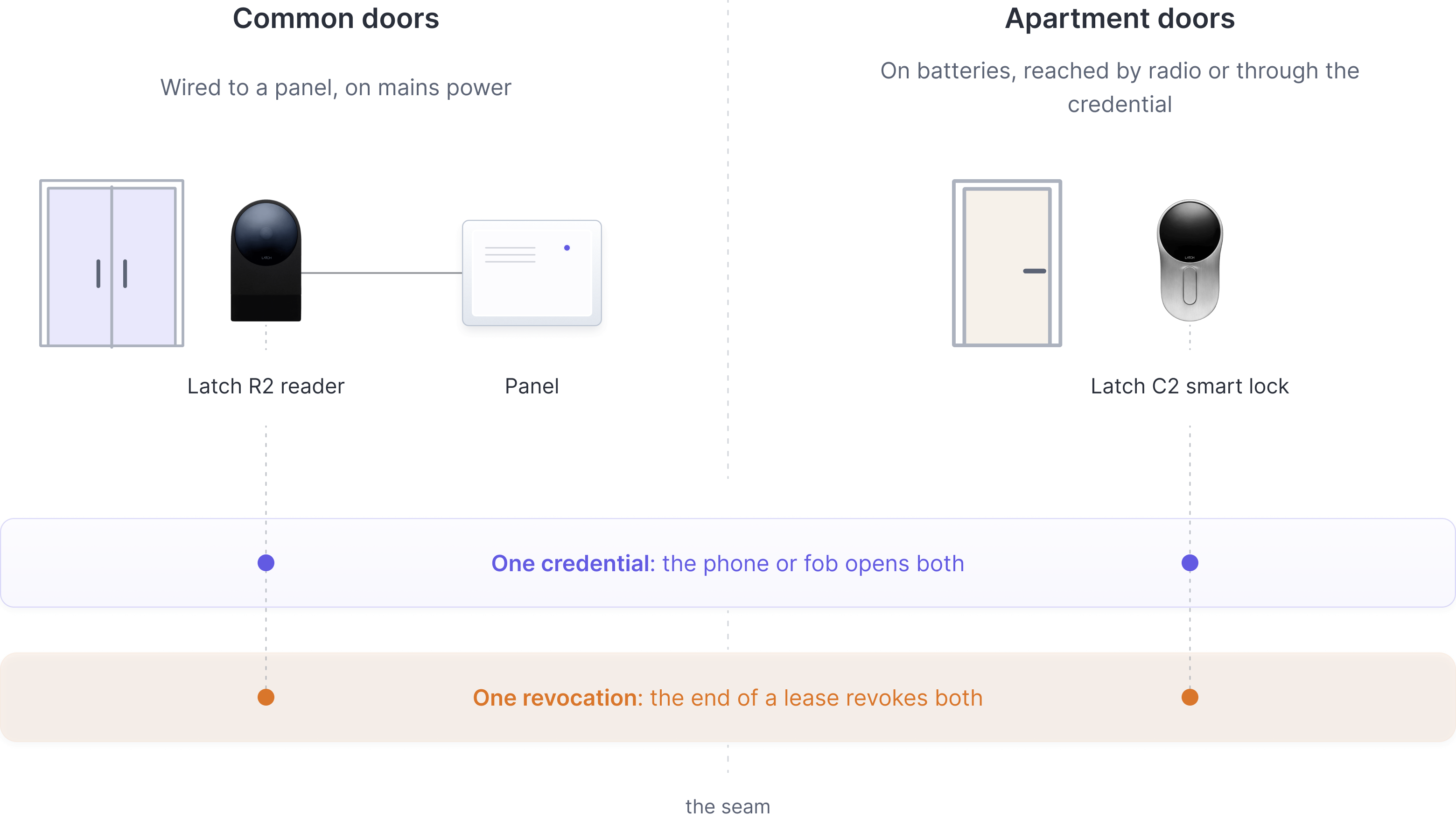
The resident experience only holds if one crosses that seam: the phone or fob that opens the entrance has to open the apartment, or the promise of one app stops in the lobby. Turnover only holds if one action crosses it: the end of a lease has to revoke the apartment door, the entrance, the garage and the gym together, at whatever speed each path allows. That is what pushes multifamily toward whose reach covers both species of hardware, and exactly why the players in this market sell complete systems rather than locks.
| The common doors | The apartment doors | |
|---|---|---|
| How many, at what pace | A handful, hundreds of crossings a day | Hundreds, a few crossings a day |
| Power and network | Mains and wiring at hand | A battery, and a radio at most |
| Whose rules | The building's: egress, lockdown, visitors | Shared: the resident daily, the manager at turnover |
| The natural hardware | Wired access control and an intercom | Battery-powered connected locks |
| Strangers | Must be able to ring and be let in | Should never get past the common door |
| What a failure costs | Everyone is affected at once | One household, but badly |
On every one of these points, the two species of door are pulled toward different technology. The category exists because residents and managers still need the two halves to behave as one system.
Hardware that lives at the seam
Apartment locks and connected building hardware from DeviceDB. The category is defined by making all of it work as one system.


Which gives the questions to ask of any multifamily access offer. Not what the lock does: both halves have good hardware. Does one credential cross the seam? Does one revocation cross it? And who gets called when each half fails? A building that answers all three has one access system. A building that cannot answer has two.