How long does it take to revoke access?
Handing out a code, a card or a phone key takes seconds. Revoking them takes three different operations, and the delay before every door refuses runs from one second to a week.
When a job ends badly, a phone is stolen, or a code leaks into a group chat, the operator's first question isn't whether the can be revoked. It's when the door will start refusing it.
Depending on the system, that takes a second or a week. The spread doesn't rank products by quality. It comes from where the decision runs, and from how the system reaches the lock.
Revoking means changing the rule before the next presentation
Revoking means changing the rule that decides whether the door opens, so it takes as long as that change takes to reach the place where the decision runs.
If the decision runs in the cloud, it's immediate: the rule lives in one place and the operator has just changed it. If it runs in a panel, the news crosses the building network and arrives within seconds to minutes. If it runs in the lock, the change has to be carried there: by radio if the lock has one, otherwise by somebody walking to the door.
And if the decision was made at encoding time, there's nothing left to update. It's already written into the credential. That leaves two options: wait for the credential to expire, or get fresher news to the door before it arrives.
An offline code is the hardest to revoke, a phone key the easiest
An offline code is the hardest, because a code is something the person knows, and you can't take it out of their head. On an online lock the platform deletes it from the device and that's that. On an offline lock whose codes are computed, there's usually nothing to delete anywhere: the code stops working when it expires, and rarely before. You make up for it beforehand, with short windows and one-time codes, which means the revocation was decided when the code was issued.
A card can be blocked by another card. On panel and cloud systems it's taken out of the rule and the door refuses it at the next presentation. In a system where the rights are written onto the cards themselves, the platform puts the stolen card on a denylist that the other cards carry to the doors: one fresher card reaching a door is enough for that door to refuse the stolen one from then on. And in every case, the stolen card eventually expires.
A phone key removes itself, in the ordinary case. It lives in an app that talks to the ; the provider withdraws it, and the phone deletes it seconds later. The awkward case is a phone that never reconnects: airplane mode, flat battery, bad faith. The key stays on the phone with its expiry date, and there's nothing to do but wait for that date.
Which makes the question worth asking the other way round. Not only how, and how fast, access can be granted, but how, and how fast, you can be sure it has been cut.
A contractor rarely has only one way in
Take a contractor whose job has ended badly. They have a badge, and that's the one everybody revokes. They may also have a service door code, given over the phone one morning in March. A gate remote still sitting in their van. And on plenty of sites, a mechanical key.
A system can only revoke what it knows about. A code read out loud, a badge lent to a colleague, a key copied at a locksmith: none of that shows up in the console. An operator who announces that somebody's access has been removed has removed the credentials the system knew about.
So the question to settle before the emergency is a simple one. For this person, how many ways in exist, and how many of them are in the console?
Which also means the ways in determine what it takes to shut them. A copied mechanical key isn't revoked, it's replaced, by rekeying or changing the cylinder.
| The cloud decides | The panel decides | The lock decides | Decided at encoding | |
|---|---|---|---|---|
| Revoking means | Editing the live rule | A message to the panel | A message to that lock | Impossible: outrun it or wait it out |
| Takes effect | At the next presentation | Seconds to minutes later | Next time the lock is reachable | At expiry, or when fresher news arrives |
| Worst case | A platform outage delays the edit | Panel down | Lock unreachable for days | The whole remaining validity |
| What the operator can act on | Account housekeeping | Network health | Radio coverage, the visit schedule | Short expiries, decided at issue |
In the right-hand column, revocation doesn't happen in the emergency. It was settled months earlier, when somebody decided how long a credential stays valid.
Every system imposes a delay between the decision and access actually stopping
That delay can be measured. It's around a second when the locks are connected and the decision runs in the cloud. It takes seconds to minutes with panels. When the lock is standalone, it lasts until a technician reaches the door.
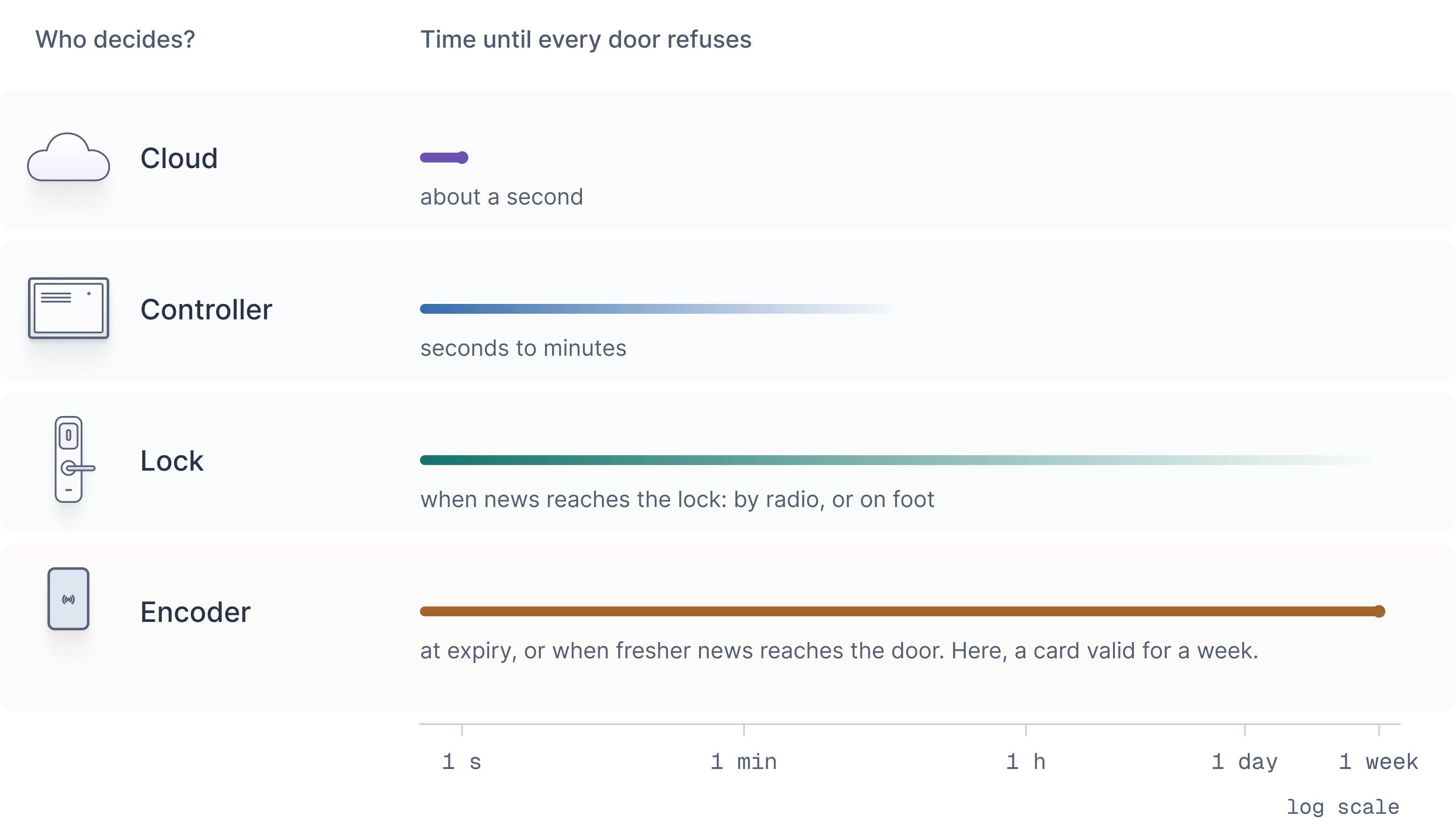
The delay decides what an operator can hand a contractor, how long a lost badge stays a live problem, and whether "we removed their access" is already true or still in progress.
In a demo they'll show you how fast the door opens. Ask instead: from this console, right now, how long until every door refuses? Then ask what has to be true for that number to hold: a connection, a network in working order, or somebody making the trip.