How do you control a lock that has no connection at all?
This lock is not wired and has no network connection of any kind, and yet the platform managed to revoke a key on it. Which way did the command travel?
A hotel corridor holds a hundred locks, none of them wired, none of them on Wi-Fi, most of them asleep. Yesterday your card opened 412. This morning, after checkout, it doesn't, and nobody went near the door in between. Software controls that lock, and that lock has never heard of the internet.
It's surprising, but there really are two distinct ways for a to control a lock. Each has its advantages and its drawbacks, depending on what happens when the network goes down, on what "revoke" actually means, and on what a battery can do when there's no mains power.
When the command travels to the lock, anything it crosses can stop it
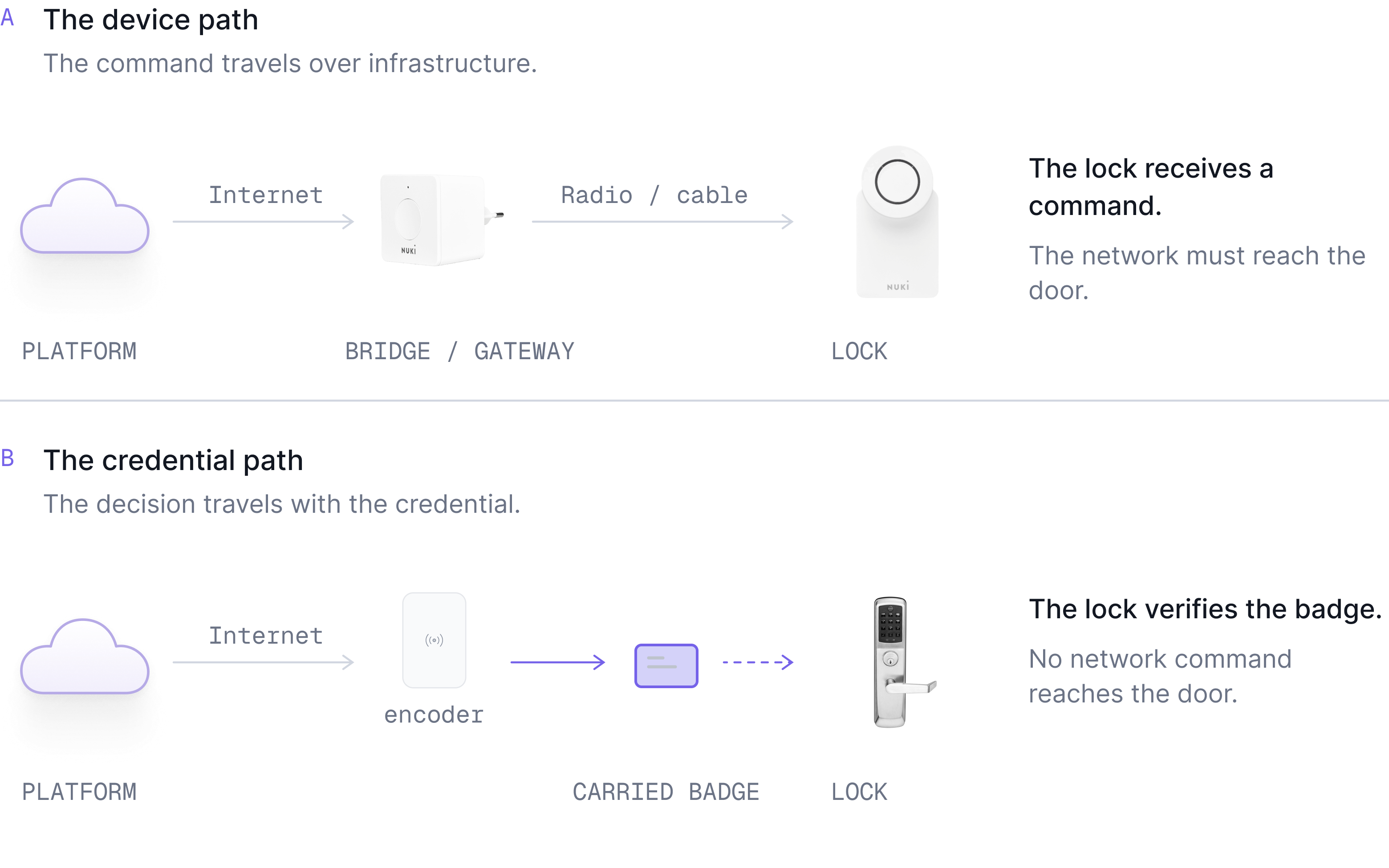
The approach that looks obvious sends a command that travels all the way to the device. This is the . The platform really does reach the device: a command leaves the cloud, crosses the internet, passes through a or a , or reaches the lock's own radio, and at the end a motor moves. Consumer smart locks behave exactly this way, and so do the wired and wireless estates of commercial access control.
Because the command has to make that trip, the system depends on one more thing: that the lock is reachable at the moment you speak to it. Everything between the cloud and the door becomes infrastructure: the bridge, its power supply, the Wi-Fi, the building's internet link. When one of them fails, the lock goes on enforcing what it already knows, but nothing new reaches it.
When the credential carries the decision, the lock is never contacted
The second way reverses the direction of travel. This is the . The platform never contacts the lock, maintenance visits aside. It writes its decision into the itself, and the credential carries that decision to the door. The lock isn't a point on the network, it's a verifier: it checks what it is shown against what it considers itself able to authorize.
The purest version of this is the hotel card. At check-in, the front desk encoder writes your access onto the card: room 412, until Thursday noon, for example. The lock on 412 reads the card and finds the answer already written there. At checkout, the next guest's card opens their access while yours stops working. Through all of this, the lock was never contacted. The command itself didn't travel: the card was encoded as an authorization to open. In the end, you're the one who carried the decision to the lock!
Salto's Space platform runs entire buildings on an industrialized version of this principle, and its documentation states the inversion plainly: "access data is stored on each contactless card" rather than on the lock, and "when a user presents their key to the SVN reader, the latest up-to-date access information is automatically transferred to the key" (Salto Space system overview). A few online wall readers refresh every key that touches them, and the keys, as they move through the building, carry updates and revocations to hundreds of battery locks that no network will ever reach.
"No radio, so it can't be controlled" is false
You often hear it: this lock has no way to reach the internet, and no radio, so there's no controlling it. That's false, and not marginally so: it's false for a great many hotel rooms on earth, and for every data-on-card estate.
A lock with no connection of any kind can have a platform, appear in software, gain and lose users on a schedule, and be part of an integration. What changes isn't whether software controls it, but the way that control is exercised: the decision is taken at encoding, enforced at the door, and refreshed at whatever rate keys pass an online reader.
When the command travels to the lock, a revocation is a message: it takes effect when the lock hears it, usually within seconds. When the credential carries the decision, the revocation waits for the next encounter: it takes effect when the dead key expires on its own, or when a fresher key reaches the door first and leaves the denylist there. Between those two moments there's a delay, and engineering an estate of this kind is largely about keeping that delay short.
| The command travels | The credential carries the decision | |
|---|---|---|
| What arrives at the door | The command itself | The credential, with the decision inside it |
| The lock is | A point on the network | A verifier, never contacted |
| Revoking means | Sending a message to the lock | A denylist entry, carried by fresher keys |
| It takes effect | When the lock hears it, usually within seconds | At expiry, or when a fresher key reaches the door |
| If the network drops | No further command reaches the door | Nothing changes at the door |
| Infrastructure per door | Radio coverage, a box, its power supply | None. The doors share a few online readers |
| Where it shines | Immediate remote action on a few doors | Hundreds of battery doors, one building |
Neither column is the modern one. They are two answers to the question of how far the network should reach, and large systems routinely run both at once.
One building often uses both
The two paths aren't rival eras, and the best proof of that is that serious estates mix them on purpose: perimeter doors and elevators on the first, where seconds count and mains power is within reach, and the long corridors of interior doors on the second, where pulling network to every door would buy almost nothing.
The two paths, visible in the catalog
A consumer bridge that exists only to put a lock on the internet, and an exit trim sold in a data-on-card version: each path, named by its own hardware.


So when a spec sheet says a lock is "offline", understand that this says nothing about whether the lock is controlled, audited and revocable. The question to ask is the one our article on platforms approaches from another angle: not just where the access exists, but which path it takes to the door.