English
Why do hotel doors lock themselves, but yours doesn't?
The same slam that locks a hotel door and troubles nobody would be a disaster at home. The two settings end up with two different kinds of lock, mostly because the people managing access are not the same.
Step out into a hotel corridor, let the door swing shut behind you: it locks. Hotel room doors work this way, and nobody finds it strange. If the same thing happened at home, you'd be standing in the stairwell in your socks.
The mechanics that let a door lock itself are described in the article on bolts: a behind a lever that only a will turn, so that the slam is the locking. The method is a century old. And yet your own front door doesn't use it. Whether a door that locks itself is an advantage or a hazard doesn't depend on the door. It depends on who is in the building.
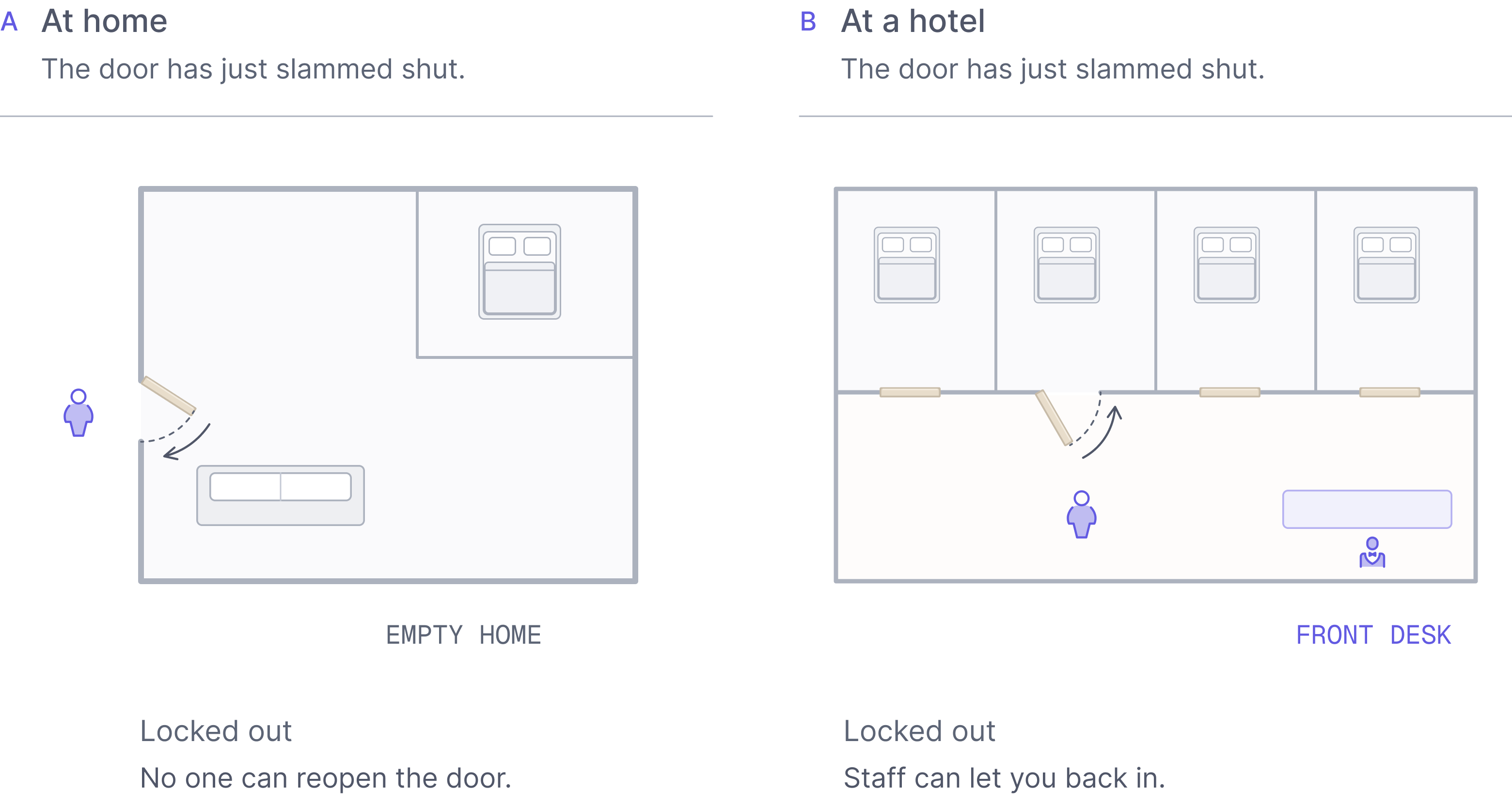
At home, nobody can reopen the door for you
A home is an autonomous cell. There's no staff, no front desk, no master key down the corridor. If the door locks with the keys inside, the building holds nobody who can put that right, short of a neighbor with a spare set, a locksmith, a drill or a window.
Residential doors leave the decision to your hand, then. The and its are the mechanism that allows it: the door only locks if somebody locks it, and the price is that somebody has to think of it every time, including the last time before the holidays.
The interesting detail is what happened when these locks got a motor. Manufacturers added auto-lock, then they made it a setting. On Schlage's Encode line it's a delay you pick in the app, and the list of choices includes "Off": to disable auto-lock, you set the timer to "Off" (Allegion knowledge base). A hotel guest has no such switch. The residential industry treats auto-lock as a risk you may consent to; hospitality treats it as the reason the lock exists. Both are right.
At a hotel, the front desk reopens the door in thirty seconds
Take the same slam in a corridor.
A hotel operator answers for a few hundred strangers asleep behind doors. Most are tired, some have been drinking, none have been trained. A door left unlocked because a guest didn't turn a knob isn't that guest's problem alone: it's a failure on the operator's part, and the operator can't ring every room at midnight to check. Security that rests on the least careful guest isn't security an operator can claim to provide.
So every door is made automatic, and the trade-off is accepted outright for the sake of real security. Locked out in a bathrobe? The front desk cuts a new card in thirty seconds. The building is supervised: there's always somebody whose job includes reopening your door, who holds a master credential, and who is standing fifty meters away.
That's the whole trade. Supervision brings down the cost of a lockout, and once a lockout costs little, the best door is the one that locks on every slam. The hardware follows: rooms get with a deadlatch behind credential-controlled trim, not out of any fondness for mortise cases, but because that's the mechanism whose default behavior matches the operator's arithmetic.
Hardware sold into supervised buildings
A hotel lock and a multifamily lock from DeviceDB. Two markets, one premise: somewhere in the building, somebody can always reopen the door.

The guest keeps a private room, the operator keeps the risk.
In an office, what changes in the evening is the outside levers, not the doors
An office floor has the same geometry, with one more setting: during the day, the supervised space runs right inside the suites.
An office suite door spends its working hours in the strangest state a door can be in, the one the article on bolts calls deadlocked without being locked. The outside lever turns for everyone, and the latch stays deadlocked the whole time: the handle works, but a card attack does not. Colleagues come and go, and the mechanism stays unworkable from the gap.
Then evening comes. Nobody walks the floor locking doors. The doors don't change; what changes is what the outside levers will do. Salto's documentation for its office mode says it plainly: office mode "permanently unlocks the door, which means everyone can open the door without presenting a tag or digital key", and in its scheduled mode, when the window ends the lock relocks by itself; outside the window, a presented credential opens the door, which "instantly lock[s] again as it would under normal operation" (Salto office mode guide).
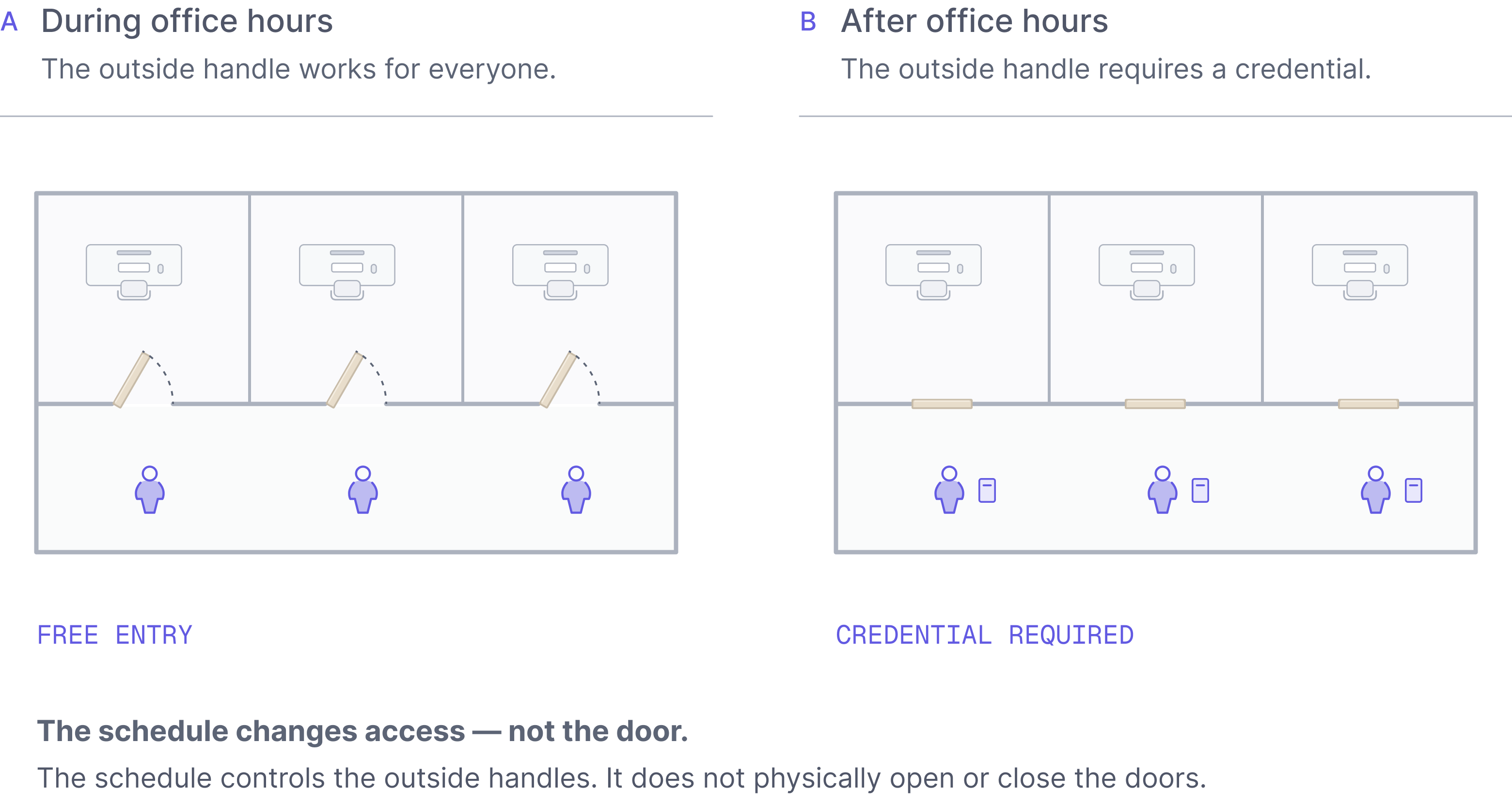
That flip, multiplied by every door on every floor, is what office access systems actually sell. Not "smart locks": the ability to change what a hundred outside levers will do, from one desk, on a schedule, without anybody walking to a door. The wall reader is only the visible end of it.
| A home | A hotel or office floor | |
|---|---|---|
| Who can reopen a locked door | Nobody, except somebody already inside | Staff on duty, with a master credential |
| What a lockout costs | A locksmith, an evening, sometimes a window | Thirty seconds at the front desk |
| The state of a door that has just shut | Shut, until somebody locks it | Locked, the instant it slammed |
| Who carries the risk of a forgotten lock | You, alone | The operator, for every door at once |
| What auto-lock is there | An optional setting | The entire design |
| The mechanism used | A deadbolt and a decision | A deadlatch behind controlled trim |
The building's organization chooses the hardware: the one that can always reopen a door is the one that can afford doors that lock themselves.
A short-term rental is a home made to behave like a hotel
One kind of building refuses to pick a side, and it happens to be the one where connected locks matter most. A short-term rental is physically a home: autonomous, no front desk in the corridor, no staff on the floor. In the way it runs, it's a hotel: strangers follow one another, they have to be let in, cut off at checkout, and never relied on to lock up on leaving.
The host solves it by supplying what the building lacks: supervision from a distance. A connected lock that reports its state, credentials that expire on the day of departure, and a host who can open from another city take the place of the front desk. Which is why the auto-lock setting, a matter of convenience on a private front door, becomes something else on a rental: the host turns on what a homeowner leaves off, because for the guest who slammed the door on the way to the beach, the host is the desk.
The question to ask at any door, then, isn't whether the lock is good. It's who can reopen it, from where, and how fast. The answer decides what the door should do when it shuts.