How was your door cut, and can you go back on that choice?
There are two ways to fit a lock into a door. One removes about three and a half times more wood than the other, so you can only really switch from one choice to the other in a single direction.
While preparing your door, forty years ago perhaps, somebody made a decision and cut it with a chisel or a drill. A bored door can be converted into a mortise door; the reverse is only ever patched, with a plate that hides the pocket.
What separates the two preparations is the edge, not the face
A keeps its whole mechanism in a steel case, and that case sits in a pocket cut into the of the . The pocket has to be deep enough to take the case, and the face also needs two bores, one for the cylinder and one for the spindle.
A , by contrast, simply requires two holes drilled: one through the face, the other in from the edge, so that the two meet at a right angle.
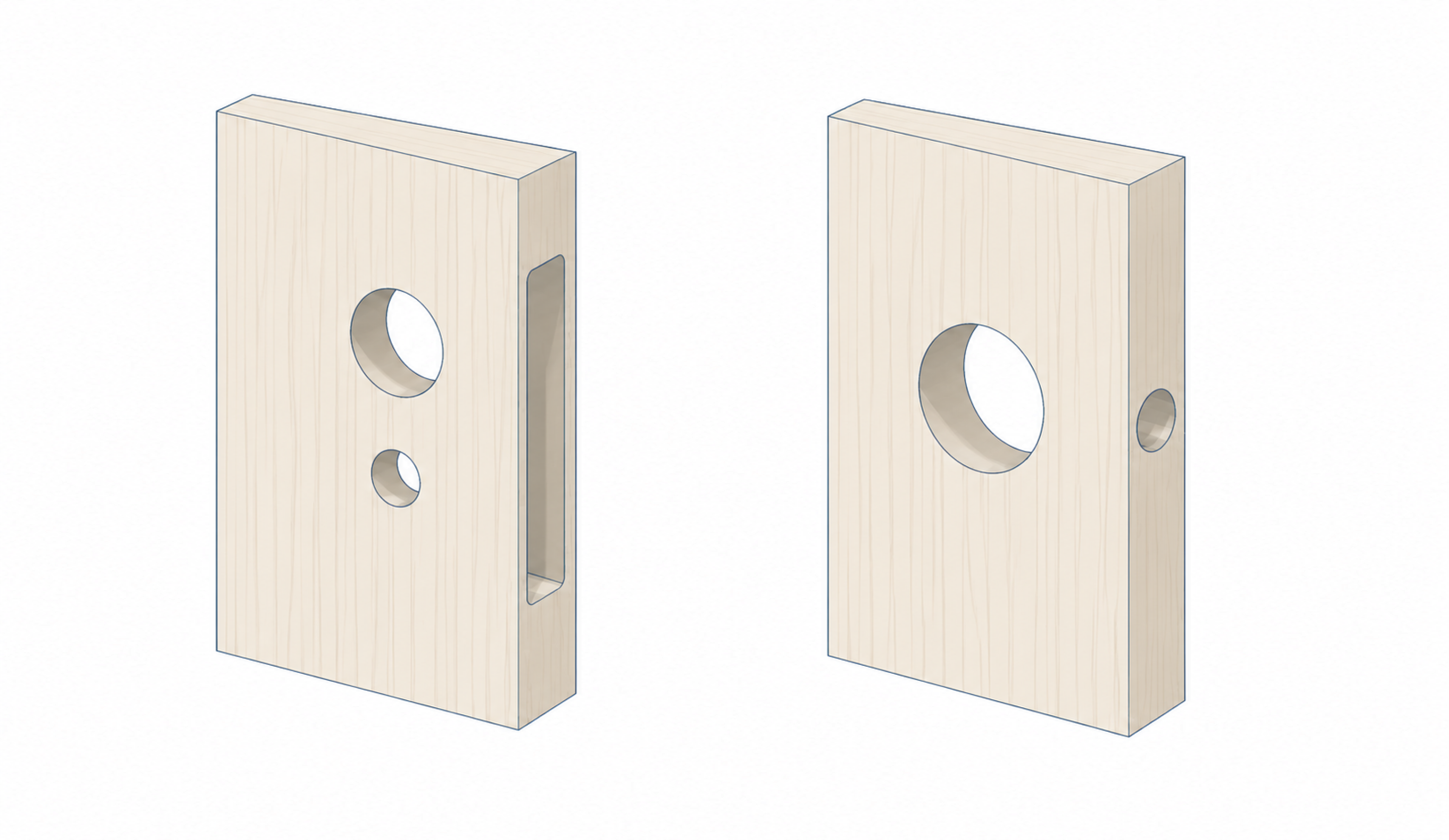
The figures vary and come from the manufacturers' own templates. In the United States, Schlage's L9000 series calls for a pocket about 1 inch (25 mm) wide and 4-1/2 inches (114 mm) deep to take a case of 4-7/16 by 6-1/16 by 1 inch, in a door between 1-3/8 and 2-1/2 inches thick (Allegion L1 template, and L896 for the cut). Its ND series calls for a of 2-1/8 inch (54 mm) and an of 1 inch (25 mm), with a of 2-3/4 inch (Allegion P515-170 template).
Those figures give the volumes removed. The pocket alone takes out about 470 cm³ of solid wood, and the two bores of a bored lock take out about 136 cm³. The mortise also needs its face bores, so the real gap is wider still: cutting for a mortise lock removes at least three and a half times as much wood as drilling for a bored one.
The cross bore is not always 54 mm. Allegion's H-Series template marks two on the same door, 1-1/2 inch above and 2-1/8 inch on the knob's centerline, 38 and 54 mm (P509-688 template).
So knowing that your door is bored is not enough to order a lock. You also need to know which diameter each hole carries, because a lock made for 54 mm does not go into a 38 mm hole.
Once the lock is fitted, the only visible difference is the plate on the edge
Almost all of this is invisible once the lock is in the door. What shows is the plate along the edge, and its height is the fastest way to tell one from the other.
The of a mortise lock is 8 inches tall on the L9000 series. A bored lock shows only a small plate, about 2-1/4 inches tall and 1-1/8 wide. To identify a door without dismantling anything, open it and look at the edge: either a tall plate with the bolts emerging from it, or a small plate around a single bolt.
Only one of these two cuts can be undone
A bored door can become a mortise door. It is simply a matter of cutting more. The pocket swallows the edge bore, and a plate can be used to cover the cross bore left in the face. It costs a little carpentry, but it can be done.
A mortise door, on the other hand, does not convert back into a bored door. Once a cavity 25 by 114 millimeters has been made in the edge, filling it with something that behaves like solid timber is not realistic. What the catalogs offer instead is a patch: a conversion plate that covers the pocket and carries a bored latch (Don-Jo CV-86).
The drill conquered America because the chisel took time
Bored locks were invented to take less out of the door. Their inventor says so explicitly. On 12 April 1920, Walter Schlage filed a patent for a lock whose mechanism is assembled into a round housing, so that it "may be readily installed without cutting away an excess of the woodwork". The patent was granted in 1923 (US 1,456,041). The patent does not promise that the lock is safer. It describes a lock that is "cheaply manufactured" and fitted into a hole "drilled through the door with an auger". The saving on labor is not in the patent. Schlage's own catalog claimed it four decades later: architects and builders "were attracted to the cylindrical or two hole bore-in principle which eliminated the traditional time consuming chiseling of a rectangular mortise in the door" (Schlage Builders Hardware catalog, 1962).
Time saved at the door, then, split the market in two on the American continent. The standards carry the trace of that schism. BHMA defines a separate standard per installation architecture: A156.2 for bored and preassembled locks, A156.13 for mortise locks.
The European standard EN 12209 is not split that way. It covers mechanically operated locks for doors in buildings as a single family (Intertek).
So the catalog of standards follows the same borders as the market.
The mortise makes enough room to house a complex mechanism
The mortise pocket opens several centimeters of usable depth inside the door, and that is what lets complex mechanisms be housed there.
Schlage lists 67 mechanical functions in its L Series, ten of them deadbolt functions, plus 15 electrified functions of which six retract the latch with a motor (L Series). All of those functions fit the same case, and therefore the same pocket in the door. The pocket is large enough for whatever extra parts each behavior needs, such as a deadbolt or a motor.
Two bores do not give that much volume. When electronic locks appeared, they ended up in the only place where enough room was left, which is to say directly on the face of the door. The thick housing bolted to an American front door is not the sign of a badly designed lock. On a door with only two bores, the face is the only place such a device fits.
Schlage shows the split more clearly still in its wireless range. Its NDE is a wireless lock for a bored preparation, which, in Allegion's words, "fits standard cylindrical prep with minor modifications" (NDE). Its LE is the same platform for a mortise preparation, fitting existing mechanical mortise preps with minor modifications (LE).
One manufacturer, one wireless platform, the same credentials and the same management software. What differs is the hole, and the lock body built for it. So the preparation of the door does not determine whether you can have a connected lock, but rather which model you can use.
Mortise does not necessarily mean high end
The trade often insists that mortise means quality, but the standard itself says otherwise.
BHMA's standard for mortise locks puts the floor of its operational and security grades at grade 3 (BHMA), which is to say it provides for mortise locks at the bottom of the scale as readily as at the top.
The bored standard, for its part, runs grade 1 locks through a million cycles (BHMA).
Architecture and grade are two separate dimensions. Poor mortise locks and excellent bored locks are both easy to find.
By "mortise" what is actually meant is the hole in the door, not the kind of bolt. A mortise case can hold a alone, or a latchbolt and a together. To learn more about bolts, read this article.
"Cylinder" and "cylindrical" do not name the same thing
Two vocabulary traps await the reader, and neither is trivial.
The first is a trade distinction. Professionals separate cylindrical from tubular by the chassis: cylindrical has a thick steel chassis passing through the bore, and it reaches grade 1; tubular integrates the mechanism into the latch body, is lighter, and rarely carries grade 1. PDQ, which manufactures commercial hardware, puts the difference on chassis construction and duty (PDQ). A retailer, meanwhile, will happily call both of them tubular.
The second is a near-homonym. A cylinder is the keyed component, in America as in Europe, where the euro-profile cylinder is a part you swap, often for a motorized one. A cylindrical lock is a different term, which names an architecture. One names a part, the other names the way the lock meets the door.
Two preparations, three product families
Sold as mortise
The name refers to the pocket. These locks need the pocket already cut, or a carpenter to cut it.


Sold as deadbolts (bored)
Named after the bolt. Bored by implication: a mortise case holding a deadbolt is sold as mortise, not as a deadbolt.


Sold as levers (bored)
Named after the handle, the same preparation as the ones above.


A deadbolt and a lever are the same preparation with something different in front of it. Both sit in a cross bore and an edge bore. What changes is what fills them: the deadbolt puts a thumbturn on the inside and a cylinder on the outside, and no handle; the lever puts a handle on both sides and a spindle between them. Both have two holes, and sit at the same backset on the same door. A great many American front doors carry one of each, one above the other, which is why you see two plates on the edge and two holes in the face.
Which shows that there is one word for the pocket, and two for the hole. Nobody sells "a bored lock" as such.
There is one more approach worth mentioning. It is the "" lock, which is fitted over the mechanism that is already there, mortise or bored. Retrofit locks have their own article.
You now know what was cut into your door. What you can put in it depends next on the bolts, the thickness, and what is already there.