Understanding the logic of door bolts
A bedroom door, a hotel room door and a front door all close the same way, but we expect them to behave very differently. Those different needs are what created different kinds of bolt.
You may never have thought about it, but how a door works depends on what it's for. Take three ordinary doors: a bedroom door, a hotel room door and a house's front door. All three close the same way, yet we expect completely different things from them.
A bedroom door should close, and anyone should be able to open it again from either side. A hotel room door should lock the moment it swings shut, without the guest doing anything. A front door should do the exact opposite and never lock by itself, so you never end up outside with no way back in.
Let's see how lock mechanisms meet these different needs. First, though, we need names for the states a door can be in, because there are more of them than open and closed. Without those states, it's hard to see why there is more than one kind of .
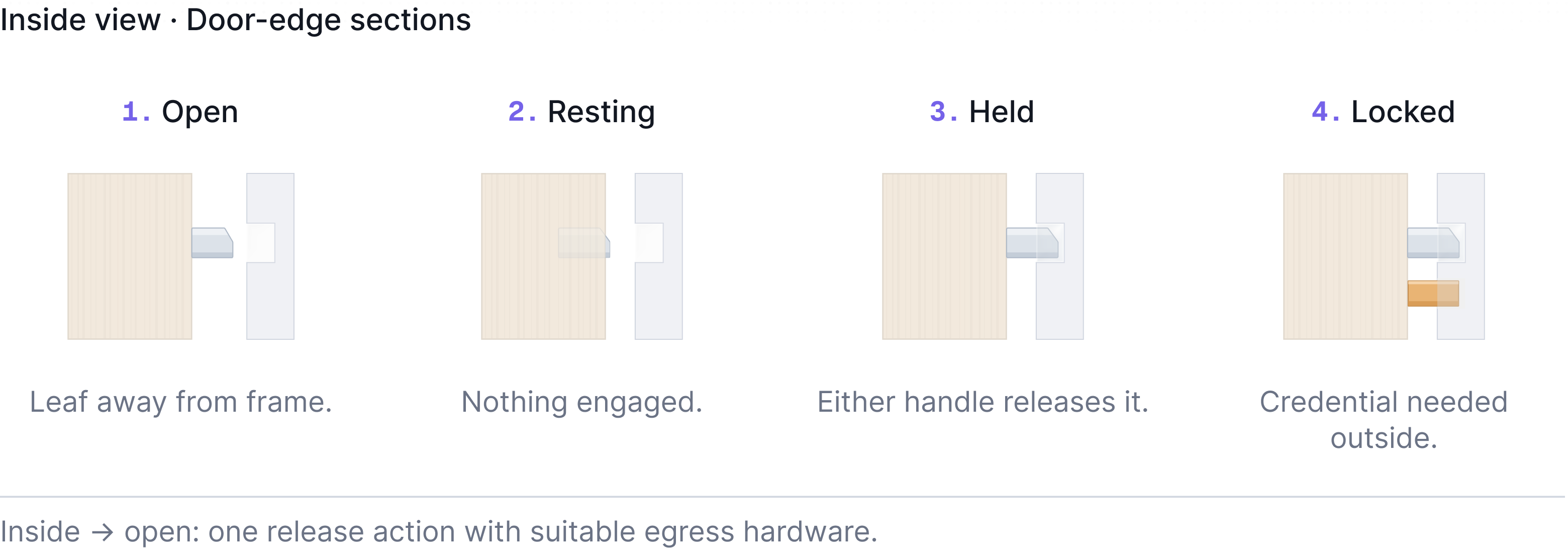
A door has four states
We usually say a door is open or closed, and few people know how much finer a locksmith's vocabulary is. Closed actually covers three very different situations, and those differences are why more than one kind of bolt exists.
Open. The is clear of the frame.
Resting. The leaf is against the frame and nothing holds it there. A draft blows it open. So does a cat.
Held. Something has engaged in the frame and the leaf won't move, but anyone can release it from either side by turning a handle. The door is shut. It isn't secure. This is where a bedroom door spends its life.
The privacy bolt on a bathroom door takes the door from held to locked. It doesn't hold the door any harder. It decides who can open it. Someone turned that bolt, and by turning it gave themselves the right to decide when the door opens again.
Locked. Held, and you can't release it from outside without a .
Being able to get out without a key, in a single motion, is only required on doors: the doors people must be able to get through to escape a fire. Fire safety codes set that requirement. The American building code, for instance, says these doors have to be "readily openable from the egress side without the use of a key or special knowledge or effort", and that unlatching "shall require not more than one motion in a single linear or rotational direction to release all latching and all locking devices" (International Building Code, 1010.2).
One motion. Nobody in a panic should have to turn a thumbturn and then work a handle. That's why an office floor, where strangers have to get out without thinking, doesn't carry the same lock hardware as a home.
Homes follow a looser rule. In the United States, the same code allows a separate deadbolt on the entry door of a home or a hotel room, as long as it opens from inside without a key. In much of Europe, no rule even requires that you be able to leave your own home without a key. French apartment doors commonly take a double cylinder, keyed on both faces. Locking the door with the key from inside keeps intruders out, but the inside handle then won't open it, because the handle only works the latchbolt. To get out, you need the key on the inside too.
What we expect from a door depends on its use
Depending on what a door is for, we expect one of four behaviors from its lock, and some of them are incompatible.
Open from either side, with no key and no code. Bedroom, kitchen, living room, a door between two rooms, a garden gate. You're keeping noise out and keeping a room private. You're not securing anything, and the last thing you want is a door that traps somebody.
Lock the second it swings shut. Hotel room, bike store, a gym on open access, an apartment lobby. Hundreds of strangers use these doors. No operator can count on them to lock up on the way out, and getting shut out barely matters, because somebody can always let you in, like the front desk at a hotel.
Never lock itself. A house front door, an apartment front door, a cellar. If the occupant is shut out, nobody can let them back in, so the decision to lock stays with them, along with the risk of forgetting. An apartment's front door is often the exception: on the landing side it has no handle, only a fixed knob. When it swings shut, the latchbolt holds it and nobody can open it from the landing without a key, so a resident who steps out without their keys is shut out.
Hold against a blade slipped into the gap, the narrow space between the and the frame. Any door that closes by itself and has to protect what's behind it needs this. It's the least obvious of the four, and the one that took manufacturers the most ingenuity.
Two of these demands clash inside the bolt itself: closing with a simple push, and holding against a blade.
One bolt can't both give way and hold
For a door to close when you push it, its bolt has to slide back into the lock as it meets the frame, then spring out again. That's what lets you shut a door with your shoulder when your arms are full.
For a door to hold against someone trying to get in, its bolt must never slide back when pushed.
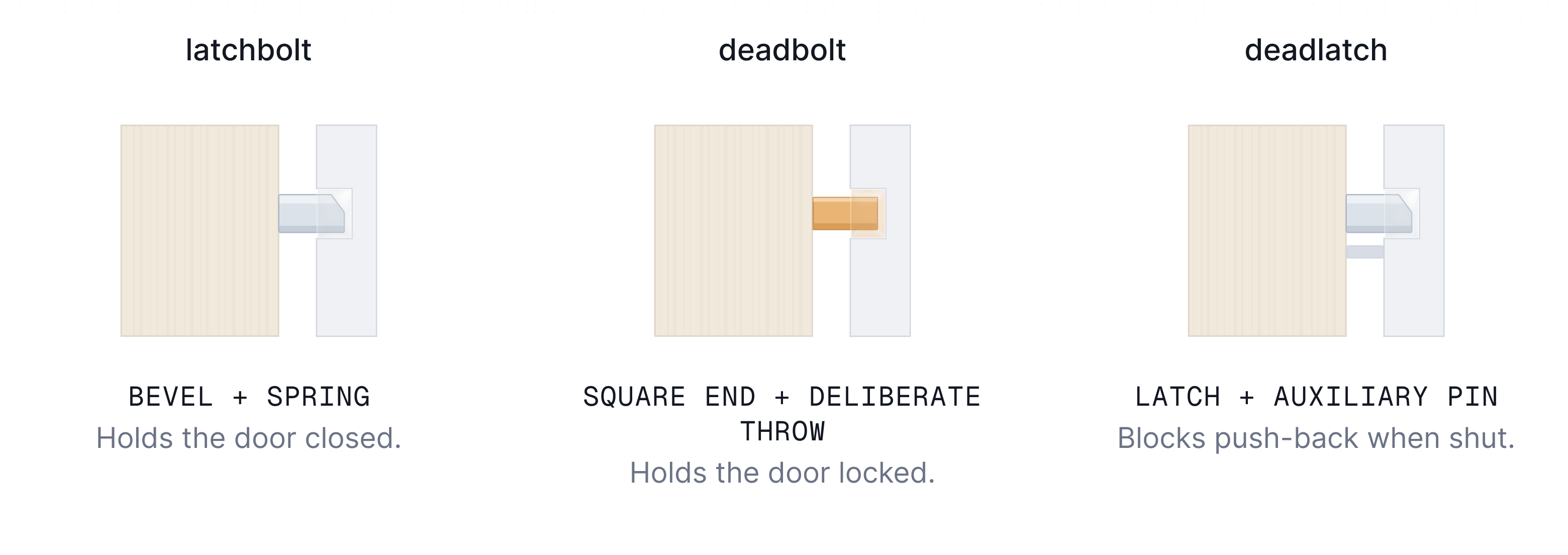
No single piece of metal can do both, so manufacturers split the work across three bolts:
- the latchbolt, which always gives way, so the door closes with a simple push;
- the deadbolt, which never gives way, and which you throw on purpose when the door needs securing;
- the deadlatch, the cleverest of the three: a latchbolt with a small extra part, the , whose only job is to sense that the door is shut and then lock the latchbolt in place.
Three bolts, three jobs
The latchbolt gives way on purpose
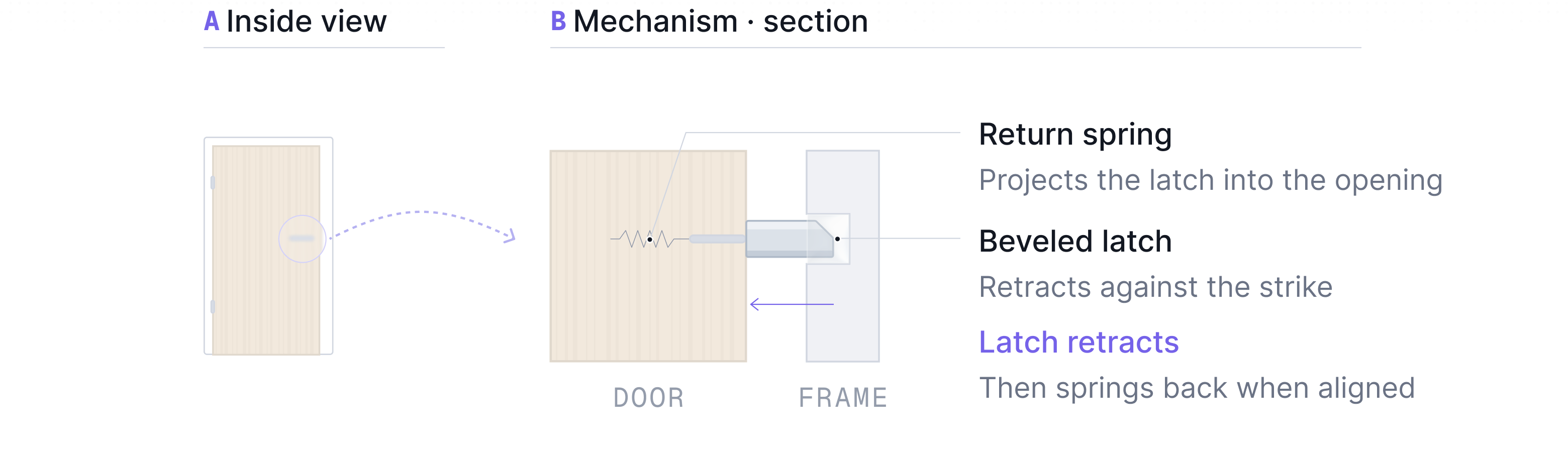
A is spring-loaded, and its outer face is cut on a slant. Schlage's ND series installation sheet gets the rule into eight words: "The bevel must face toward the door stop" (P517-381).
That one detail is the whole mechanism. The faces the way the door travels, so the frame shoves the bolt back into the as the door swings, and the spring snaps it into the the moment it clears. Nobody touches the handle and the door closes anyway. Fit the latch backwards and the door won't close at all, which is why the instruction exists.
The spring is also the weakness, and there's nothing subtle about it. If a door frame can shove the bolt back, so can other things. On its own, a latch gets a door from resting to held and no further.
So it's the bolt for doors you want shut but not secured: bedrooms, kitchens, living rooms, a door between two rooms, a garden gate. You'll find one on nearly every other door too, sitting next to a second bolt, because something has to hold the door before anything can lock it.
The deadbolt never gives way
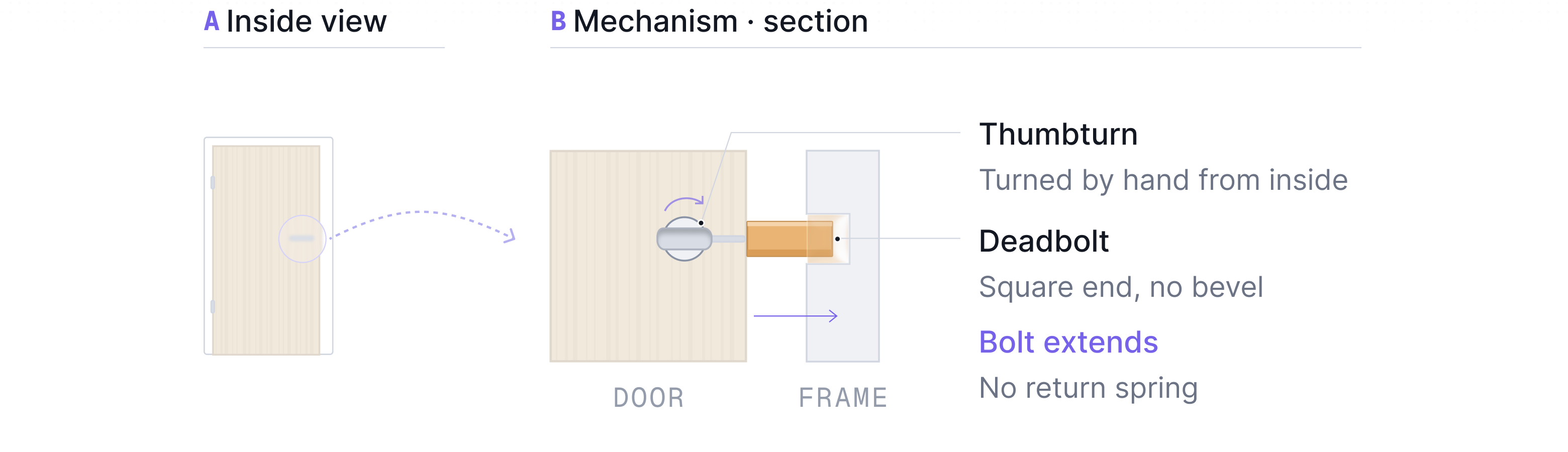
A has a square end, it's solid, and it has no spring. That's what dead means. It moves when something deliberately moves it, which means a key, a or a motor, and it moves at no other time. Push on it and nothing happens.
The number that matters is the , how far it sticks out. Adams Rite gives its MS1850S deadlock a laminated stainless bolt that throws 1-3/8 inches (34.9 mm); the hookbolt version of the same lock only reaches 13/16 inch (20.6 mm) and makes up for it by hooking the jamb instead of just entering it (Adams Rite). Throw is where security meets carpentry: the longer the bolt, the better it holds when someone tries to spread the door away from its frame, and the deeper the frame has to be cut to take it.
Deadbolt names a part, not a product, an installation type or a price bracket. The same bolt shows up in a , in a , and in a rim lock screwed to the back of a door.
And on its own, a deadbolt does nothing when a door closes. It's the one bolt of the three that waits for a person to decide.
So it's the bolt for doors that must never lock themselves: a house front door, an apartment entrance, a cellar, a plant room. Where nobody can let you back in, a gesture you might forget beats a door that locks behind you.
The deadlatch senses that the door is shut
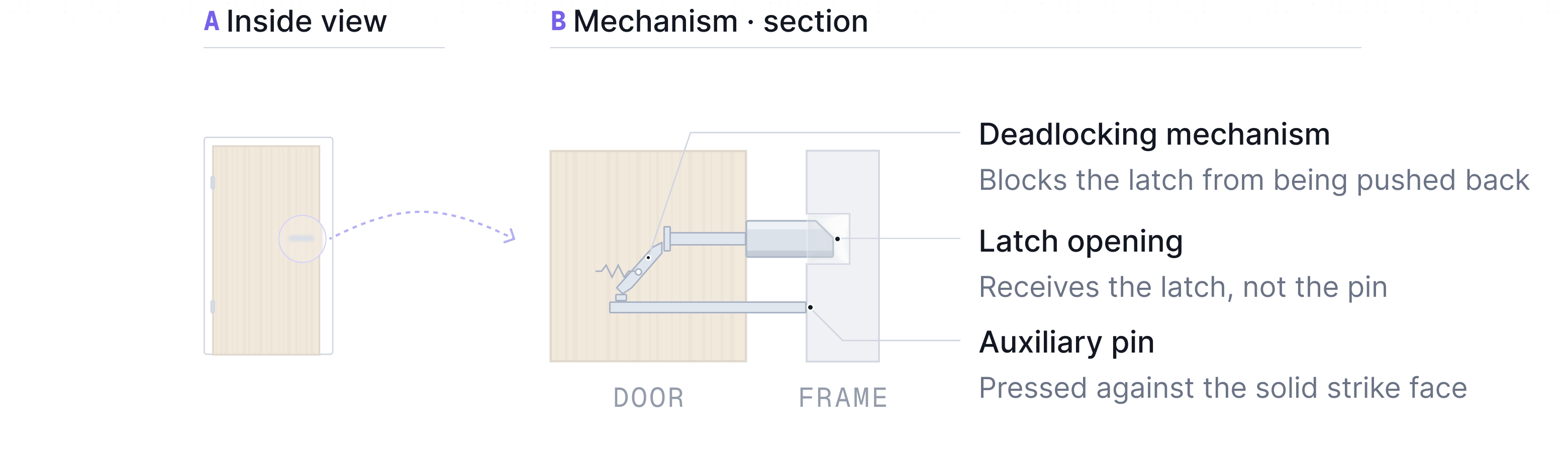
Next to the latch in most locks made for offices, hotels and shops sits a second, much smaller part, and manufacturers can't agree on what to call it. Adams Rite says auxiliary linchpin. Securitron says deadlatch pin, or guard bolt, and notes that it "may be positioned either above or below the springlatch" (Securitron MUNL instructions, PN 500-18800). Plenty of people just say deadlocking plunger. This article calls it the plunger.
Here's the trick, in four steps:
- The door is open. The plunger stands proud, next to the latchbolt.
- The door closes. The latchbolt finds the opening in the and drops into it. The plunger sits slightly off to one side, so it lands on solid metal instead and gets held pressed in.
- Being pressed in is the signal. It shifts a part inside the lock case, which drops into a notch and pins the latchbolt where it is. Now you can't push the bolt back into the door.
- Turn the handle and that part lifts out of the notch, so the lock pulls both bolts back together, deliberately, from inside the mechanism.
Step three is what the plunger buys you. A patent for one such assembly describes the strike forcing the auxiliary bolt in, that movement turning a cam whose lugs drop into recesses in the case plates, "blocking movement of said latch bolt from its locking position to its unlocking position when said auxiliary bolt is in its second position" (US5100184A). A pawl drops into a notch. That's all it is.
So it's the bolt for doors that have to be locked the moment they swing shut: hotel rooms, bike stores, open-access gyms, lobbies, a shop after closing. It's also the only one of the three that answers the fourth demand, holding against a blade worked into the gap.
How the deadlatch beats the card
For much of the twentieth century, plenty of doors opened to a thin strip of plastic. Locksmiths call the technique loiding, after the celluloid strips people used before credit cards were common.
The card doesn't force the lock. It pushes on the latchbolt's bevel. That ramp doesn't care which side pushes it. Slide something thin and stiff into the gap at bolt height, work against the slanted face, and the bolt pulls back into the door exactly the way it does when the door closes. The card never beats the lock. It gets the lock to do its everyday job at a bad moment. The one feature that lets a door close by itself is the weakness.
So it matters what the deadlatch actually does. It doesn't stop the card, and the plunger isn't in the card's way. The card still gets into the gap, still reaches the bevel, still pushes on it. What changed is inside the door: the strike is holding the plunger pressed in, the pawl has dropped into its notch, and the bolt won't slide. Push the bevel as hard as you like. Adams Rite puts the objective in one line: the plunger "deadlocks latch bolt to prevent 'loiding' or case-knife entry" (deadlatch 4900). It deadlocks the bolt. It doesn't close the gap, and it doesn't stop the card.
The trick has a limit, too: it needs the beveled face to be reachable from the gap, and on plenty of doors the frame's stop covers it. A card gets nothing there, deadlatch or no deadlatch.
A door can be deadlocked without being locked
Spec sheets also use the word deadlocked, and it doesn't mean locked.
Locked answers a question about people: can you work the outside face without a credential? Deadlocked answers a question about physics: can you work the mechanism from the gap between door and frame? Two different questions, two different answers on the same door, and all four combinations are out there.
| Deadlocked | Not deadlocked | |
|---|---|---|
| Locked | A thrown deadbolt, too inert to need a plunger at all. Or a hotel room door: deadlatch engaged, outside trim refusing every handle without a credential. | An old knob lock with no plunger, or a deadlatch whose plunger has drifted off the strike. Locked, and open to a card. |
| Not locked | An office door in day mode: the outside lever turns freely and the latch stays deadlocked all day. The handle works for everyone, the card for nobody. | A passage set, or a bedroom door with its privacy bolt not turned. Held, and nothing more. |
Locked says who can work the lock. Deadlocked says whether the gap can work it. Neither one implies the other, which is why they don't belong on a single scale.
Two cells of this table are worth a second look. The deadbolt only appears under locked and deadlocked, and it needs no plunger to get there: with no spring and no bevel, it gives a card nothing to push on. Deadlocking is only ever needed on latchbolts, the only bolts a card can beat. The not-locked, deadlocked cell describes an office door that is safe from the card but open to everyone during the day, by design. You couldn't describe that door at all if doors were ranked on a single scale from open to locked.
Two ways from a closed door to a locked one
Line the three bolts up, let the door swing shut on its own, and only two routes end at locked.
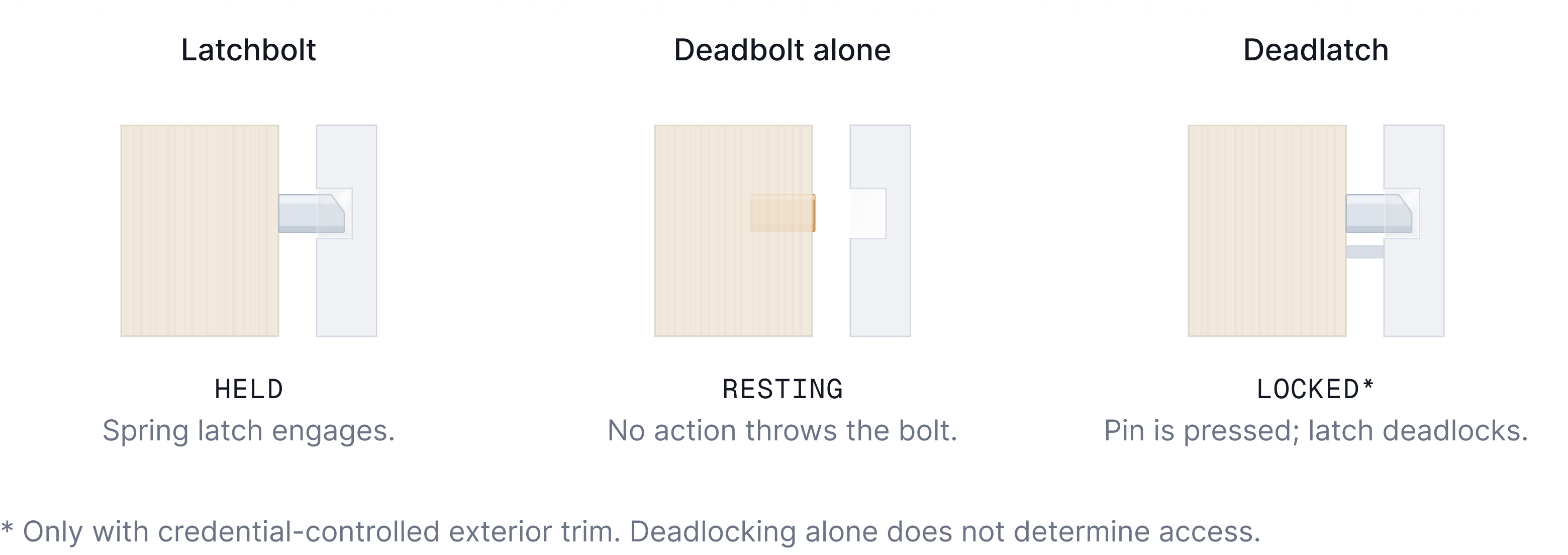
The deadbolt is the surprise. A door with only a deadbolt is still resting after it swings shut, with nothing holding it. That's why you almost always buy a deadbolt alongside a latch rather than instead of one.
So there are exactly two routes from a door that swings shut to a door that's locked, and they aren't two price points. They're two philosophies.
The deliberate route. A deadbolt, thrown by a person or a motor, every single time. Security rides on a gesture, and the gesture can be forgotten. In exchange, no gust of wind ever shuts anybody out, because the door never secures itself.
The automatic route. A deadlatch behind outside trim that only a credential will work. The slam is the locking. Security rides on nobody's memory and, in exchange, stepping out for two seconds without your credential leaves you on the wrong side of the door.
Homes take the deliberate route, because nobody can let the occupant back in. Hotels take the automatic one, because the front desk always can. The choice isn't about the lock but about the bolt inside it: without a deadlatch, there's no automatic route, short of a motor set to throw the deadbolt after a delay.
Sold as deadbolts
The deliberate route, the way the market sells it. These wait for a key, a thumbturn or a motor, and a closing door doesn't move them.


Sold as levers
The automatic route lives here: a handle means a latch, and in commercial and hotel hardware, a latch that deadlocks the instant the door is shut.


Which bolt for which door
| Bolt | Secure as soon as it closes? | Who has to act | Typical door |
|---|---|---|---|
| Latchbolt | No. Held, not locked | Nobody, just to close it | Interior doors, bedrooms, passage sets |
| Deadbolt | No. Closing does nothing | Somebody with a key or thumbturn, or a motor | House front doors, alongside a latch |
| Deadlatch | Yes, with credential-controlled trim | Nobody | Hotel rooms, office floors, shops, gym entrances |
| Latch and deadbolt interconnected | No, but one motion from inside releases both | Somebody, or a motor, to lock it | Apartment entrances, egress doors under code |
Find your own building in the last column. A short-term rental front door and a gym entrance have genuinely different needs, and the difference isn't budget. It's which bolt.
"Locked" in an app describes a motor, not a door
Motorizing a lock changes nothing about what holds the door. It replaces a human hand at one precise point, and what a system can report afterwards comes down entirely to the bolt underneath.
| Bolt type | What the app or API actually knows | What it can't know |
|---|---|---|
| Motorized deadbolt | That a motor turned and reported a bolt position | Whether the door is actually shut, unless a separate sensor says so |
| Latchbolt | Usually nothing. On a residential latch there's no motor and no position to report | Anything about the state of the door |
| Deadlatch | Usually nothing. A switch that monitors the plunger exists, as an option on some mortise locks | On most doors, anything at all: nothing connects the plunger to a system |
So a dashboard showing "locked" is, unless the lock carries a door sensor, making a claim about a motor, not about a door. On the deliberate route that means a bolt moved, which is real but narrow. On the automatic route it means almost nothing: the door was already secure the instant it closed, and no software had anything to do with it. On most locks no motor drives the plunger and no firmware knows its state. The door works it, by closing.