What does a retrofit smart lock actually replace?
Retrofit: what does the word actually mean, what does it change about my door, and why does a garage door opener get the same name?
A unit doesn't replace your lock. It adds something to it. The cylinder stays, the stays, the key stays, the hole in the door stays. What it replaces is a gesture: the quarter turn your hand gave the every night. A motor is bolted over the part you used to touch, or in its place, and it performs that turn on command.
Think of a retrofit as a motorized gesture rather than as a lock in its own right, and several odd things about the category start to make sense. You are barely asked to measure your door to find out whether the lock will fit, when that is normally the whole question. A garage door opener can sit in the category, as surprising as it may sound. And people who would rather not change their habits take to it far more readily than they take to a new smart lock.
A retrofit's motor repeats the gesture your hand made
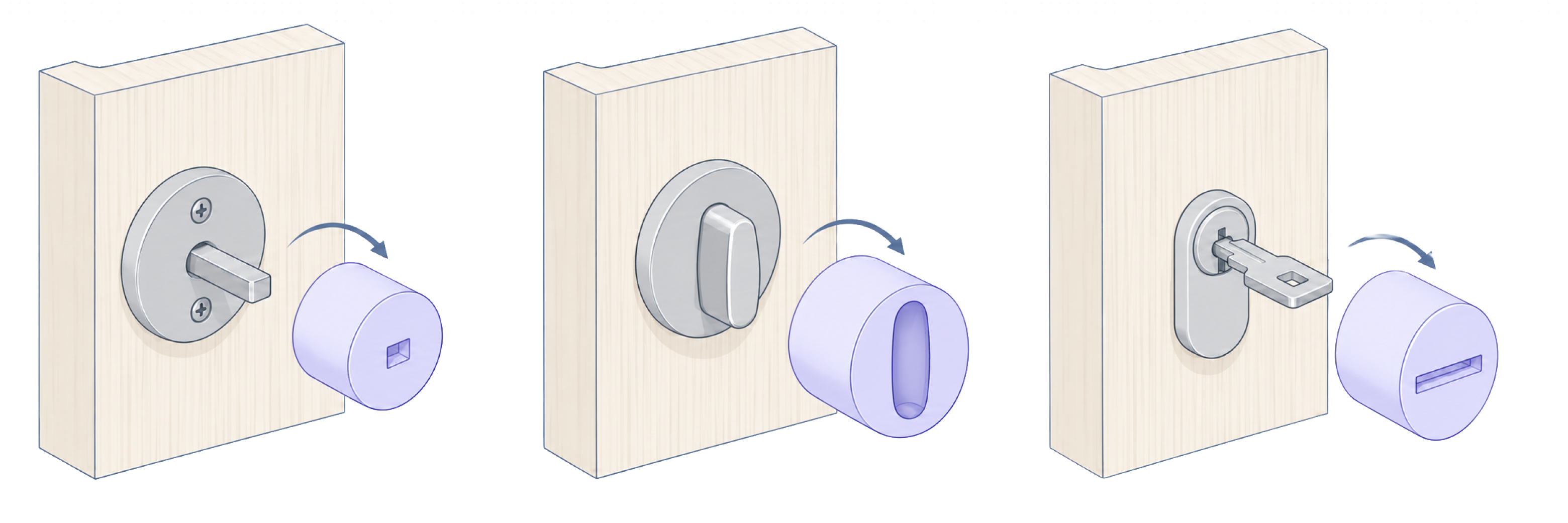
Open up the inside face of a door with a retrofit unit on it and the anatomy is obvious. The existing mechanism sits untouched in the door. The unit's body mounts over it, and at its heart is a clamp gripping the same your hand used: the thumbturn of a case, the tailpiece of a deadbolt, once the interior thumbturn has come off, or the key itself, left sitting in a European cylinder.
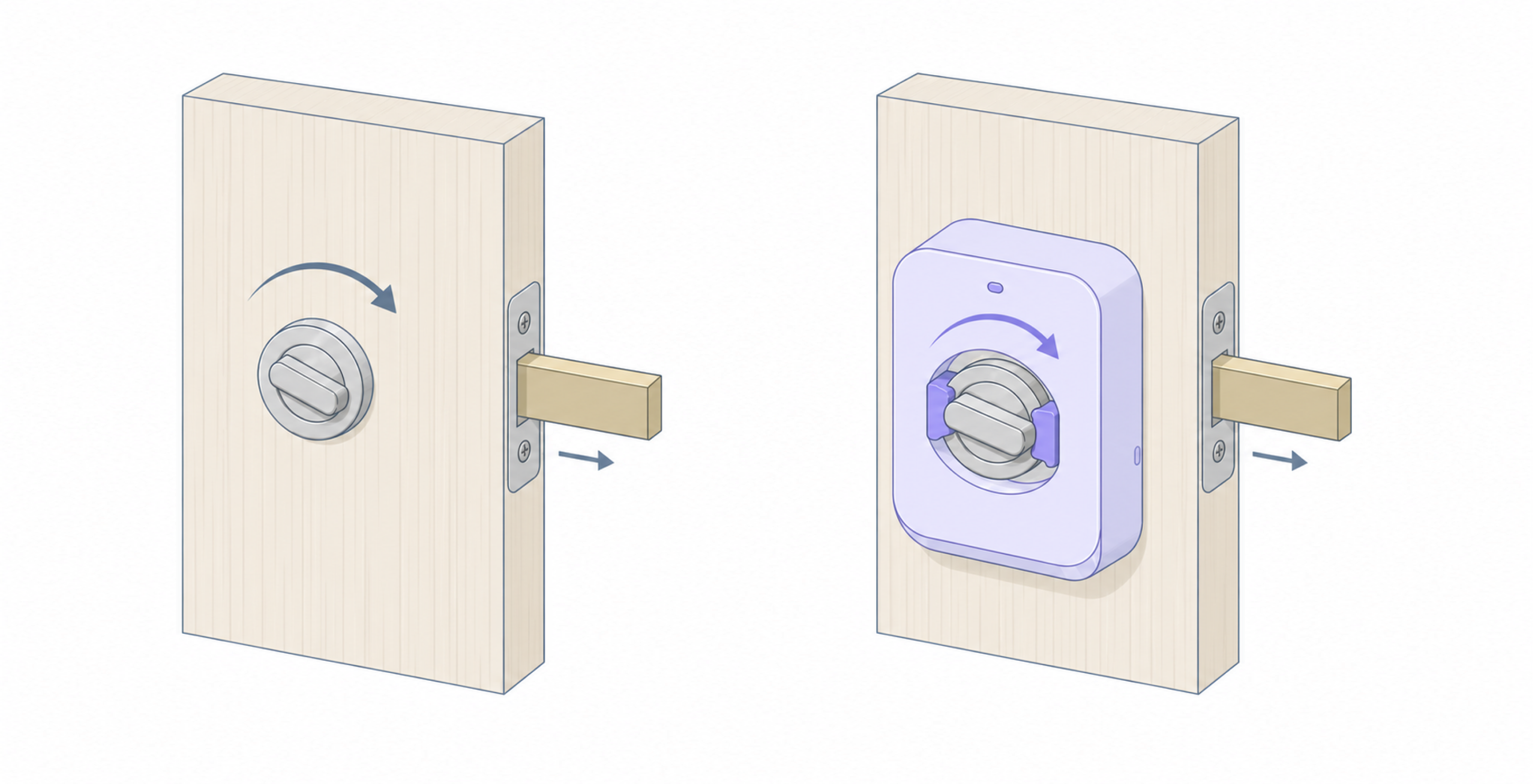
Kwikset sells Convert, a North American retrofit that takes the place of the interior thumbturn, with this promise: "Keep your existing deadbolt and make it smarter in minutes". Of the outside face, which stays untouched, it says: "Keep the look and style of your current lock on the exterior" (Kwikset Convert). The exterior keyway never learns that anything happened. Your old keys work because nothing they touch has changed.
Compatibility stops being a question about the door and becomes one about the part that turns
Before you fit any other smart lock, you measure the door: is the pocket mortised or bored, what's the , how thick is the , where are the holes. Those numbers are unforgiving, and getting one of them wrong means the lock won't go on the door at all.
A retrofit asks for almost none of them. It never enters the door, so most of the door's dimensions are none of its business. The mechanism already fits, because it's already there. One main question is left, and you answer it by looking: will the clamp close around the part that turns? A flat tailpiece, a D-shaped thumbturn, a euro cylinder with the key left in. Each unit ships adapters for the shapes it can hold, and a list of the locks it works with. Kwikset's list for Convert is a list of deadbolts, not of doors: "select single cylinder deadbolts including Kwikset, Weiser, Schlage and Baldwin".
A garage door opener counts as a retrofit too
It comes as a surprise to find Genie's Aladdin Connect "retrofit kit" in DeviceDB, filed among the smart locks, when the thing is a garage accessory.
The entry in question
Look at where it lives: a garage door accessory, catalogued under smart locks. The appellation describes how a product is sold, not what it bolts to.

But it's the same principle at work. Your garage door already has a motor, the opener, which decades ago replaced the gesture of hauling the door up by hand. And the retrofit kit replaces neither the door nor the opener: it wires onto the one you already own, "compatible with most residential garage door openers made after 1993 that include safety sensors" (Genie), and performs the gesture you had left, the button press, on command from somewhere else.
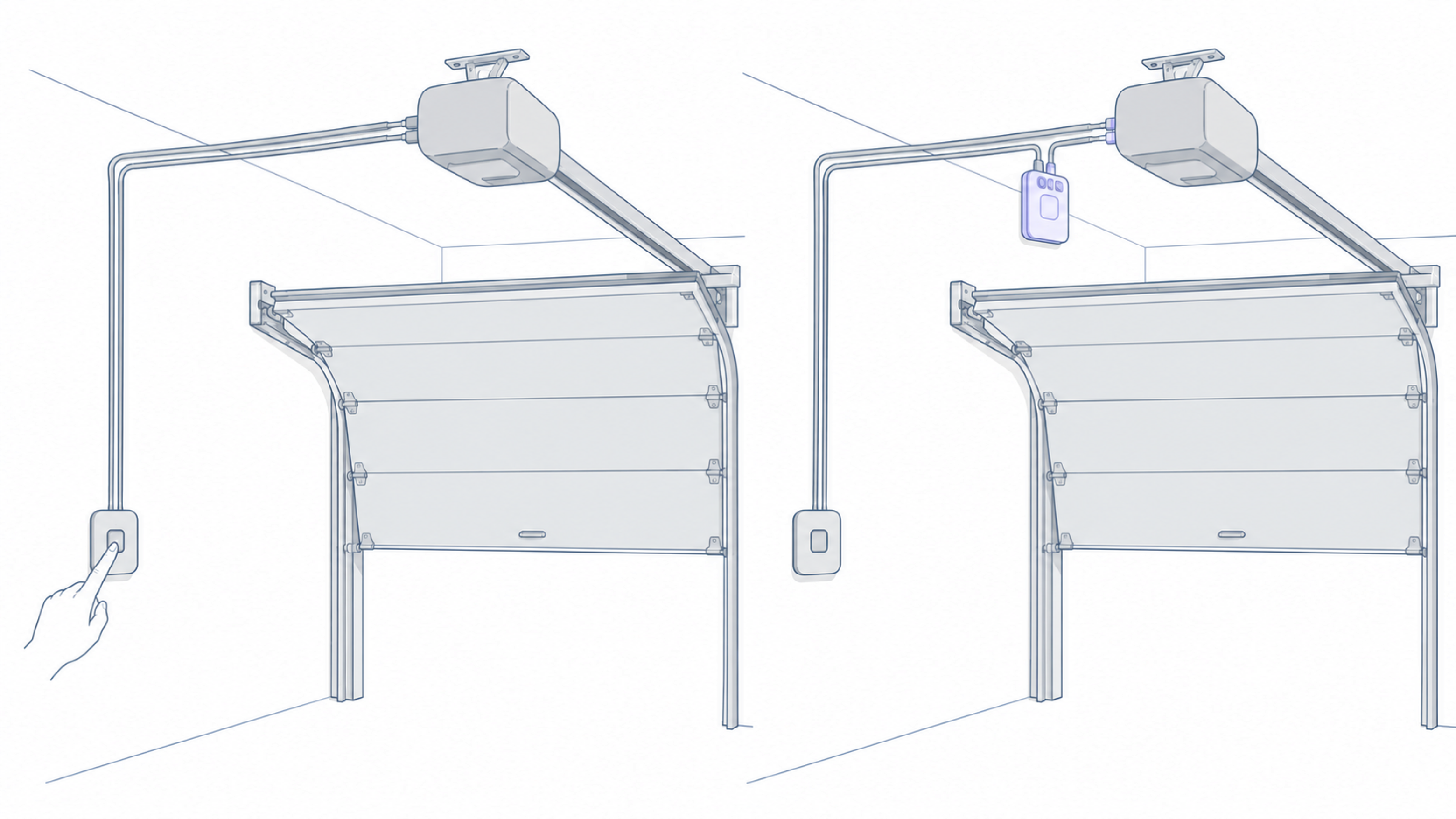
What makes the category is a motor taking over a gesture you used to make by hand, not the . That's also why DeviceDB's retrofit
appellation gathers interior motors, clip-on cylinder units and a garage kit
without contradiction: it names how these products are sold, and they're all sold
on the same promise. Keep what you have; stop touching it.
The advantages and the drawbacks of a retrofit
Start with what you gain, because that's what decides the choice.
Nothing changes in the house. Your key still opens the door, and so does the one your neighbor keeps. (Where the unit turns a key left inside a European cylinder, that holds only if the cylinder lets a second key work from outside.) There is still a thumbturn and it still turns by hand, the unit's own where it replaced yours, so nobody has a new gesture to learn, not the children and not whoever waters the plants while you're away. It's the best of both worlds in the strict sense: the door opens from your phone when you want it to, and from the key when you've left the phone behind, or when the unit's battery is dead.
Fitting it is barely fitting anything. No drilling, no locksmith, no door off its hinges on a Saturday morning: a few screws on the inside face. And since nothing was drilled, the same screwdriver puts the door back the way it was in ten minutes. So you can try it, instead of deciding.
You only pay for the motor. The cylinder, the bolt, the and the carpentry are already there and already paid for. What you're buying is the electronics that drive them, not a lock.
Those three gains hang together, and they're why the retrofit is the renter's smart lock, the condo board's and the short-term rental host's: anywhere you aren't allowed to modify the door, or don't want to.
Against these obvious advantages come a few drawbacks.
A retrofit motorizes your gesture with roughly the strength of your wrist. Every fault the mechanism had yesterday it keeps here, with your hand no longer there to compensate. The door that needed a shove against the seal before the bolt would throw still needs it, and the motor can't lean on the leaf. The misaligned strike your wrist had learned to beat now stalls the motor, which reports a jam. The stiff cylinder is still stiff, running on a battery instead of a forearm. Which is why a retrofit is best kept for doors that already work easily: otherwise you're asking a motor to make the effort you were making by hand. Watch the battery life.
And the most important limit is how little of the operation the unit really controls. The motor knows it turned. It doesn't know whether the door is shut unless a separate door sensor tells it: if the door was left ajar, the bolt throws into empty air and the unit reports locked all the same. It's blind outside the one job it was given, which is to reproduce a mechanical gesture in your place.
So a retrofit's "locked" is a fairly narrow claim: the gesture was performed, and that is all locked means here. Whether the door is actually secure is still a question about the mechanism, and the mechanism is precisely the part nobody changed, and the part the retrofit can't see, because all it ever does is work it.
| Replacing the lock | Retrofitting it | |
|---|---|---|
| The mechanism in the door | New | The one you had |
| Your existing keys | Rekeyed or replaced | Keep working, unchanged |
| What you have to check | The door: mortised or bored, backset, holes | The shape of the part that turns |
| Outside face | New hardware, visible from the street | Unchanged |
| Reversibility | Refitting the old lock | A screwdriver |
| The mechanism's defects | Gone with the mechanism | Inherited, now fought by a motor |
Neither column is the better answer in the abstract.
Sold as retrofit in DeviceDB
How the appellation is sold: interior motors for deadbolts, clip-on units for European cylinders, and a garage opener kit, all making the same promise.


The word retrofit, then, doesn't name a lock in the full sense. It names a motor that performs an action in your place. Retrofitting a lock always means replacing a hand on the part that hand worked, never acting on the bolt itself.