English
Zigbee, Z-Wave, Thread, Matter, Wi-Fi, BLE: making sense of the protocol jungle
These names turn up all over product packaging, one beside the other, as if you had to choose. You don't always choose between them, though, because they often complete each other.
On the box of one smart lock you read Z-Wave. On the box beside it you read "Matter over Thread". The app that will run the whole thing is called SmartThings. Nobody tells you what these words name, or whether one of them is to be preferred, and the spec sheet lines them up as though they went without saying.
These words do not name things of the same kind. Comparing Matter to Zigbee is like comparing a language to a telephone: both are for talking to someone, but you do not pick one instead of the other.
From your phone to the lock, four roles have to be filled
The radio carries the signal, physically. Beyond the hardware, that carriage needs a protocol. It settles which frequency is transmitted on, and with it how far the signal gets through walls, and how much energy each transmission costs the battery.
The network (addressing, meshing, and so on) settles how the device is located so that something can talk to it. It defines how one lock is told apart from the others, and the path a message takes to reach it when that lock is three rooms and two floors away.
The language carries what the message means. Without it the message would be no more than a run of digits. It defines the grammar of the instructions, what "lock the door" means, what a user code is, and what the signal looks like that says a battery is running low.
The decision comes from software. It is the software that decides this person may enter, and until when, then announces it to the lock.
When you open a lock by pressing a button on your phone screen, these four come into play. The lock necessarily transmits on a radio (as does the phone, for that matter), it is reachable on a network, it speaks a language, and it obeys the instructions software sends it.
But these four roles are rarely filled by way of the same protocols.
On a Zigbee lock, Zigbee provides the radio and the network, and the language as well. The hub sitting in your living room links it to the internet; the app decides.
On a "Matter over Thread" lock, Thread provides the radio and the network, while Matter carries the language. A small box relays the messages, and it is Apple Home or Alexa, say, that issues the decisions.
A single name on a box therefore never tells you everything that happens. You have to know what it brings, and where the rest comes from. The table at the end of this article lines them up.
Zigbee carries its own commands, and needs a hub
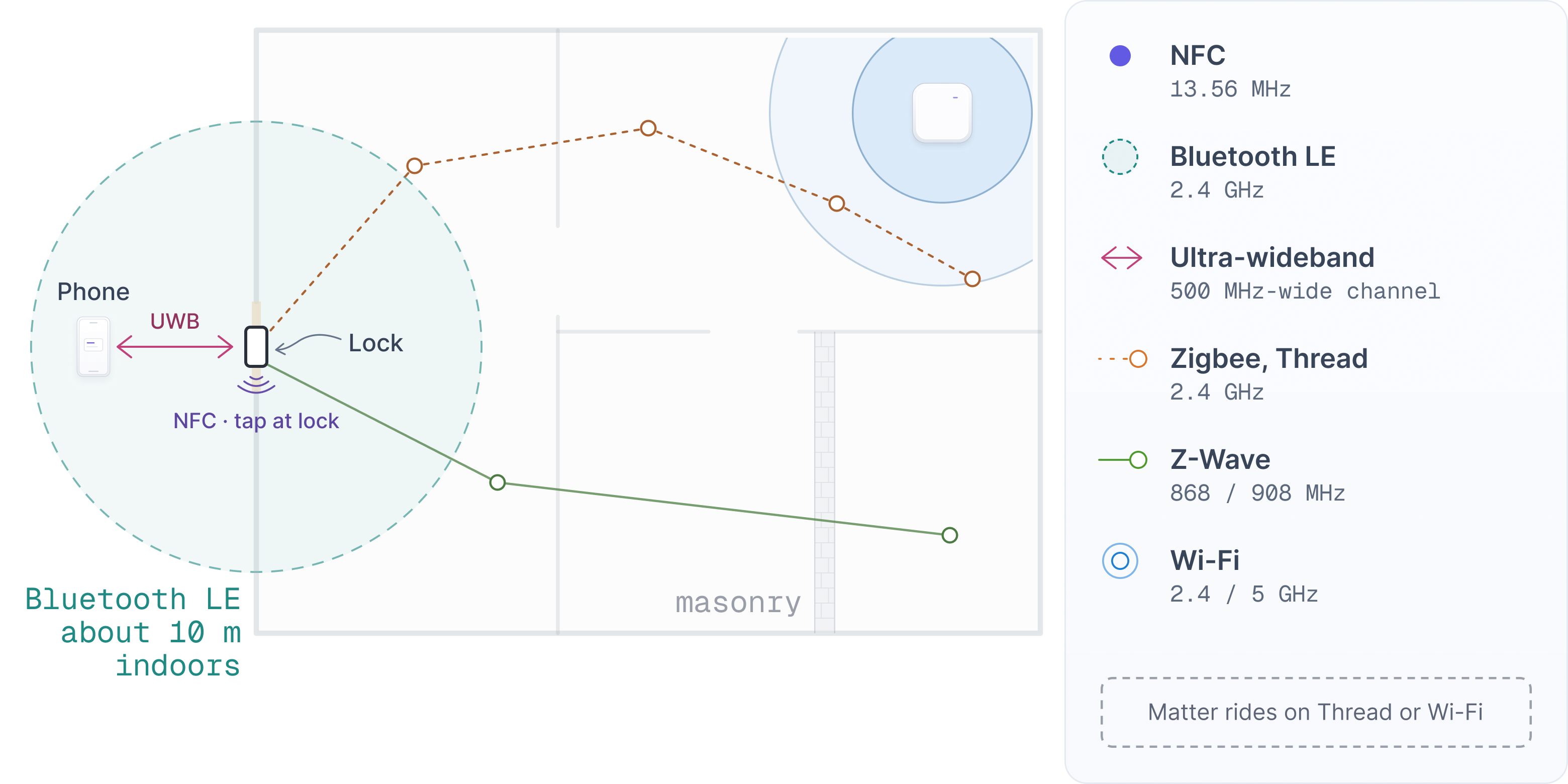
Zigbee fills three roles out of four. It provides the radio, the network and the language. Its physical layer "supports both 2.4 and Sub-GHz bands" (CSA, Zigbee), and in connected homes it is the 2.4 GHz one. Devices relay one another, which extends range step by step.
Because it speaks its own language, it needs a box able to understand it in order to make the link with the internet. That box is called a hub (see our article on the difference between bridge, hub and gateway).
Z-Wave does the same, on a less crowded frequency
Z-Wave fills those same three roles, but it transmits below the gigahertz. It "operates at 908.42 MHz in the United States and Canada" (Z-Wave Alliance), and on the 868 MHz band in Europe. Its waves are longer, they get through masonry better, and they travel in an almost empty band, where 2.4 GHz is shared with Wi-Fi, Bluetooth, Zigbee, Thread and your microwave oven. The Alliance sums the advantage up in words you can check at home: Z-Wave "will not interfere with your Wi-Fi signal".
In exchange, Z-Wave long depended on a single chip supplier. On that point the situation has changed. For years the silicon came from one company, which also owned the specification. In December 2019 Silicon Labs and the Z-Wave Alliance announced that this specification would open as a ratified standard, the Alliance itself becoming the standards body (announcement). The Alliance today counts three suppliers, Silicon Labs, Trident IoT and Semtech (Z-Wave Alliance).
That closed origin left one advantage: every certified product is held to the same Alliance standards, and the Alliance counts more than 4,500 of them.
Thread carries messages, but it has nothing to say
Thread uses exactly the same radio as Zigbee, which is to say the same IEEE 802.15.4 hardware on the same 2.4 GHz band. Silicon Labs sells parts where "a single device can communicate with Zigbee and Thread end nodes on different 802.15.4 channels" (Silicon Labs, multiprotocol). The Thread Group confirms that shared foundation and adds that Thread is an open, IPv6-based protocol (Thread Group).
The difference with Zigbee plays out on the network: a Thread device has an IP address, a Zigbee device does not.
And Thread stops there, deliberately. Under a heading that says "Select an application layer", the Thread Group tells integrators that "multiple options are available". Used on its own, Thread cannot ask a lock to lock itself. It needs a language, and that language is supplied by somebody else.
Matter is that language, and it borrows someone else's radio
Matter fills only one of the four roles, the language. The CSA describes it as "a new, open smart home protocol that uses existing, familiar technologies, including Bluetooth Low Energy for device setup and Wi-Fi, Thread, and Ethernet for connecting devices" (CSA, Matter FAQ). It defines no radio and must always borrow a network.
"Matter over Thread" carries two names on the boxes for that reason: Thread brings the radio and the network, Matter brings the language. Setting Matter on its own against Zigbee makes no sense, while choosing between "Matter over Thread" and "Matter over Wi-Fi" makes a great deal of it: the lock hears the same language either way, but the power consumption is nothing alike.
Wi-Fi is the expensive radio for a lock on batteries
Wi-Fi provides the radio and the network, and nothing more. It therefore always turns up with a language beside it, Matter or the maker's own.
Staying associated with a network costs more energy than a short-range radio does, so a battery lock with Wi-Fi built in sleeps between exchanges and still runs its cells down sooner. In professional access control the wired equivalent is not Ethernet but a field bus, for reasons set out in the article on RS-485.
Bluetooth carries the maker's own language
Bluetooth LE also provides the radio and the network, and above them it carries whatever the maker invented for it. This is not an oversight but a business model: every Bluetooth lock arrives with its app, its online service and its pairing procedure.
A Bluetooth lock is therefore never open to another platform without its maker's cooperation. Its range is also limited to about ten metres indoors, which means being near the door, or going through a box that relays.
SmartThings, Apple Home and Alexa are not protocols
These names are the fourth role, the decision. They are software that decides who may enter, then announces it to the lock in the protocol the lock understands.
SmartThings' developer documentation shows this plainly. Devices reach it four ways, three of which concern a lock: those that go through a hub "connect directly to a SmartThings Hub", typically Matter, Zigbee, Z-Wave, LAN and Bluetooth products; those that go through a third-party service "communicate with the SmartThings Cloud through a third-party cloud"; those that are directly connected "connect directly to the SmartThings Cloud via WiFi" (SmartThings architecture).
Three different paths therefore end at the same software. That software has a precise name in this trade: a platform can create access, where a brand names only hardware. Asking "Zigbee or SmartThings" is like asking whether a parcel travels by truck or by Amazon.
NFC and ultra-wideband are there to recognise people
You may well have spotted these names on your spec sheets too. But they fill none of the four roles just described. They are not there to reach a lock from software, only for the case where somebody has to identify themselves directly, physically, to it.
The same stacking exists on the card side: the reader and the card speak ISO/IEC 14443 to each other, and what is written on top carries yet another name. MIFARE is one of them, and NXP gives its radio interface as "ISO/IEC 14443 Type A" (NXP, MIFARE DESFire EV3). A MIFARE card is therefore not another radio, but other content on the same one.
They got a standard of their own on February 26, 2026, when the CSA published Aliro 1.0. NFC serves there "for tap-to-access", Bluetooth LE "for user-initiated long-range communication", and Bluetooth combined with ultra-wideband serves the hands-free approach, where the reader measures the distance instead of guessing it. Ultra-wideband earns its name: instead of occupying a narrow frequency, it transmits on a channel 500 MHz wide, in pulses of about two nanoseconds, and the reader gets a distance out of timing their round trip (FiRa Consortium). The shortness of the pulse is what makes the measurement possible: the shorter it is, the more precisely the moment of its return can be dated, and it is that time which gives the distance. The Apple, Google and Samsung wallets have committed to carrying the credential (CSA, Aliro 1.0). This is the subject of the credential path.
Reaching a lock is not the same as being allowed to command it
Up to here, the question was who provides what. Two boxes sitting in the same place, between your lock and the internet, do not give you the same rights.
A hub understands the lock's language. Z-Wave comes in one side, the online service's protocol leaves the other, and the box translates between the two. It can therefore say everything that language allows, including "store this code in slot four". Z-Wave has a command for exactly that: "The User Code Set Command used to set a User Code in the device" (Silicon Labs, User Code). Zigbee has its equivalent.
A Thread border router translates nothing. The Thread Group insists on the word: "a Border Router, as defined by the Thread specification, is a function, not a device" (Thread Group). It moves packets between the low-power network and the home network, without ever reading them. You very probably own one without having bought it, because that function sits inside speakers, streaming boxes, displays and mesh Wi-Fi nodes.
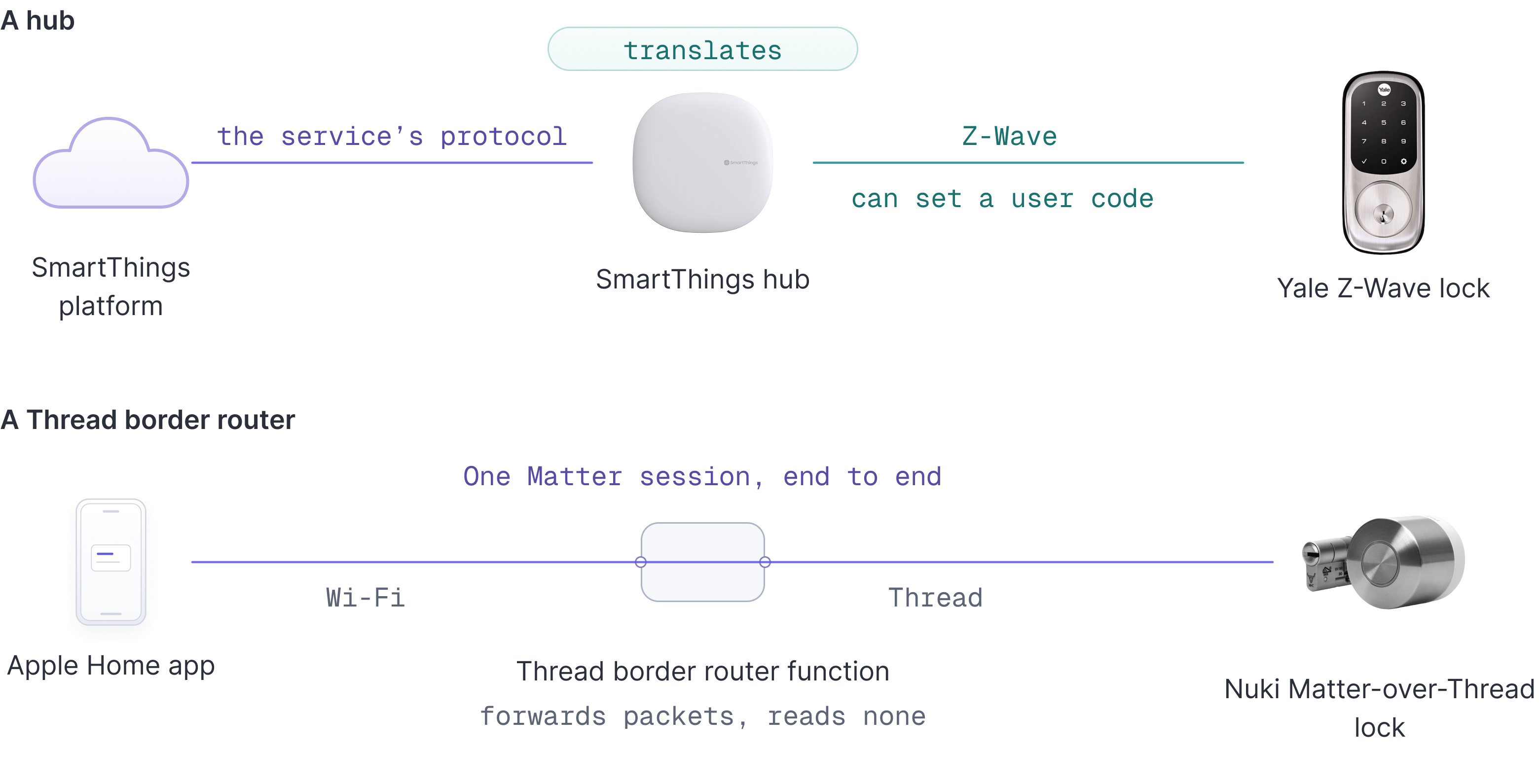
A border router therefore makes the lock reachable without giving anyone the right to command it. "Works with SmartThings" and "SmartThings can create access on this lock" are consequently two different statements, and only the second counts when codes are handed out.
A lock can be Matter compatible and accept no code at all
The same difference plays out inside Matter. Matter does not ignore credentials,
since its Door Lock defines them. But the data model published by the
CSA marks them all optional. PINCredential ("Lock supports PIN credentials
(via keypad, or over-the-air)"), RFIDCredential,
CredentialOverTheAirAccess and the Aliro provisioning features all carry that
mention
(Matter 1.4, Door Lock cluster).
Optional means that every device declares what it actually has. A lock with no keypad and no reader has nowhere to keep a code anyone could type, so it usually claims no PIN feature. A Matter controller then gets what the hardware can do, which is lock, unlock and report state.
The line "Matter compatible, works with Apple Home, Google Home, Alexa and SmartThings" therefore says that four pieces of software can reach the lock. It says nothing about their ability to issue a credential. The verbs each protocol can actually carry as far as a lock are the subject of another article.
| Radio | Network | Language | Box needed | |
|---|---|---|---|---|
| Zigbee | 2.4 GHz | Its own mesh | Its own, codes included | A hub, which translates |
| Z-Wave | 868 / 908 MHz | Its own mesh | Its own, codes included | A hub, which translates |
| Thread | 2.4 GHz | IPv6 mesh | None: Matter or another language | A border router, which relays |
| Matter | Borrowed: Thread or Wi-Fi | Borrowed: Thread or Wi-Fi | Its own, credentials optional | Whatever the borrowed radio needs |
| Wi-Fi | 2.4 / 5 GHz | IP | None: Matter or the maker's | None, at a cost in battery life |
| Bluetooth LE | 2.4 GHz | One to one | None: the maker's | One box per brand |
| SmartThings, Apple Home, Alexa, the maker's platform | None | None | None | None: it makes the decision |
What a box in the middle does to a protocol decides whether a platform can act on the lock, or only reach it.
The box in the middle, as the catalogue files it
Every one of these sits between a device and a platform. What separates them is the role they fill, and no product name tells you.


The industry files these boxes together all the same, whatever their function. A hub, a gateway and a border router do three different jobs on the same shop shelf, which is the argument of gateways, hubs and bridges.
The useful question in front of a spec sheet therefore comes in two steps. First, which of the four roles each announced name comes to fill, and who fills the others. Then, which of the announced pieces of software can actually command the lock, and not merely reach it. A lock reachable by four pieces of software and drivable by none is a perfectly ordinary product, and the spec sheet will not warn you about it.