English
How and why did access control move from Wiegand to OSDP?
Card readers are sold in two versions, Wiegand or OSDP. Where do those two words come from, why did the first one last forty years, and why did it finally give way to the second?
The word is on almost every card reader, next to another one: . The first comes from a patent granted in 1974. The second from a standard published in 2020, for a protocol that itself dates from 2008. In between, forty years during which readers talked to their panel over the same two wires.
Here is how the industry moved from one to the other, explained in four steps.
Wiegand files a patent, and his effect becomes a card
The inventor John R. Wiegand patented a magnetic effect in 1974. The patent describes a work-hardened ferromagnetic wire whose outer shell and inner core do not hold magnetization the same way. Pass a magnet near the wire and its core flips polarity all at once, and that sudden flip produces a voltage pulse in a coil placed beside it.
The pulse needs no battery and no amplifier. It either exists or it does not. So it is a bit.
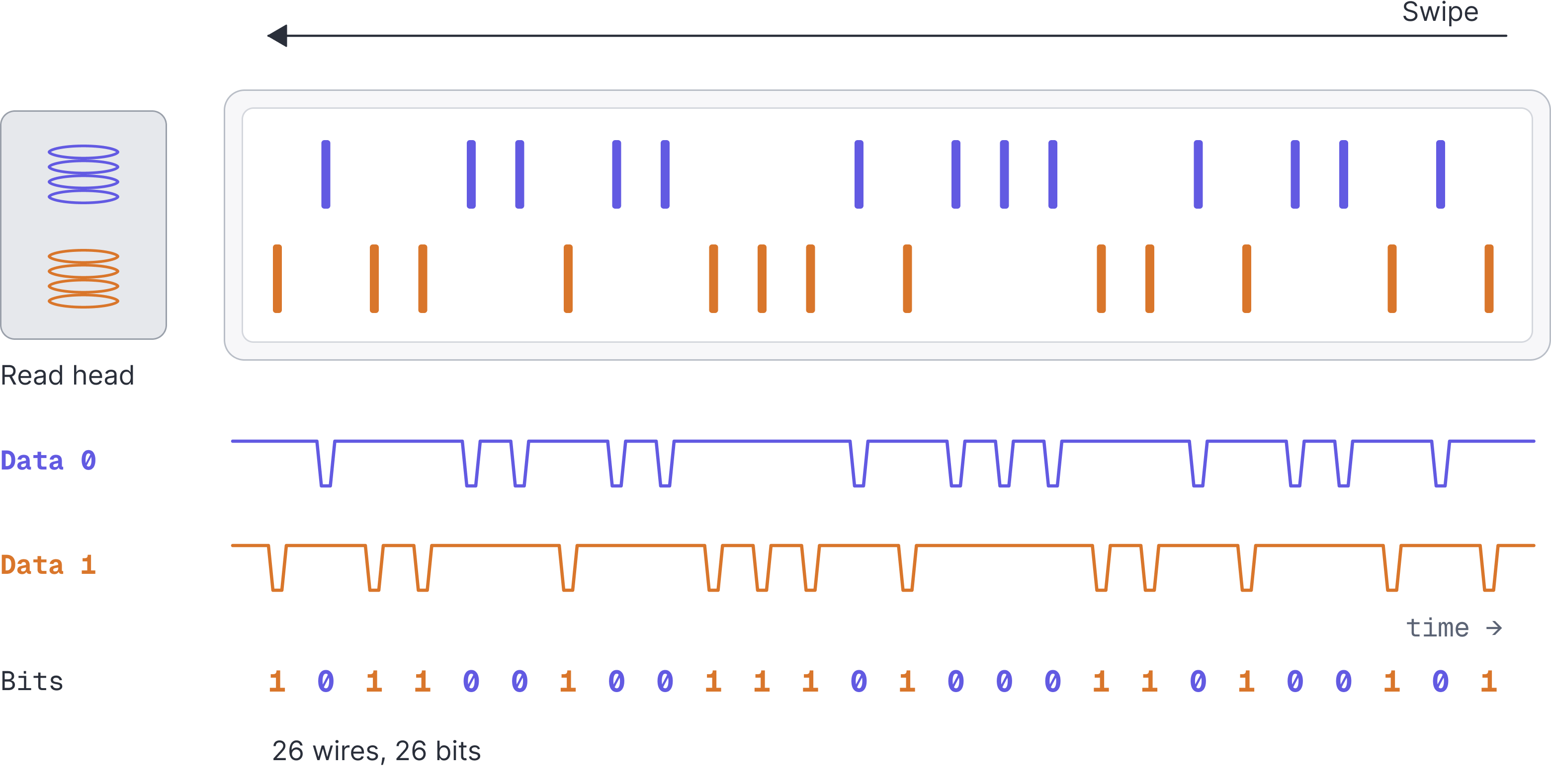
So a few dozen of these wires were embedded in a plastic card, in two rows. It is a bar code made of metal. The card is swiped through a slot, each wire passes the read head and produces its pulse, and the reader sends the pulses out on two lines: a pulse on the first means zero, a pulse on the second means one. Hence the three wires of the interface this created: Data 0, Data 1 and ground.
The number of wires that fit in a card is limited, so the number the card carries is limited too. Allegion says it plainly: the technology "placed limits on the number of bits a card could have: 26 Bit was the most common, and 37 Bit format was the top limit" (Selecting campus readers). Twenty-six bits is twenty-six wires in the card.
The card is eventually replaced, but the wiring stays
Contactless cards eventually replaced Wiegand cards. A 125 kHz proximity badge, then a 13.56 MHz smart card, are held up to the reader without being swiped through anything. Neither the card nor the reader wears out. In the late 1990s, patents were still being filed on tokens with Wiegand wires, and HID did not retire its Wiegand card and reader line until January 2013 (Secura Key press release).
And yet the wiring did not change.
Every installed panel had two terminals marked Data 0 and Data 1. A manufacturer bringing out a contactless reader therefore had a choice: invent a new way of sending the number, and force its customers to replace their panels, or send its pulses the old way and plug into what was there. Everyone chose the second. Readers changed technology twice, and the panel never noticed.
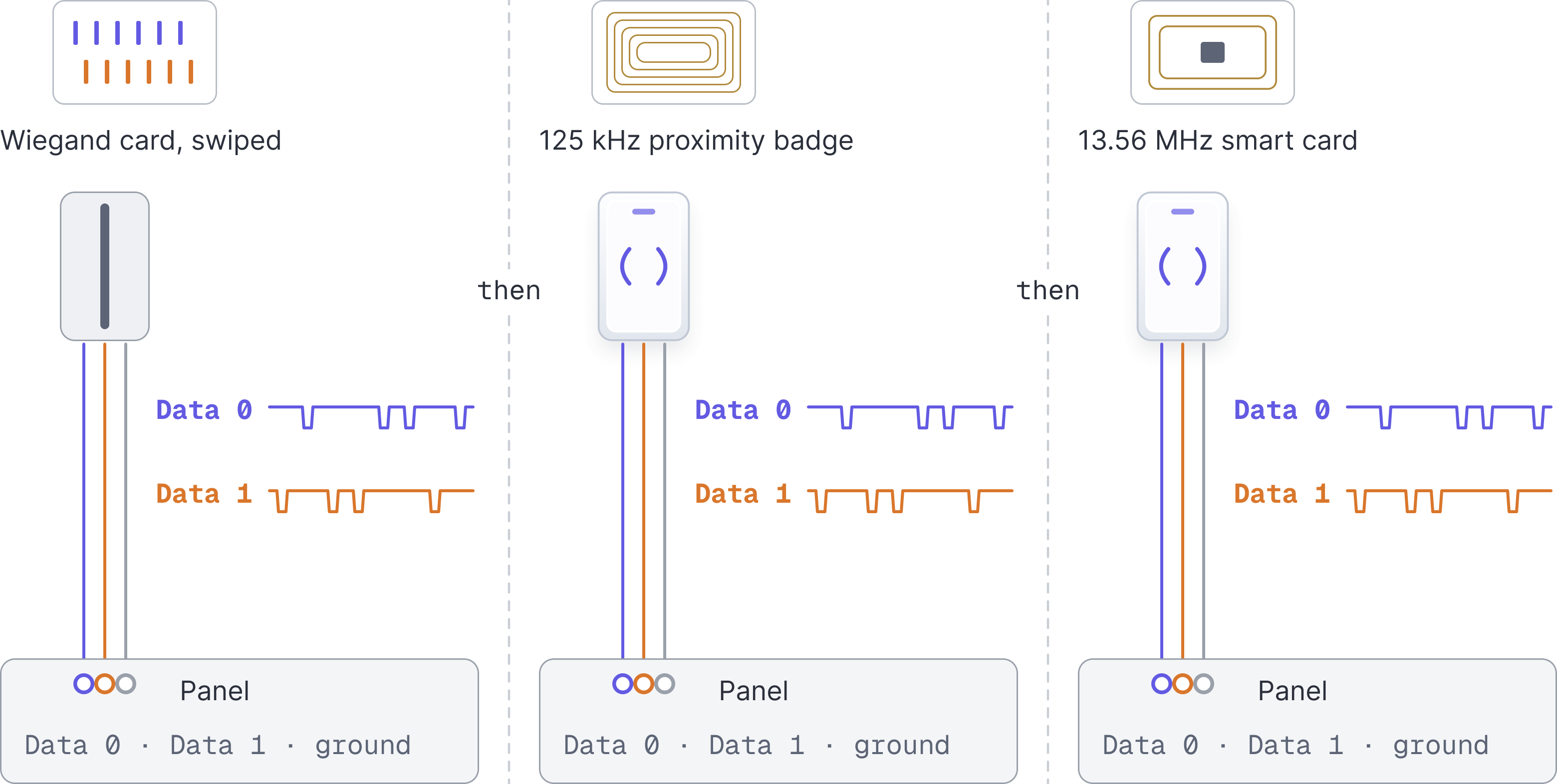
So the word Wiegand stopped naming the card and came to name the wiring. And with that wiring, every installation kept the rules of the 1970s: one cable per reader, one direction of travel, a number sent in the clear, and a number size inherited from how many wires fit in a card. Nobody chose those rules in the 2000s. They were already there.
The 26-bit format is the most visible trace of this today. An operator ordering badges still gives that number to the supplier, and sets the readers to it. There is no wire in the card any more and no slot in the reader. What remains is a number that originally counted pieces of metal.
A system weak on security, which can be tapped at the wires
One flaw was never fixed in the Wiegand system, because it came not from the card but from the wiring itself: the identification number travelled in the clear. Nobody had encrypted it, because at the time nobody imagined that someone would come and listen to the signals behind a reader in order to steal credentials.
The problem is that the reader sits on the side of the door where everyone passes. That is its purpose: you present your badge outside, not inside. And behind the reader's faceplate are the two wires. The trick is then simple: take the reader off with a screwdriver, clip a small box onto the reader's wires, and the box records the number of every badge presented to it.
From then on, replaying one of those numbers is enough to open the door. The box exists and is sold, and Allegion names it in its documentation: the ESPKey. It requires no particular skill.
Nothing can be done about this on the reader side. Better cards and better radios can be used: the number will still come out in the clear on the two wires that follow, and that is where it gets intercepted. The wires had to change if the system was to be properly secured.
Farpointe, a reader manufacturer, puts it bluntly: "For years, Wiegand has been the industry standard but it is no longer inherently secure due simply to its original obscure and non-standard nature" (OSDP white paper).
OSDP appears, and adopts a standard from 1983
If Wiegand wiring stayed in place for forty years, it is because replacing it was expensive.
A reader is easy to replace: it is fixed to the wall and it does not cost much. But a reader that starts speaking OSDP is no longer understood by a panel that only listens for Wiegand. Changing one reader alone is therefore useless. Every reader on a site, every panel that serves them, and the software that drives those panels all have to change, at the same time or, with converters, in stages. Often the cable too, because demands a twisted pair of a quality Wiegand never required. In a building in service, that means cutting access floor by floor to replace equipment that works.
As long as nobody risked anything by not changing, nobody went to the trouble. The ESPKey tap invented nothing: it put a weakness the industry already knew within anyone's reach.
Three requirements had taken shape well before it, and they also made Wiegand wiring obsolete, since it could do none of them: encrypt the number, let the panel query a reader instead of merely listening to it, and put several readers on the same cable instead of running one cable per door.
A standard published in 1983 already met two of those three conditions: RS-485. It had nothing to do with access control. It simply offered a way to let many devices communicate over one pair of wires and over long distances. Factories had been using it for decades. Encryption it does not provide: that part is OSDP's own.
Mercury Security and HID Global therefore had nothing to invent there. They wrote OSDP on top of that standard in 2008, and in 2012 handed it to the Security Industry Association, which has maintained it since (HID Global, Demystifying OSDP, SecurityInfoWatch, 2015).
The IEC approved the result as an international standard in May 2020 and published it that July, and OSDP v2.2 followed in December (Impro's OSDP FAQ, IEC webstore).
How that cable works, and why two wires are enough, is its own article.
| The Wiegand card | Wiegand wiring | OSDP over RS-485 | |
|---|---|---|---|
| The badge | Magnetic wires in a card | Proximity, then smart cards | Smart cards, mobile, biometrics |
| What the cable carries | The pulses from the card's wires | The same pulses, imitated | Addressed messages, optionally encrypted |
| Direction | Reader to panel | Reader to panel | Both ways |
| Readers per cable | One | One | Several |
| The number in transit | In the clear | In the clear | Encrypted with AES-128 when Secure Channel is on |
| What limits the number | How many wires fit in the card | The formats inherited from the card | The protocol, not the cable |
The middle column is the surprising one: wiring kept for decades after the card that dictated it had disappeared.
Readers in DeviceDB
The transition shows in the model numbers: Schlage, for one, marks its RS-485 readers with a -485 suffix.


Schlage's current multi-technology readers all carry that suffix, the MT11-485 among them, and each one offers both interfaces, Wiegand and OSDP over RS-485 (data sheet). If a manufacturer still offers both, it is because both kinds of wiring are still installed, and the move from one to the other is not finished.
For forty years, the cards, the radios and the chips changed, but the wiring did not. In the end it changed too, and what replaced it was not even new: a standard from 1983, which access control used only under proprietary protocols before finally giving it an open one.