English
Why is your card reader on two RS-485 wires?
Open a card reader and count the wires: two of them carry the whole conversation, and that pair is shared with the other readers on the floor. What can those two wires actually do, and why is that enough?
Take the cover off a card reader and count the wires. Five or six go into the conduit, and two of them carry the whole conversation: one twisted pair, shared with the other readers on that floor, running back to a panel in a service cupboard, past a fluorescent ballast and the motor of a door operator.
Those two wires are , a transmission standard approved in 1983 (The RS-485 Design Guide, SLLA272D). And if they still turn up in new installations, it is not for want of newer ideas. , the industry's current reader protocol, is specified for exactly those two wires. The standard "specifies the protocol implementation over a two-wire RS-485 multi-drop serial communication channel" (IEC 60839-11-5, Edition 1.0, July 2020).
Thirty-seven years separate the physical layer from that international edition, and twenty-five from the protocol itself, created in 2008 (HID Global, Demystifying OSDP). So it is worth seeing what makes this cable so well suited to the job.
RS-485 is a carrier: it has no idea what a message is
Three things have to be told apart first.
There is the cable: copper, twisted in pairs, with a characteristic impedance. What that structure buys you comes up in a moment.
Then there is the physical layer, a convention whose job is to define how electrical signals actually travel. It decides how many volts stand for a one, how many for a zero, and how far the signal may go. RS-485 is one particular physical layer. Copper Ethernet, in an office network for instance, rests on a different one. The CAN buses used in cars use a third.
Finally there is the protocol: it decides what the bits, as defined by the physical layer, actually mean. OSDP is one of those protocols, specialised in access control, as Modbus RTU and BACnet MS/TP are on the building automation side.
The physical layer and the protocol are both written conventions, standards negotiated between manufacturers. One fixes voltages, distances and a ceiling on the number of devices; the other settles what the bits mean. If the first is called "physical", it is not that it is any more material than the other. It is that it legislates on physical quantities.
Texas Instruments says in as many words where RS-485 stops. It "only defines the electrical characteristics of drivers and receivers", and is "intended to be referenced by higher level standards" (The RS-485 Design Guide, SLLA272D).
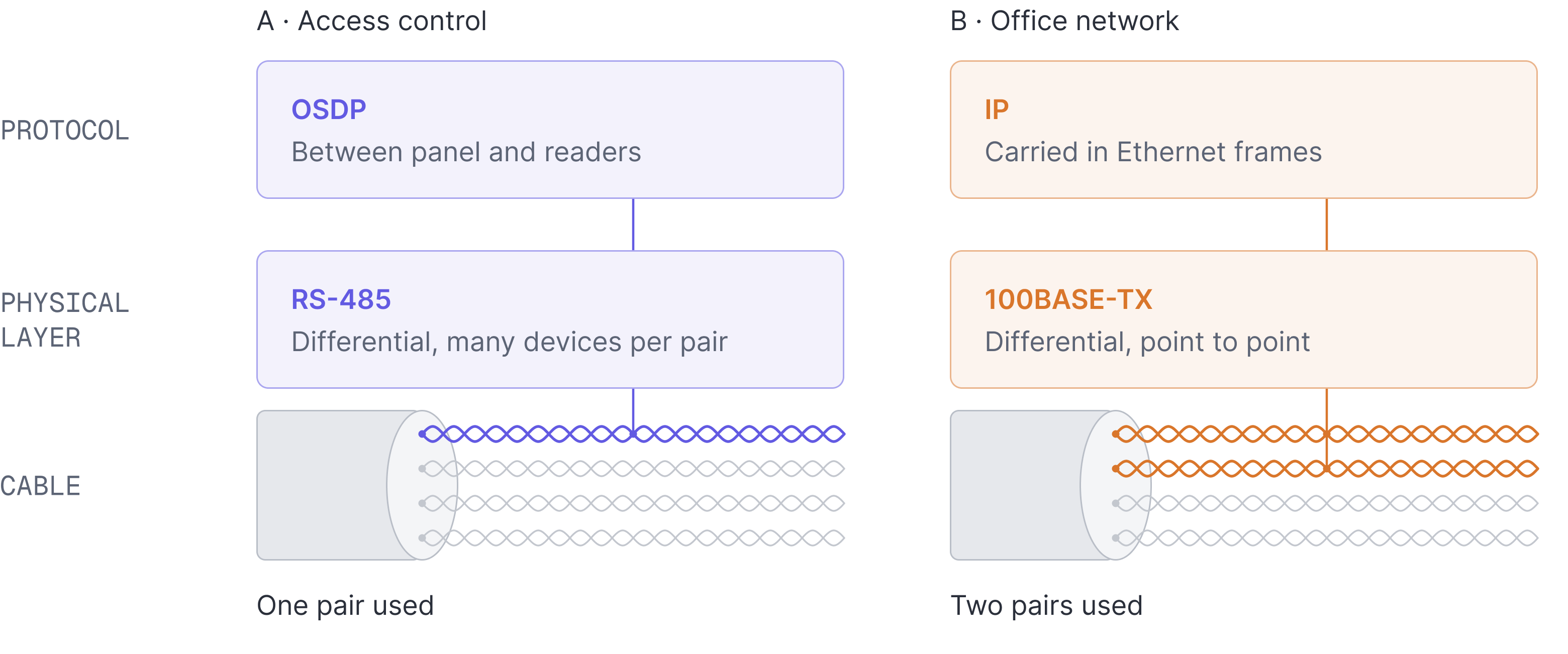
That separation turns very concrete the day a site changes its readers, because it governs a question of money: can the cable already in the wall be kept? Allegion answers in three parts (Selecting campus readers). Replace a reader with another Wiegand reader and the existing cable is reused. Move to OSDP and new cable usually has to be pulled. Unless the cable already there was installed recently enough to meet the RS-485 wiring specification.
What changes between those cases is what the layer demands of the copper. A Wiegand reader sends pulses one way and asks nothing in particular of the cable. RS-485 works differently: it needs a twisted pair of known impedance, 120 ohms by the standard's recommendation, because the resistor placed at each end of the line has to match that value. Without the match, the signal's edges bounce off the end of the cable and come back to blur the ones behind them (The RS-485 Design Guide, SLLA272D).
A cable is therefore neither good nor bad in itself. It either meets the requirements of what you want to run over it, or it does not.
The double wire is what lets RS-485 shrug off interference
A reader's cable runs past everything that radiates in a building. It follows fluorescent tubes, passes the motor of an automatic door, crosses power cables. Each of those neighbours induces stray voltages in the copper it runs beside, and a badge misread is a badge refused at a door.
This is where the RS-485 cable turns out to be clever. It does not send the signal on one wire, it sends it on two, and what carries meaning is neither the voltage on one nor the voltage on the other, but the gap between them. Because the two conductors are twisted together, they follow exactly the same route and cross exactly the same fields. Interference therefore reaches both at once, and in the same proportion. And since it adds itself to both voltages, it vanishes entirely the moment you take only their difference. The receiver, which reads nothing but that difference, never sees it.
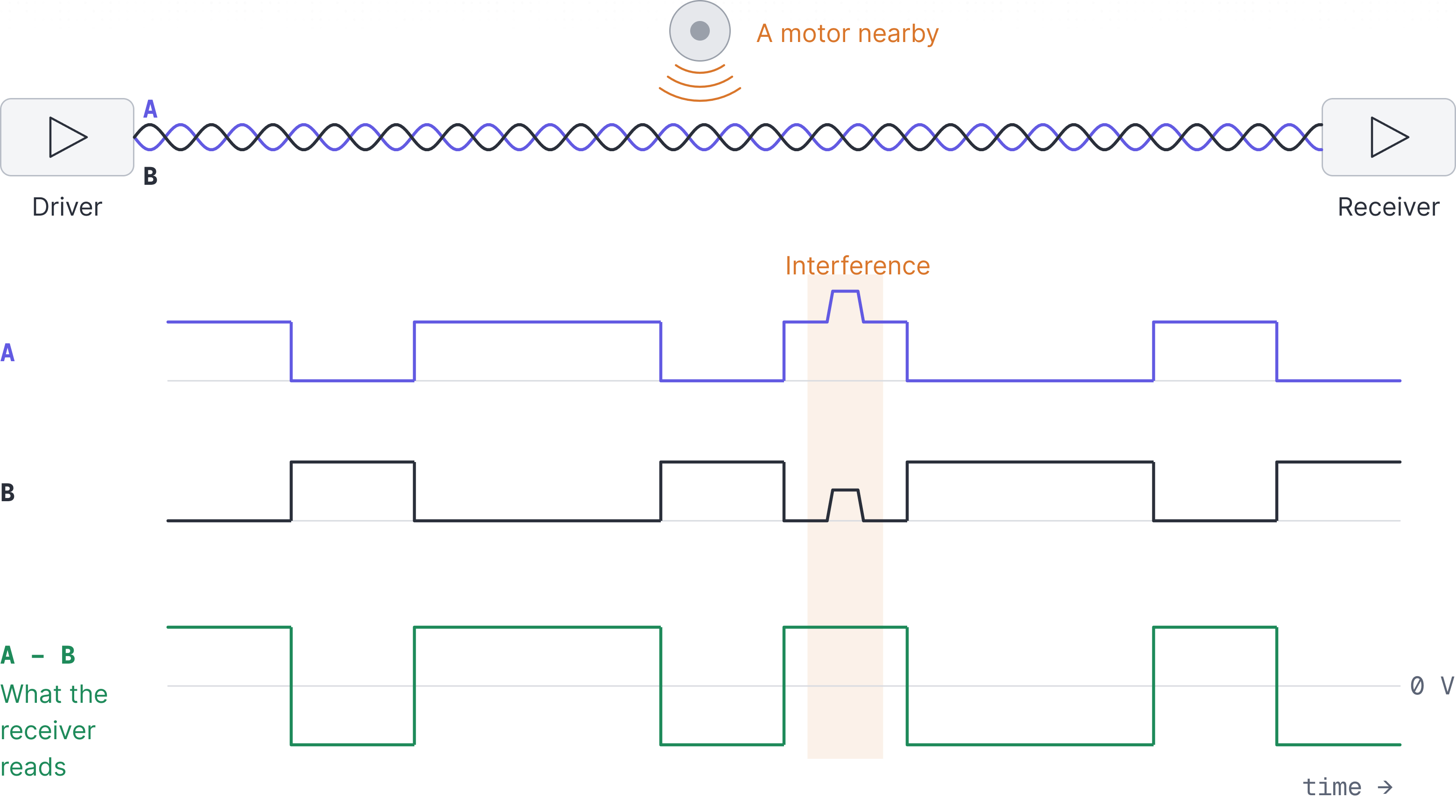
Two numbers show how much margin the trick buys. A compliant driver puts out at least 1.5 V of difference, while a compliant receiver has to resolve a difference as small as 200 mV. The signal can arrive at a seventh of the amplitude it left with and still be read perfectly well.
is not an RS-485 invention. Copper Ethernet is differential too, and its eight wires are four twisted pairs for exactly the same reason. CAN does the same. "Robust because it is differential" is only part of the explanation, because an Ethernet pair runs from one device to one port, whereas an RS-485 line has a harder job: it has to run past several readers.
The reader and the panel may not share a ground
Explaining what is genuinely particular to this physical layer needs one more point, and it has nothing to do with interference.
A card reader may be fixed to a wall at the far end of a building from the panel that serves it. The two may draw power from different circuits, sometimes from different distribution boards. Then the reader's zero volts and the panel's zero volts are not the same voltage. That offset adds itself to everything travelling on the line.
RS-485 anticipated this and left itself margin: the standard requires receivers to work for as long as both wires of the pair stay between -7 V and +12 V relative to their own ground. An interface that measures a single wire against its ground has no such tolerance. For it, the ground offset does not cancel between two wires; it adds itself to the measurement and reads as signal.
Texas Instruments describes what this looks like in a real building:
Because remote nodes are likely to draw their power from different sections of the electrical installation, modification to the installation, (i.e., during maintenance work), can increase the GPD to the extent that the receiver's input common-mode range is exceeded. Thus, a data link working today might cease operation sometime in the future.
An electrician moves a circuit, and a reader that has worked for four years suddenly stops. Nobody touched the door. This is why, over long runs, the devices on the bus can be galvanically isolated: their electronics are no longer electrically tied to the line, and the tolerable ground offset goes from a dozen volts to several thousand. But a line on which every device was isolated would have no reference voltage at all. So, in TI's scheme, exactly one is left unisolated, and that one gives the whole line its ground.
The lower the data rate, the longer the cable may run
On an RS-485 cable, length and speed are not chosen separately: the more bits per second you send, the shorter the cable has to be. Each bit travels as an electrical pulse, and a long cable blunts it. At high rates the pulses are so brief that they end up merging before they arrive.
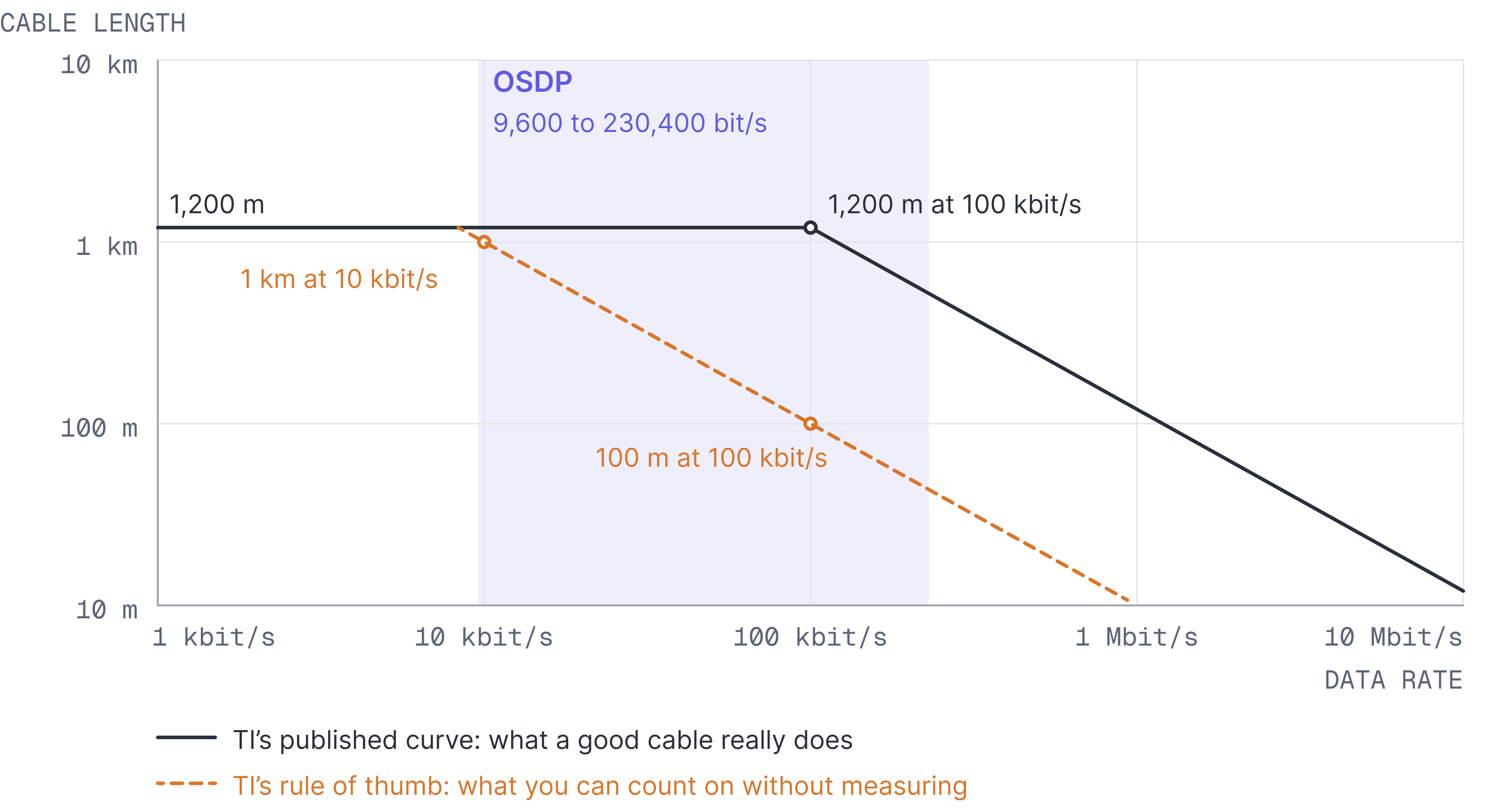
Texas Instruments, which makes these chips, gives a rough rule: length in metres multiplied by rate in bits per second should stay under ten million. A hundred metres of cable therefore allows about 100,000 bits per second, and a kilometre about 10,000.
Beyond roughly 1,200 metres of thin wire, the common 22 AWG at 0.6 mm across, another limit applies whatever the rate. Copper itself resists current, and over that distance its resistance becomes comparable to the small resistor placed at the end of the line to terminate it. The signal is then divided between the two, and only half of it reaches the receiver.
Those 1,200 metres are worth a pause, because Texas Instruments gives two answers to the length question and says as much. Its key-features list quotes 4,000 feet of cable, which is that same distance, but at 100,000 bits per second: twelve times better than the rough rule allows over such a run. Both numbers are right, and they measure different things. TI spells it out under its own graph, where the rule of thumb "is far more conservative than today's cable performance and will therefore show less length at a given data rate than the graph presents". The graph describes what a good cable really does; the rule describes what you can count on without measuring anything. It is also the same 4,000 feet that Allegion will quote further down for an OSDP bus.
A reader has almost nothing to send. Present a badge and it passes a few dozen bytes to the controller, and that only happens now and then.
OSDP, the protocol between readers and controllers, runs between 9,600 and 230,400 bits per second. At 9,600, the rule above allows about a kilometre of cable. And a higher rate would do nothing for a door: a link a thousand times faster would not open it any sooner.
The bus works because a driver knows how to let go of the wire
What makes RS-485 particular comes down to one simple thing: a device on the line can fall completely silent.
Every device on the bus holds a small chip that can both speak and listen on the same two wires. To speak, that chip imposes a voltage on the pair, one way for a 1, the other way for a 0. But it has a third state: it can withdraw and impose no voltage at all, as though it had unplugged itself. Electronics engineers say it goes high impedance. Throughout, the listening half carries on working.
A device that falls silent has therefore let go of the wire electrically while still listening to it. That is what lets several readers share one pair: each speaks in turn, and the others stand aside.
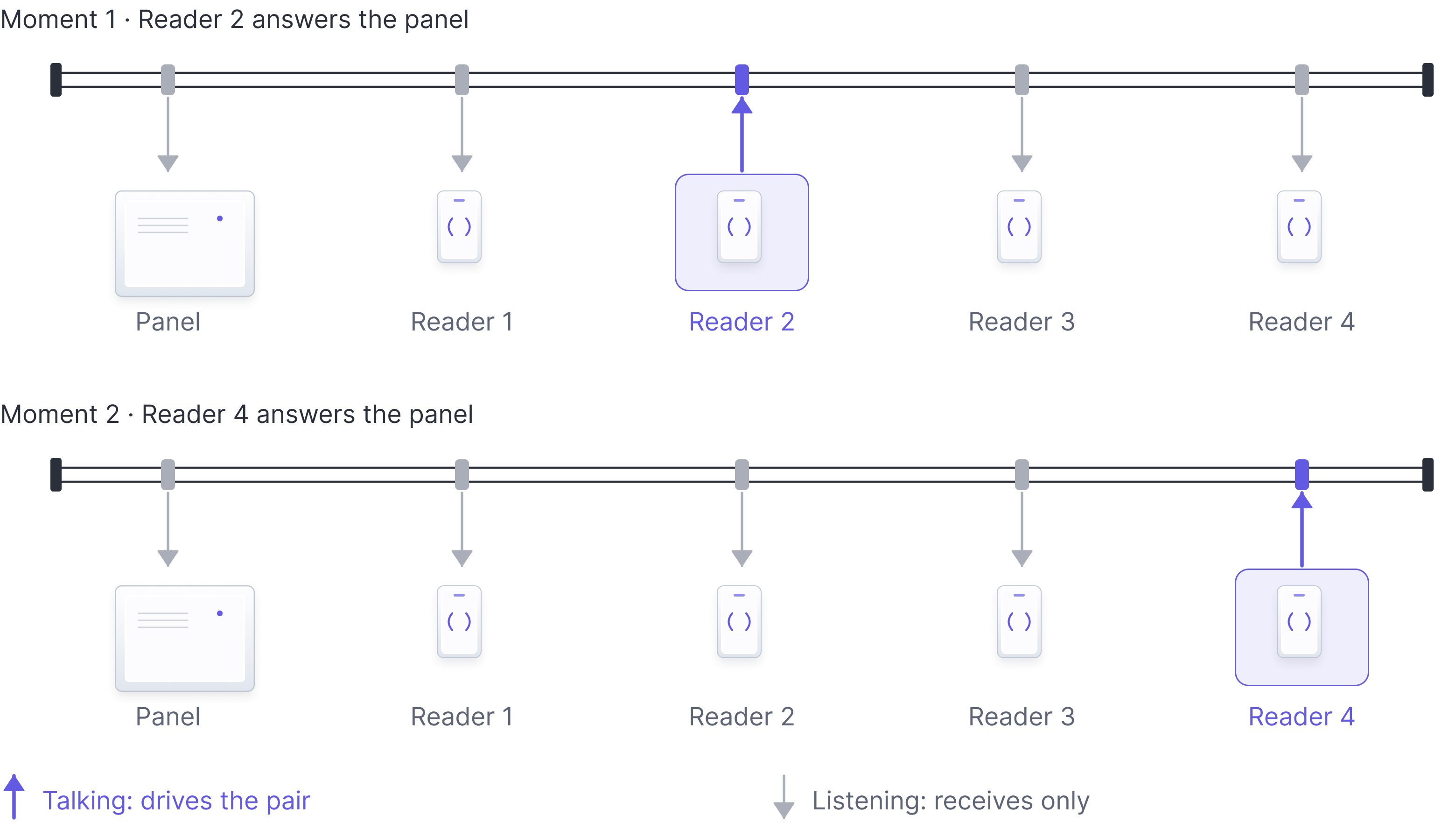
That single capability is what makes a shared bus possible, and it is why the devices along the cable are never wired in series. The pair runs past each of them and they hang off it in parallel, at the same electrical node, seeing the same voltages at the same instant.
How many can be hung on one line? It depends on what each one draws. The standard defines a unit of measure, the unit load, corresponding to a device that draws like a resistance of about 12 kilohms, and it requires a compliant driver to feed thirty-two of them. Recent parts draw only an eighth of that unit, which would in theory allow 256.
In practice Texas Instruments brings the figure down to 96. When every device falls silent, nobody is imposing a voltage on the line, and the smallest stray pickup could be read as data. So resistors are added to hold the line in a known resting state, which is called failsafe biasing. Those resistors draw current too, and take up part of what the driver can feed.
Every reader hears everything, and one of them answers
If four readers hang on the same node, all of them receive the same bits. There is no routing, no filtering, and no notion of a destination anywhere in RS-485. Every hands its microcontroller every byte that crosses.
So the protocol puts the destination inside the message itself. Reader 1 reads the address, finds it is not 3, and drops the frame. Reader 3 finds its own and acts. The decision happens in software, several storeys above the copper, which carries everything without giving it a thought.
And what stops two readers answering at once? Not the RS-485 standard: it describes the electricity on the pair, not who is entitled to speak. That is the job of the protocol above it. OSDP landed on the simplest shape: only the panel speaks unprompted, each message names exactly one device, and the device named replies. Building automation solved it the same way and earlier, which is why a Modbus RTU bus also has exactly one device entitled to ask the questions.
| The question | What RS-485 says about it | Who decides |
|---|---|---|
| How many volts is a one? | At least 1.5 V of difference out, read down to 200 mV. | RS-485 |
| How far may the pair run? | As far as the chosen data rate allows, and no further. | RS-485 |
| How many devices may share it? | Thirty-two unit loads, more with modern parts. | RS-485 |
| May the pair float against my ground? | Anywhere from -7 V to +12 V. | RS-485 |
| May two devices transmit at once? | Nothing. It supplies an off switch and no policy for using it. | the protocol above it |
| Which reader is this message for? | Nothing. | the protocol above it |
| Where does a message begin and end? | Nothing. | the protocol above it |
| Was the message corrupted in transit? | Nothing. | the protocol above it |
| What does the payload mean? | Nothing. | the protocol above it |
| Which cable, which connector, which pinout? | A recommended impedance, and that is all. | the installation specification |
Read down the right-hand column. Almost everything an installer calls RS-485 behavior turns out to belong to something else.
Wiegand needs one cable per reader, OSDP can put several on one
For decades the industry's reader interface was Wiegand, and Wiegand is what RS-485 replaced, not Ethernet.
A Wiegand reader pulses two data lines, one way, toward the panel. Its cable runs from that reader to the panel and serves that reader alone, up to 500 ft, or 152 metres. OSDP readers, on the same kind of field cable, allow a multi-drop or daisy-chain layout in which several readers share one run, at distances Allegion puts at up to 4,000 ft (Selecting campus readers). Treat that upper figure as a family of figures: ICT publishes 900 m and Impro 1,000 m for the same protocol, which is what you would expect of a limit that depends on rate, gauge and topology.
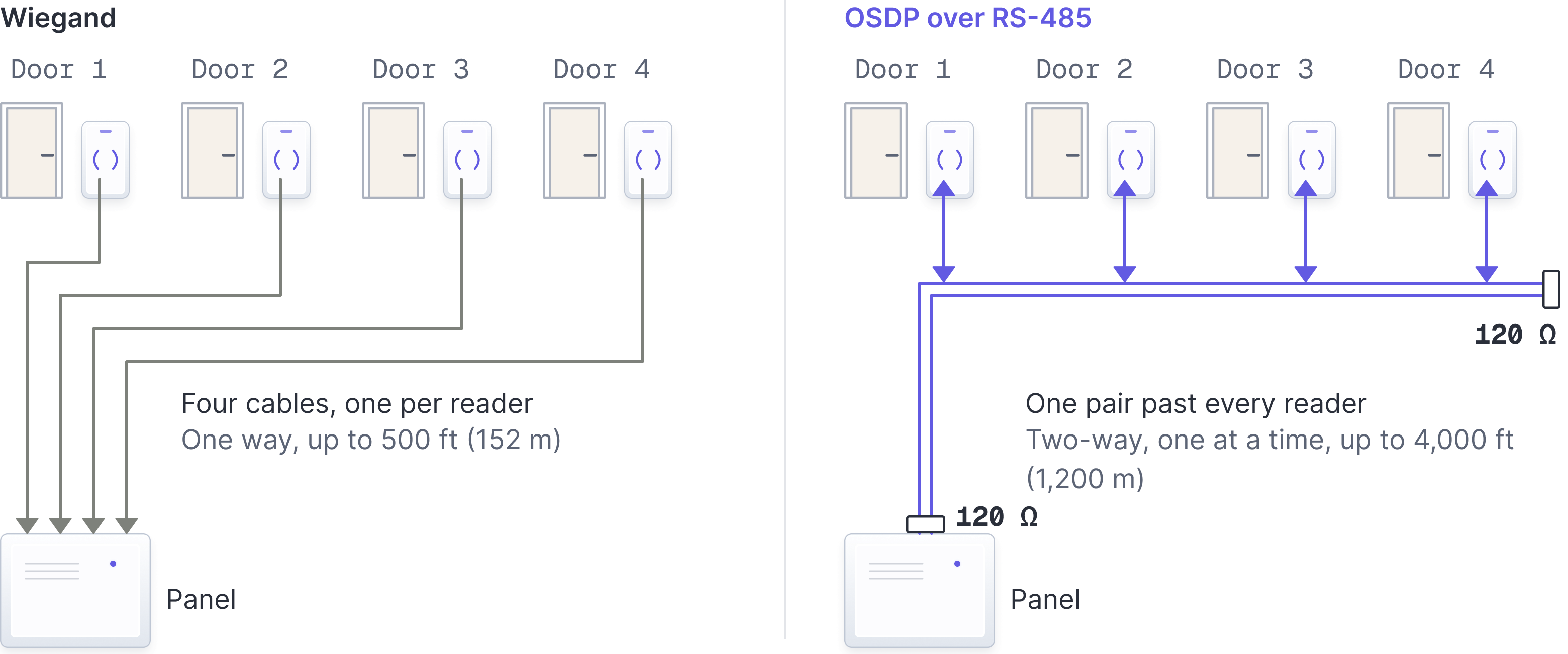
The one-way part is the deeper change. A panel that can only be spoken to cannot ask a reader anything: not whether it is still alive, not what firmware it runs, not to change a setting. It is also why a converter between OSDP and Wiegand, a catalogue item (Cypress OSM-1000), only goes so far: its Wiegand side still runs one way, and everything the two-way link buys stops at the converter.
Wiegand has another and graver flaw, and it follows from the same one-way design: it sends the badge number in the clear, along wires that run to the side of the door anyone can walk up to. That is one of the reasons the industry eventually changed interface, and that story belongs to the article on how RS-485 took over.
| What changes | Wiegand | OSDP over RS-485 |
|---|---|---|
| Documented distance | 500 ft (152 m) | Up to 4,000 ft per Allegion; 900 m to 1,000 m elsewhere |
| Panel notices a dead reader | No, the reader is unsupervised | Yes, it is polled continuously |
| Firmware and settings | A visit to the door | Pushed down the bus, where the panel supports it |
| Wires for LED, buzzer, tamper | Extra conductors each | Carried in the protocol |
Four consequences of one thing, a reader that can answer back. Distances and the unsupervised-reader point are from Allegion and Axis product documentation.
The far end of a field bus
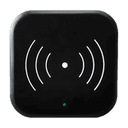
Wall readers and keypads, the devices a panel polls. Schlage, for one, marks its RS-485 readers with a -485 suffix in the model number.


The near end
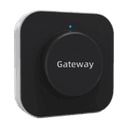
Door controllers and panels. On a bus like this one, the panel is the device that owns the conversation and decides who speaks next.


Why two wires rather than a network cable
Choosing RS-485 is not a refusal of Ethernet. It is the answer to one precise need: many small devices, very little data each, long runs, cable routed through electrically noisy places, and no appetite for installing a network switch, an IP address and an IT team at every door.
When a device genuinely has a lot of data to move, or when reader and controller are combined in one box on the site's computer network, Ethernet is the better fit.
Which is why a reader protocol that became an international standard in 2020 still rests on an electrical standard from 1983. It is not nostalgia. A card reader has almost nothing to say, says it rarely, and says it from a long way off through a great deal of electrical noise. For those requirements, RS-485 is an excellent answer.