Levers, knobs and panic bars: what needs do they answer?
Access usually runs on a double principle. Outside, you have to prove who you are. Inside, you have to be let out. Prisons are the exception that proves the rule…
Stand outside your own front door, as familiar with the house as anybody could be, and you still have to prove who you are, or that you're allowed in. Move twenty inches, to the inside of that same door, and it's the reverse: you have to be let out immediately, whoever you are and whatever you're carrying in your full hands.
The two sides of a door are not solving the same problem, which is why, on a door that locks, they almost never carry the same hardware. Every knob, , and push bar you've ever touched is a mechanical answer to one of those two problems.
The two faces of a door don't give you the same rights
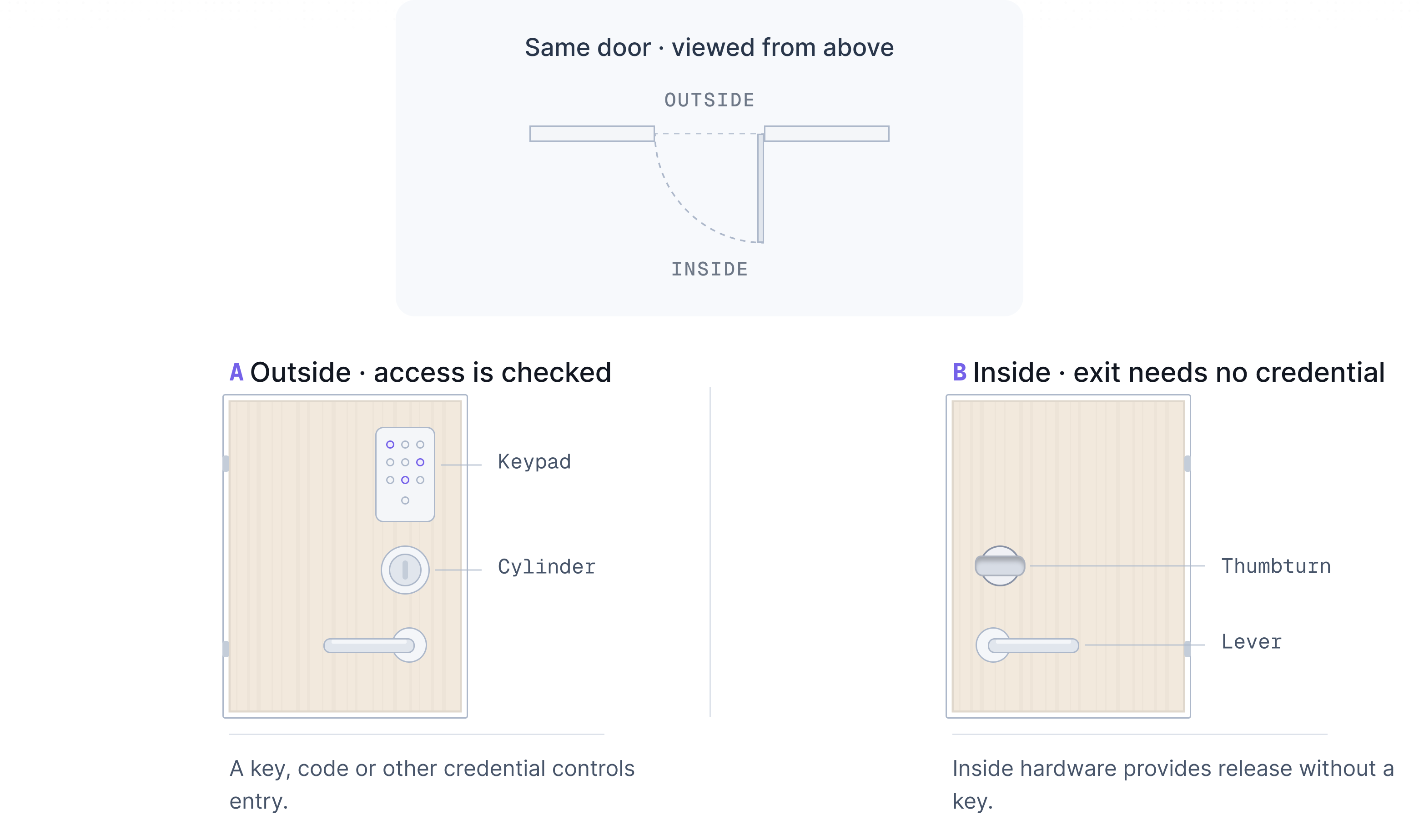
The outside face asks a question, so it needs something that can read an answer: a cylinder, a keypad, a card reader. Whatever shape it takes, its job is to accept a and to be capable of refusing one.
Under US building codes, with a few listed exceptions, the inside face isn't allowed to ask anything. The American building code is explicit: egress doors must be "readily openable from the egress side without the use of a key or special knowledge or effort", and unlatching "shall require not more than one motion in a single linear or rotational direction to release all latching and all locking devices" (International Building Code, 1010.2).
Read those two sentences as a hardware specification and nearly every oddity on a door explains itself. No key on the inside. That's why a deadbolt keyed on both faces isn't permitted on an occupied dwelling's exit door, and why the humble thumbturn exists at all. One motion. That's why some locks link their together: turning the inside lever retracts the latchbolt and the deadbolt at once. Two separate gestures aren't allowed, except on the entry door of a home or a hotel room. These are called interconnected locks, and they have their own standard, ANSI/BHMA A156.12, which asks that "a single operation retracts all bolts" (ANSI).
Knobs and levers: the same action, through a different interface
A and a lever do the same mechanical work: turn a spindle, retract a . The job is identical. As interfaces they're nothing alike.
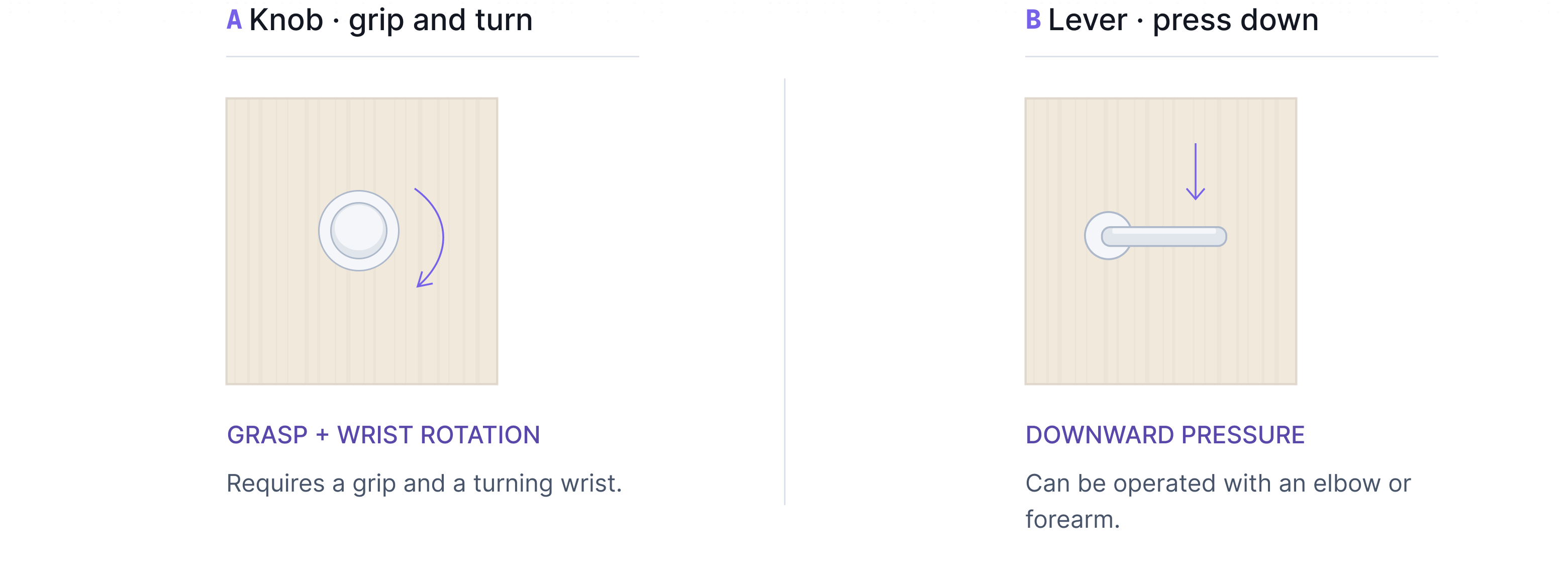
The ADA Standards require operable parts to work with one hand and without "tight grasping, pinching, or twisting of the wrist", with a maximum operating force of 5 pounds (US Access Board, 309.4). A knob asks for exactly the grip and the rotation that sentence rules out. BHMA draws the conclusion in its own words: "Lever or paddle type trim meets these stipulations, while knob trim should be avoided for accessible routes" (Hardware Highlights, A156.2-2017).
So in a commercial building the lever is a compliance decision. In a house it's still an ergonomics decision, which matters to anyone holding a child, a laundry basket, or a hand that doesn't grip well any more.
One rule about levers gets quoted everywhere as universal and isn't. California's Referenced Standards Code requires a lever to be "curved with a return to within 1/2 inch of the face of the door to prevent catching on the clothing of persons during egress". Lori Greene, who manages codes and resources at Allegion, points out that this appears in neither ADAAG, A117.1, the IBC nor NFPA 101 (I Dig Hardware). Good practice everywhere, law in California.
The thumbturn: a deadbolt you can open from inside without a key
A thumbturn throws and withdraws a by hand, from the inside face, with no key involved. That design satisfies the egress rule. The thumbturn sits on the inside, where nobody may be asked for a credential. It exists because a deadbolt has to be operable by somebody with no key in their pocket and no time to look for one.
The code says so directly, in its exception for individual dwelling units: night latches, deadbolts and security chains are permitted only where "such devices are openable from the inside without the use of a key or tool" (International Building Code, 1010.2).
So calling the thumbturn a decorative knob gets it backwards. It's the piece of hardware that makes a deadbolt legal on a door people live behind.
Panic bars: getting out by leaning, and in a crowd
If the inside face only has to let you out, push that to the extreme. What's the least a person could possibly be asked to do?
Lean on the door.
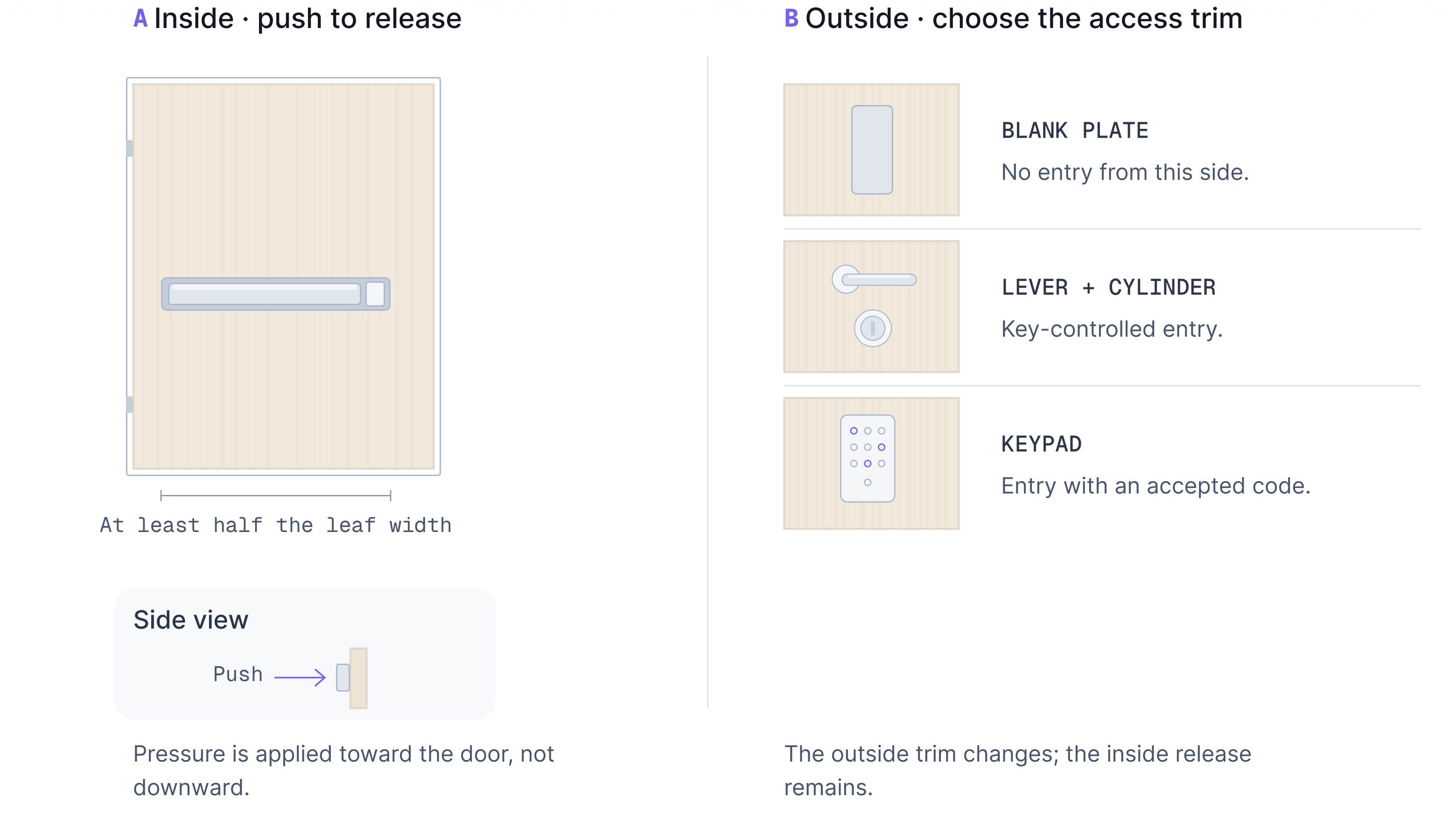
The code sets the numbers. The releasing device has to extend at least half the width of the door leaf, so you can't miss it, and the latch has to release under 15 pounds of force (IBC 1010.2.9). Like any door hardware, it's mounted between 34 and 48 inches from the floor (IBC 1010.2.3). No grip, no rotation, no aim. A shoulder does it. A wheelchair footplate does it. A crowd does it without anyone deciding to.
Meanwhile the outside of that same door is entirely open to negotiation, and that's where exit trim comes in: the outside furniture of an exit device. It can be a blank plate, meaning nobody comes in this way at all. It can be a lever with a cylinder. It can be a keypad or a reader. The inside gesture is fixed by law; the outside is a purchasing decision.
Two things worth knowing about this hardware. It's graded like everything else, and ANSI/BHMA A156.3, the exit devices standard, sets grade 1 at 500,000 cycles, grade 2 at 250,000 and grade 3 at 100,000 (BHMA, Allegion). And a fire door takes fire exit hardware: a panic device also listed for fire, which NFPA 80 wants labeled as such (I Dig Hardware), because a fire door has to latch as reliably as it has to release.
Seven doors, seven needs
What a door carries isn't a matter of taste.
| The door | Outside | Inside | What decides it |
|---|---|---|---|
| Bathroom | no lock, or an emergency slot | thumbturn or turn button | somebody must be able to open it from outside in an accident |
| Hotel room | card or mobile reader | free lever, sometimes a deadbolt | guests must leave freely, staff must get in |
| Home front door | cylinder plus keypad | thumbturn | no key on the inside, under US codes |
| Office suite | lever, often with a credential | lever, plus a way to lock up | constant traffic, occasional lock-up |
| Plant room | key | free lever | you never lock a person in |
| Fire stair, gym exit, school corridor | blank plate, lever, or keypad | push bar | crowd egress, one reflex, under 15 lbf |
| Apartment building entry | reader | push bar or free lever | residents leave without thinking |
Read the last column and the rest of the row follows from it.
Two patterns run through the whole table. The inside column is always the simplest thing that works, and it never contains a credential. The outside column is where all the variety lives, because that's the only side where anybody is deciding anything.
Catalogs name what the buyer chooses, not the whole door
DeviceDB's names describe the hardware a buyer picks out, and nothing about the rest of the door.
Sold as levers
Named after the handle, which is the part your hand meets. Says nothing about what is on the other side.


Motorizing: which gesture are you replacing, and on which side?
Motorizing a lock doesn't change what holds the door. It replaces a hand at one specific point. A retrofit deadbolt drive mounts where the thumbturn was and turns the same spindle. Motorized latch retraction pulls back the latchbolt a lever would have pulled. The bolt, the and the hole in the door are untouched.
So the useful question about any connected lock is: which side is it on, and which gesture is it replacing? A motor on the inside is doing the thumbturn's job, which means it inherits the thumbturn's legal duty to release. A reader on the outside is doing the cylinder's job, which means it inherits the cylinder's duty to be able to say no.
And the one thing electronics may never block is . Whatever a lock does to the outside world, the inside face still has to open in one motion, with no key, for somebody who isn't thinking clearly. That requirement predates every smart lock and will outlive all of them.