English
What is actually on a hotel key card?
A lock no system has ever contacted reads your card and decides, in half a second, to let you into a room or to refuse you. What exactly is it reading?
The lock on most hotel room doors is connected to nothing, and in a fraction of a second it still has to decide whether your card opens room 412 this Tuesday at 11.
The common intuition is that all of this runs on a list: the lock would hold a register of valid cards, somebody would keep it up to date, and the lock would know which ones to obey. The opposite is what happens. The lock holds almost nothing. The card does not supply an identifier to be looked up in a register. The card is the register, carried to the reader.
The card holds access information rather than an identifier
Rather than assign an identifier to the card, the writes a decision into what it encodes. The card reaches the door already carrying the instructions the lock merely obeys: which openings, and during which periods. The lock's job is not to check whether the person in front of it is on a guest list, but to decode those instructions, and to verify them. Does this information come from my system? Is it intact? Is it still valid?
Verifying that it comes from the right system rests on a shared secret. The locks and the encoder belong to one installation and hold the same keys, so a lock can check that the data it reads was written by its own platform, and not by an amateur with an encoder. The detail varies between product generations, and it is of course the part manufacturers keep to themselves. What does not change from one brand to another is the shape: the card proves its information is authentic, and the lock never needs to have been told anything about your rights beforehand.
Expiry sets the safety margin
The objection comes immediately: if nobody can talk to the lock, nobody can tell it that a card has been stolen. That is true, at least directly. And the answer here is not a connection, it is a limited window of authorization.
Everything written to the card expires. A guest's card stops working at checkout time, on its own, without any revocation needing to reach the door. What would be an emergency on a networked lock, revoking a lost card, becomes here mostly a matter of waiting. The operator's real lever is the validity they grant. Short-lived staff cards exist for no other reason: rights re-issued each morning at an online reader die out the same evening.
When the system goes down, doors still open and no card can be made
A system failure does not have the same effects here as elsewhere. In a system where the command has to travel to the lock, a failure means doors that stop obeying. Here, the doors do not change their behavior: every lock goes on accepting the cards presented to it, and guests already checked in walk into their rooms without noticing anything. What stops, instead, is the encoder. Nobody can make a card any more, so nobody can take possession of a room, and arrivals pile up at the front desk.
A card can carry information in both directions
The card is the only thing that travels regularly between the online equipment and the offline locks. Which is why, and this is probably the surprising part, some systems use it as a courier, in both directions.
Salto's documentation describes both journeys. Outbound: "when a user presents their key to the SVN reader, the latest up-to-date access information is automatically transferred to the key", including the lists that neutralize lost cards before they expire. Inbound: as keys are used around the building, the locks hand them "information such as audit trail events and, if the battery is low, the lock battery status", and the next touch of an online reader delivers all of it to the system (Salto Space system overview).
A battery lock that was never wired therefore reports a low battery and its opening history to a server it cannot reach. Every guest who walks past it carries that information away without knowing it.
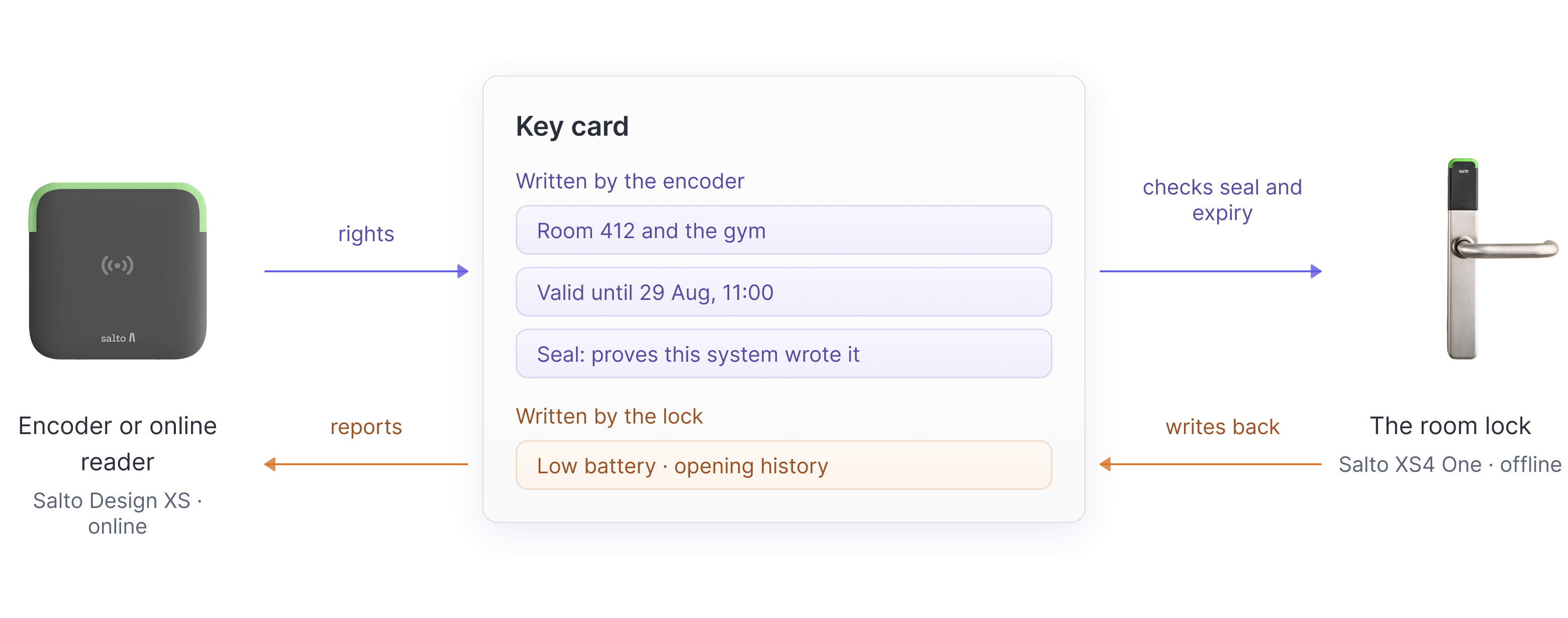
| On the card | In the lock | In the platform | |
|---|---|---|---|
| Who may open this door today | Its own rights, authenticated and dated | No register of people at all | The master copy |
| This card was stolen | A denylist entry, carried by the other cards | Known when a fresher card brings the news | Known immediately |
| What time it is | Encoded validity windows | Its own clock, the one thing it has to keep | Authoritative time |
| The lock's battery and history | In transit on the cards | The source | After the next card goes by |
The card is both the key and the register, and that is what sets this arrangement apart from every other one.
Hardware built for this
Two battery-powered hotel locks that open on a keycard, and an exit trim whose product name says data-on-card in so many words.


The decision taken at the threshold of room 412 is therefore not a search through a guest list. The card presents authenticated and dated data, the lock verifies where it came from and its date, and during that exchange, on a system like Salto's, the lock stores its battery status so that it travels back the other way. The register you imagined does exist, but only at the encoder. The locks along the corridor never see it.