When you tap a badge, where is the decision actually made?
Between the tap and the click, a machine evaluated a rule. It ran on one specific processor, and where that processor sits governs how fast the door opens, what still works during an outage, and what can be changed in a hurry.
You tap a badge, you hear the click. Somewhere in between, a machine evaluated a rule: "this , this door, this hour? Fine, come in." That decision isn't an abstraction. It ran on one specific processor, in one specific box, and which one is among the most useful facts about any access system, because that location governs how fast the door opens, what keeps working during an outage, and what can be changed in a hurry when it has to be.
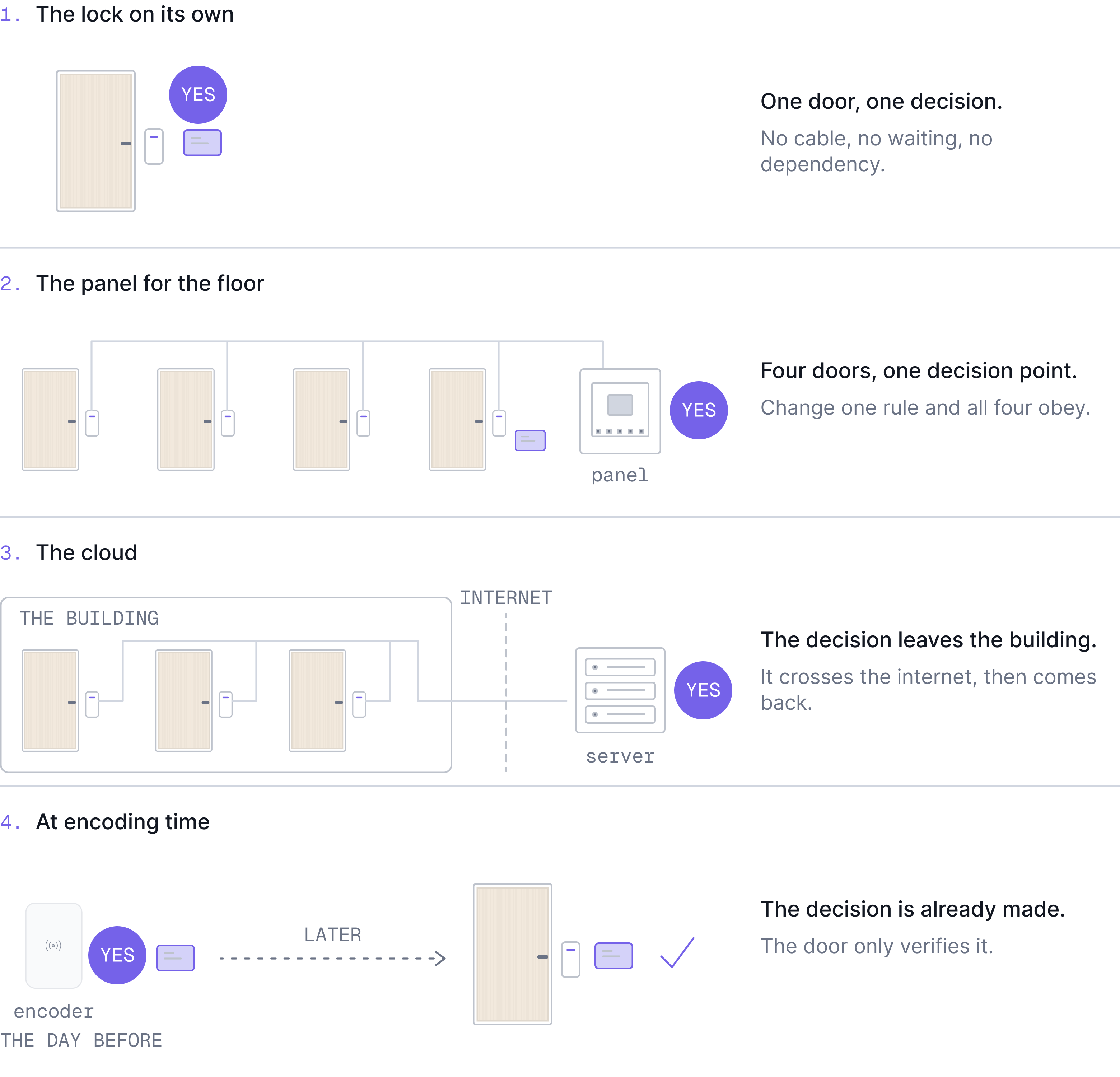
There are three places it can run, plus a fourth case that doesn't work like the others at all: the lock, the panel down the corridor, the cloud, and encoding time.
In the lock: it decides on its own, and takes a long time to change its mind
This is the standalone answer. The lock holds its own rules: the codes it'll accept, the badges it knows, the schedules it enforces. Presentation, evaluation and motor all sit in the same box, on the door.
For deciding, nothing beats it: no cable, no round trip, no dependency. The yes takes as long as the electronics need and not a moment more. Changing the rules, on the other hand, is slow. New ones have to reach the lock, by radio if it has one, otherwise by somebody walking to the door. A standalone lock is always available and always out of date.
In the panel down the corridor: change one rule and the whole floor obeys
This is the classic access control answer. The reader on the wall is deliberately ignorant: it reads the credential and passes the number to a panel in a riser closet, over the wiring we covered in another article. The panel holds the rules for a whole floor of doors, evaluates, and fires the strike.
So the rules live in one place: change one and every door on the panel obeys a moment later. In exchange, the corridor wiring and the panel's health are now part of every decision, which is why this world cares so much about supervised lines and battery-backed panels.
The panel is also the natural place to evaluate rules no single lock could enforce, because they are about the relationship between several doors. The two classics are anti-passback, which refuses a badge at an entry reader when that badge has already gone in and has not been presented at an exit reader since, and lockdown, which shuts a whole set of doors on one command.
In the cloud: rules change in seconds, but the decision crosses the internet
This is the newest answer. In its pure form, the reader or the lock sends the presentation upward, a server evaluates, the answer comes back down. The rules are in the 's database now, live. They change in seconds across ten thousand doors, and the decision can consult anything the platform knows, including whether the subscription was paid.
The clearest example is a card that has just been assigned. Presented once, it is refused: the reader read its number perfectly well, but that number doesn't yet belong to anybody who may come in here. An administrator assigns it to someone, from anywhere. On the next presentation, the same card opens the door. Nothing changed in the card and nothing changed in the door. What changed is the record linking that number to a person, and that record lives on the provider's servers, which the door reaches over the internet.
This shows what a card really is in a cloud system. It carries no rights at all. It carries a number, and the server uses that number to look up the rights of the person it belongs to.
The price is the round trip, and what the round trip crosses: the building's internet link, the state of the network, the platform's own availability. That's why every serious system of this kind keeps a fallback copy of some rules further down, in the panel or in the lock. And that fallback tells you what matters: the cloud is the best place to manage the rules and a bad place to be the only thing applying them.
At encoding time: the decision is made before you get there
That leaves the , where the question changes character. In a system where the rights are written onto the cards, or on a lock that takes offline codes, the yes was computed when the credential was issued: at the encoder, or in the arithmetic that produced the code. The door doesn't decide, it verifies a decision already made, sometimes days earlier.
Hence the exact contrast with the card that has just been assigned. Here a card can't change meaning while it sits in your pocket, because its rights are written into it. Changing them means presenting it again to an encoder or an online reader.
That's why revocation behaves so differently there, which we cover in another article.
| In the lock | In the panel | In the cloud | At encoding time | |
|---|---|---|---|---|
| The yes takes | Milliseconds, inside the lock itself | A round trip down a cable | A round trip over the internet | Milliseconds: it's only a check |
| Changing a rule | Slowly: every lock has to be reached | Quickly, panel by panel | In seconds, everywhere | At the next issue, or at expiry |
| If the internet drops | Nothing changes | Nothing changes | Fallback rules, or refusal | Nothing changes at the door |
| What it can take into account | Its own door, and nothing else | Its floor: anti-passback, lockdown | Everything the platform knows | What was true at issue |
| What the card carries | A number, nothing more | A number, nothing more | A number, nothing more | The rights themselves |
| Where you find it | Standalone and offline locks | Wired estates | Cloud-native systems | Hotel cards, offline codes |
None of the four wins every row, which is why real buildings mix them.
The habit worth picking up is a simple one. When somebody's showing you an access system, find where the decision runs. Not the reader, not the app, not the brochure: the processor where the rule is actually evaluated. Everything else, the speed, the outages, how it behaves in an emergency, follows from that.