Why a connected lock sold in Europe does not fit an American door
You bought the lock everyone recommends, the right brand and the right model, and it does not fit your door. How can one product name cover two different machines?
On the marketplace listing for a Nuki Smart Lock Ultra, one of the first images is not a photograph of the product. It is a diagram: a green check beside a European cylinder, and a large red cross through an American deadbolt. The manufacturer paid to produce an illustration whose only job is to warn you, at the moment of purchase, that this product is not for you.
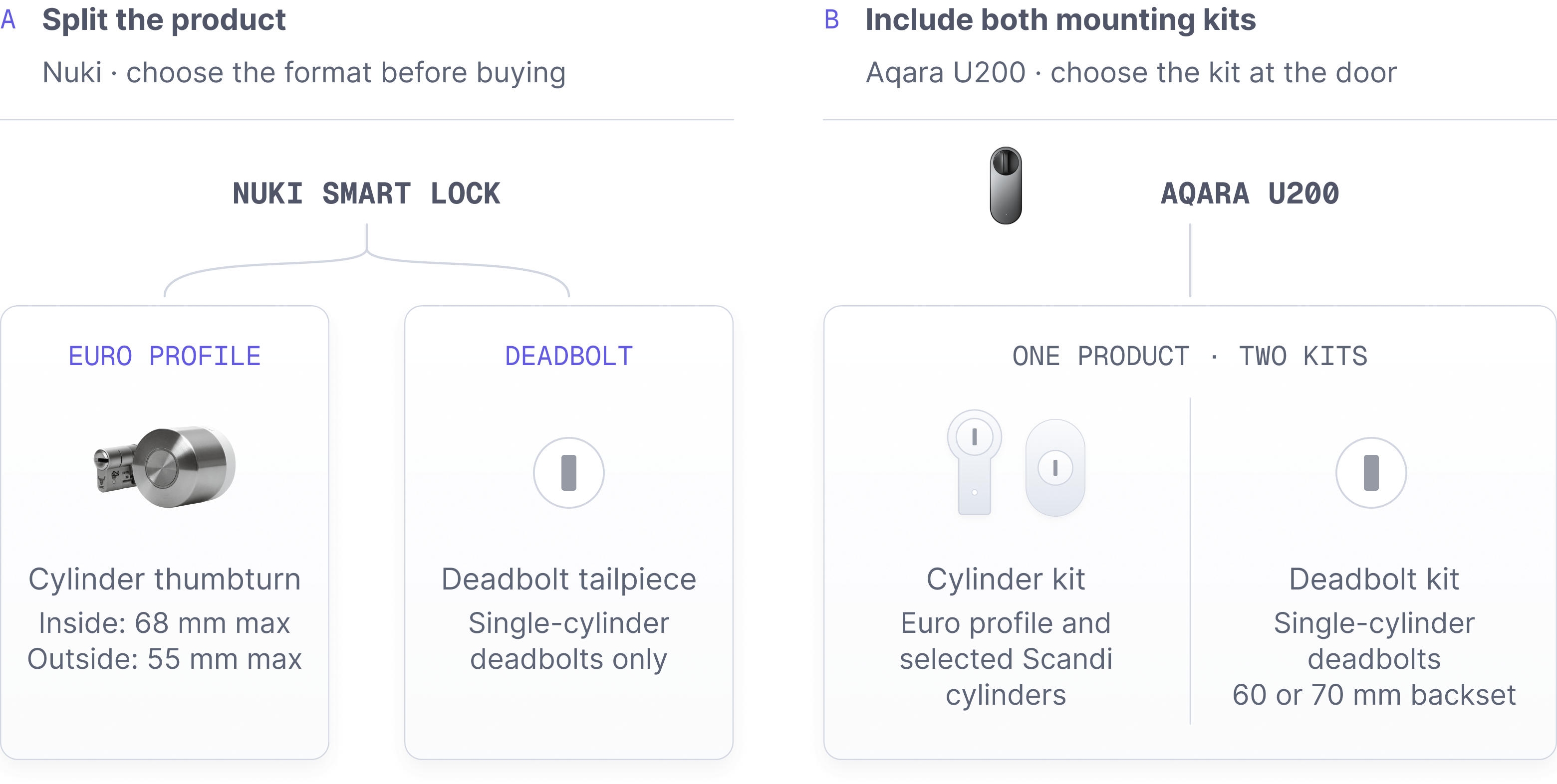
On its own American site, Nuki sells two different locks that are both called Nuki Smart Lock. One is the "Nuki Smart Lock", which Nuki's own FAQ calls "the Smart Lock (Deadbolt)" and which "mounts on the inside of your door over your existing single-cylinder deadbolt" (Nuki, US catalog). The other is the "Nuki Smart Lock Ultra (Euro Profile)", whose compatibility guide speaks in cylinder lengths, 68 mm maximum inside and 55 mm maximum outside (Nuki, compatibility guide).
Europe standardized the shape of the cylinder, America standardized the holes in the door
The European cylinder and the American deadbolt, surprisingly, come from the same invention. Linus Yale Jr. was granted a patent for an "improvement in locks" on June 27, 1865, and his idea was that the part holding the secret could be a separate , screwed into the lock body and changed without changing the lock. The patent already reads like a catalog entry: the tumbler case "may be screwed in to different depths, thus making the lock suitable for doors of various thickness", and "can be screwed into either side of the lock-case, thus making it a right or left hand lock" (US patent 48,475).
After that, each of the two continents standardized an opposite half of that idea.
Europe standardized the shape of the removable part. The is a fixed silhouette, a circle above a narrow body, published as a section of 17 by 33 by 10 mm (ABLOY data sheet). Any cylinder of that profile, in the right length, goes into any cut for that profile, in every country that adopted it. The cylinder became an ordinary commodity, and changing who can open your door means buying a new one and turning one screw.
North America standardized the holes in the door. The residential standard is two bores: a 2-1/8 inch (54 mm) , at a of 2-3/8 or 2-3/4 inch, and a 1 inch (25 mm) for the . The is a complete product that sits in those two holes. There is no continent-wide replaceable cylinder profile, because the part you replace is the whole lock. The bored preparation gives the templates and the figures.
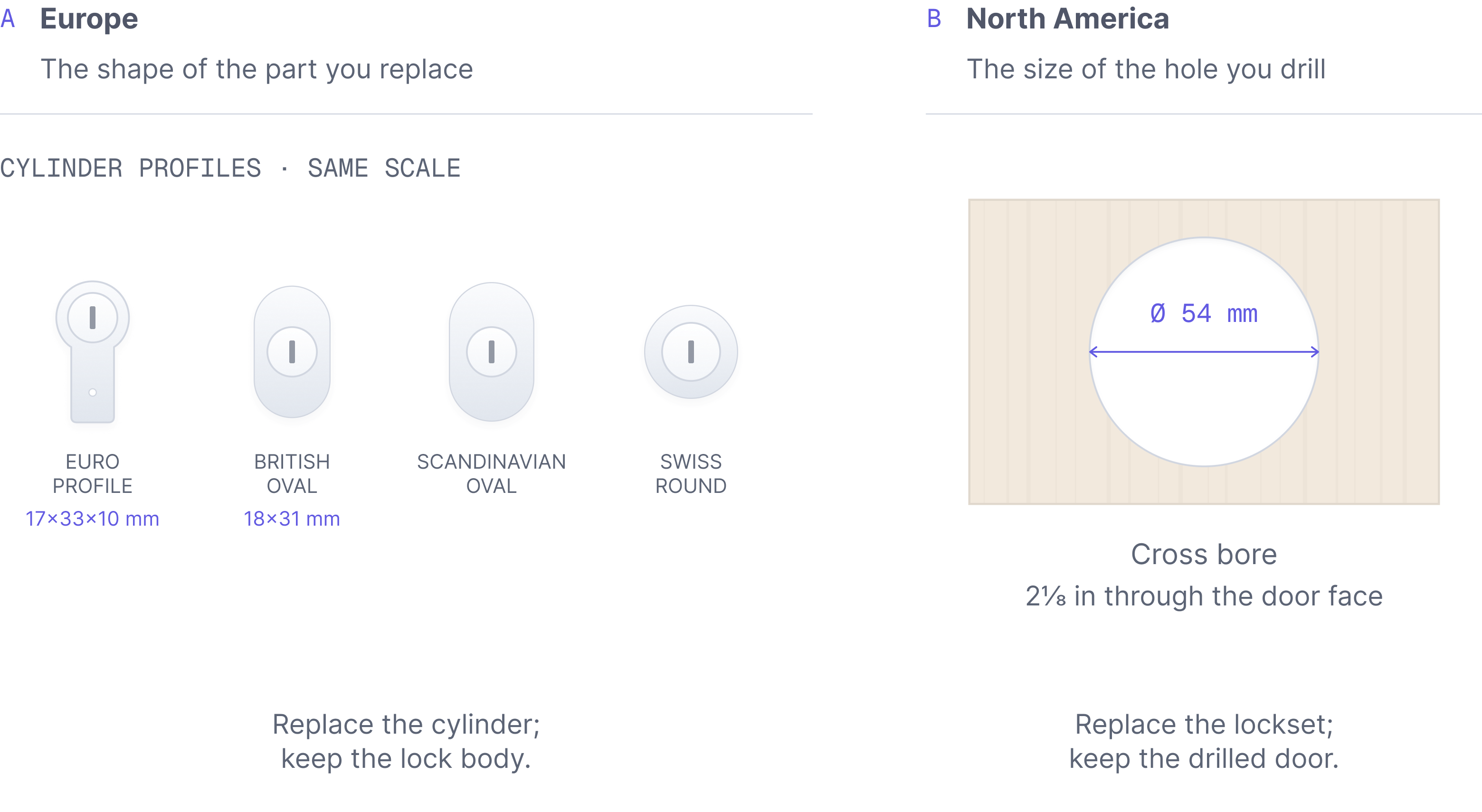
Each choice is coherent on its own, but the two are completely incompatible. For a buyer, the consequence is what matters: a product that grips the key left in a cylinder, or the cylinder's , has nothing to grip on an American door, and a product built around a deadbolt's has nothing to grip on a European one.
Nuki signals the format in a parenthesis
A manufacturer who wants both markets has to say which machine is in the box, and the product name is a bad place to say it.
Nuki's answer is to split the product and let the parenthesis carry the format. That works on the manufacturer's own site, where the two products sit in different sections. It works much less well everywhere else, because a parenthesis is exactly the part of a title that a marketplace truncates, that a search result drops, and that a shopper skims. Which is how a company ends up buying a picture with a red cross in it.
Aqara puts both machines in the box
Aqara answers the same border the other way. The Smart Lock U200 is a single product that "supports Euro profile and select Scandi cylinders" and is also "suitable for single-cylinder deadbolt locks", with "backsets of 2-3/8" (60 mm) and 2-3/4" (70 mm)" (Aqara). One name, one purchase, a kit of adapters in the box, and the buyer picks the right one at the door.
A line of small print in Aqara's European column is worth stopping on: "Please ensure your cylinder is equipped with an Emergency Function." That is a European mechanical idea with no American equivalent. The emergency function lets the outside key turn the cylinder while a key is still sitting in the inside, and it exists because Europeans leave the key in the lock. An American deadbolt has a thumbturn on the inside rather than a keyway, so the situation never arises and the trade never needed the word. A cultural habit became a mechanical requirement, printed in a compatibility list.
For anyone building software on locks, the two strategies are not equivalent. Splitting the product gives a catalog two identifiers and an easy life. Shipping one identifier that covers two mechanics forces a decision: is that one model with two variants, or two models? Every integration inherits whichever answer the catalog picked, and it is the same question that model numbers ask.
Four cylinder profiles coexist in Europe
The euro profile is dominant, not universal, and the exceptions live inside Europe. Britain fits the euro profile on most uPVC doors and keeps an oval beside it, a flat-sided profile of roughly 18 by 31 mm that looks similar at a glance and will not enter a euro cutout. Scandinavia uses its own oval, chunkier, fixed with bolts through the door rather than a single screw. Switzerland uses a round profile. Each is a small closed world with its own cylinders, and a connected lock built around a euro cylinder may or may not clamp onto any of them.
This is why manufacturer compatibility pages are written in profiles and millimeters rather than in country names. The country is a good first guess and a poor final answer.
Japan and Korea kept their own hardware
In Japan and Korea, neither of the two conventions applies. Japanese doors run on manufacturer keyway systems rather than a shared national profile. MIWA's cylinder families, U9, PR and JN, are named the way a brand names its own range, not the way a standard names a shape.
Korea went off exploring somewhere else again. The catalog of the Singapore and Malaysia distributor of Samsung's digital locks organizes the range into "Mortise, Deadbolt, RIM", where mortise means "handle type locks", deadbolt means locks "without handles", and rim units are "specially designed for gate and add on lock for doors" (Samsung Digital Life). No cylinder profile appears in that list. In a market that went keypad-first, on steel apartment doors, the replaceable keyhole never became the organizing idea, and there is therefore no national cylinder format for a to clamp onto. A European or American retrofit does not fail there for lack of an adapter. It fails because the part it was designed to grip is not on the door.
Two photographs and one measurement tell you which door you own
For a host buying remotely, or an operator equipping a flat they have not visited, the useful discipline is short.
- The outside face tells you which world you are in. A pear-shaped keyhole in a narrow plate is Europe. A round with a separate deadbolt above it is North America.
- The inside face tells you what a motor can grip: a key or a thumbturn in the cylinder, or a thumbturn on its own rose above the handle.
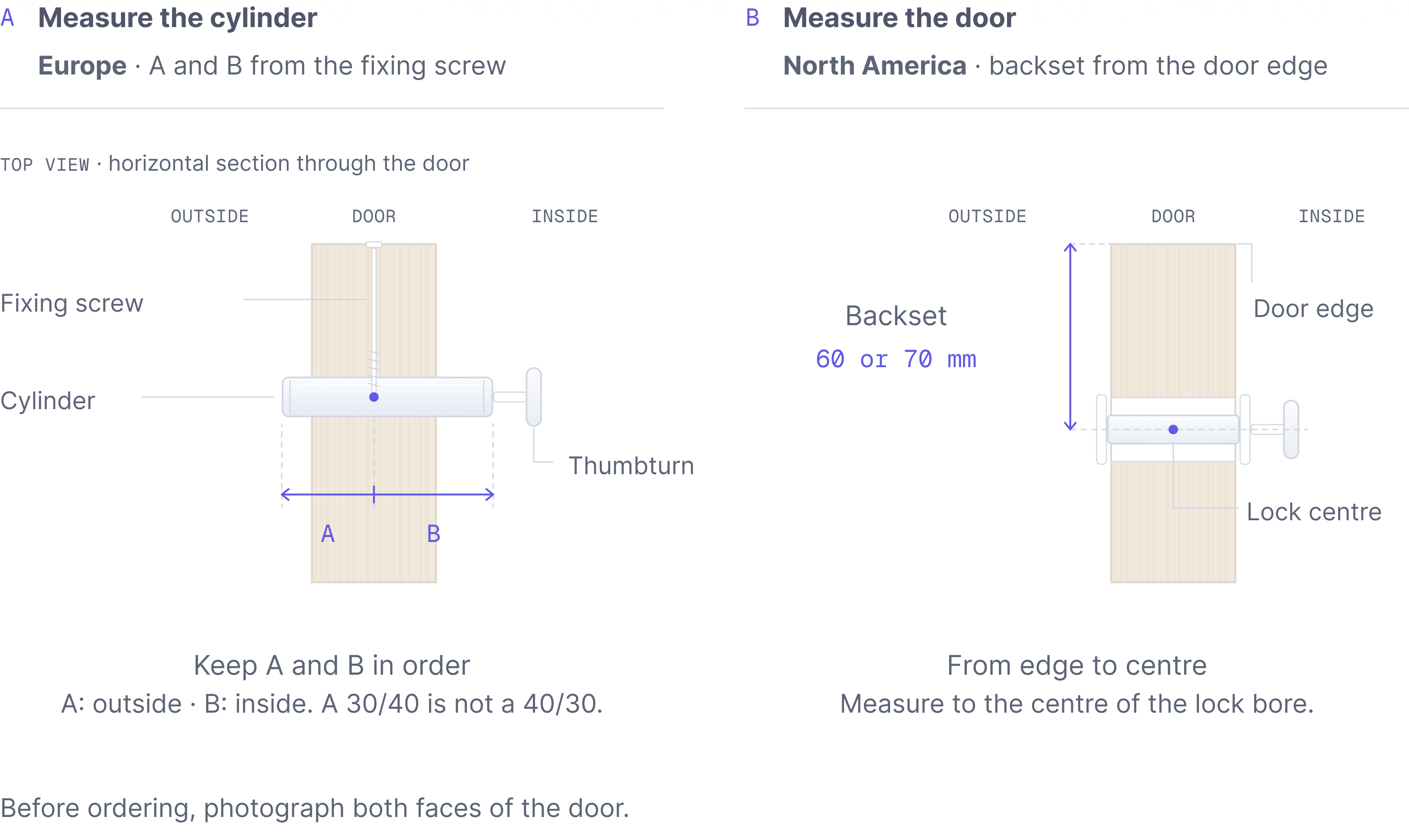
- The number is A and B in millimeters from the fixing screw for a cylinder, or the backset for a deadbolt. Measure the cylinder from the screw, never end to end, and keep the two halves in the right order.
| The standardized thing | What a retrofit grips | The number you supply | |
|---|---|---|---|
| Continental Europe | The euro profile, 17 x 33 x 10 mm | The key left in the cylinder, or a cylinder supplied with the lock | A and B, from the fixing screw |
| Britain | The euro profile, and an oval of about 18 x 31 mm beside it | The cylinder's key or thumbturn | A and B, from the fixing screw |
| Scandinavia | The Scandinavian oval, bolted through | The cylinder's key or thumbturn | A and B, and the fixing type |
| Switzerland | The round profile | The cylinder's key or thumbturn | A and B, from the fixing screw |
| North America | The bores: 54 mm at a 60 or 70 mm backset | The deadbolt's tailpiece | The backset |
| Japan | Manufacturer keyway families, not a shared profile | It depends on the maker | Ask the maker |
| Korea | Neither: mortise, deadbolt or rim units, keypad first | Usually nothing; the unit replaces the lock | The door's mortise dimensions |
What a retrofit grips is the column that decides whether it has anything to hold onto, and it is the one no product name carries.
Built to grip a cylinder
Retrofits built around the euro profile cylinder. Nothing on an American door presents that shape.


Built to grip a tailpiece
Interior conversions and complete deadbolts built around the two bores. Nothing on a European door presents that shape.


For an operator whose estate straddles the two continents, the consequence is heavier than two photographs. A portfolio covering Amsterdam and Austin cannot standardize on one lock model, however good it is. At best it standardizes on a platform whose hardware family has a member on each side of the water. The purchasing question stops being which lock, and becomes which ecosystem stands up on both sides, which is a question about platforms and product families rather than about any one device.
None of this is going to converge. The doors were drilled decades before these locks were designed, and there are hundreds of millions of them on each convention. So product names will keep carrying a parenthesis, or boxes will keep carrying adapters, and the buyer will keep being the person who has to know which door they own.