Escutcheon, rose, trim: what the plate around a lock is really for
The plate around a smart lock looks like decoration but it's also hiding the carpentry, holding the lock onto the door, keeping the parts in line, and these days housing the electronics.
Nearly every smart lock you've ever seen is bulkier than the mechanical lock it replaced, and it isn't for lack of trying to slim it down. The plate around the handle changed jobs.
On a mechanical lock that plate is a lid. The mechanism lives inside the door, and the plate's main job is to close the hole, as elegantly as it can. On an electronic lock the plate is a real case: the keypad, the board, the antenna, the batteries and often the motor all sit inside it, and almost nothing but the is left in the door.
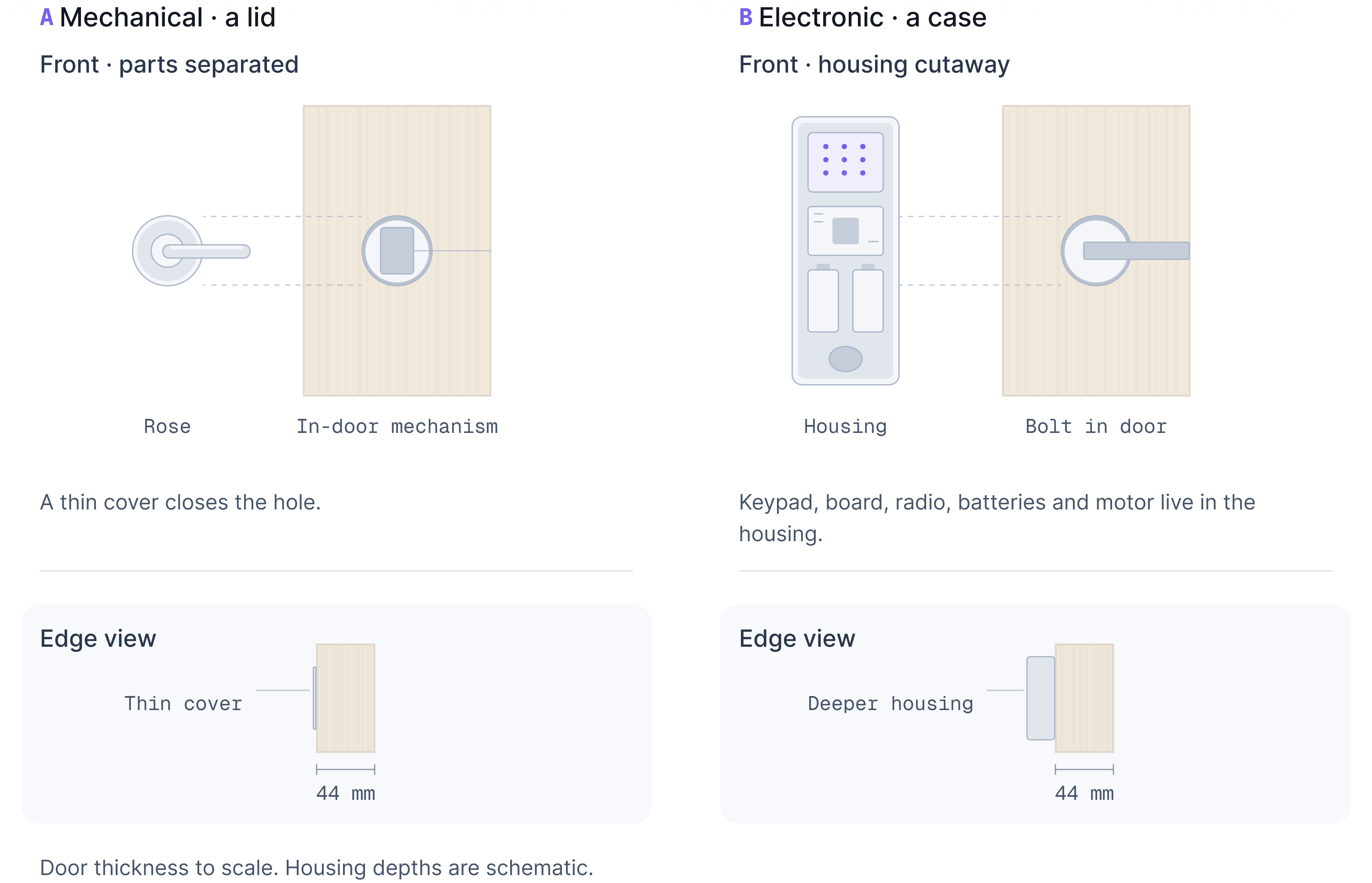
But "lid" was always too thin a word for what this plate does. Even on a purely mechanical lock it's doing several jobs at once. It hides the carpentry. It holds the lock onto the door. It lines its openings up with the mechanism. It stands between the cylinder and a burglar. Electronics added a fifth, housing the lock itself, and that's the one that made plates thick and has them carrying a keypad where they used to carry a cylinder.
Here they are, one at a time.
Hiding the carpentry, and holding the lock onto the door
Lift the off a and you're looking at a 2-1/8 inch (54 mm) through the face of the door, with two 5/16 inch (8 mm) holes above and below it for the through bolts, which pass all the way from one side to the other (Schlage ND template). Lift it off a and you find the pocket, the cavity routed into the thickness of the door to take the , its mounting holes, and separate cut-outs for the and the turn piece.
Either way, what the plate covers is rough carpentry, and that's the job everybody guesses.
The second one is less obvious. The through bolts clamp against the plate, which makes the plate the thing holding the two halves of the lock together through the door. It's structural, not applied, and that's why a bored lock with its trim taken off has nothing left to hang on to.
Lining up with the lock case, which is what decides the shape
Schlage's L9000 template, the dimension sheet the installer works from, puts the 3-55/64 inch (98 mm) from the cylinder and 2-23/32 inch (69 mm) from the turn piece (L1 template). Those are center-to-center distances, and they aren't up for negotiation: the lock case fixes them. Whatever goes on the face of the door has to land on those centers, and how it gets there is the plate's business.
This is the job that produces the three shapes trim comes in.
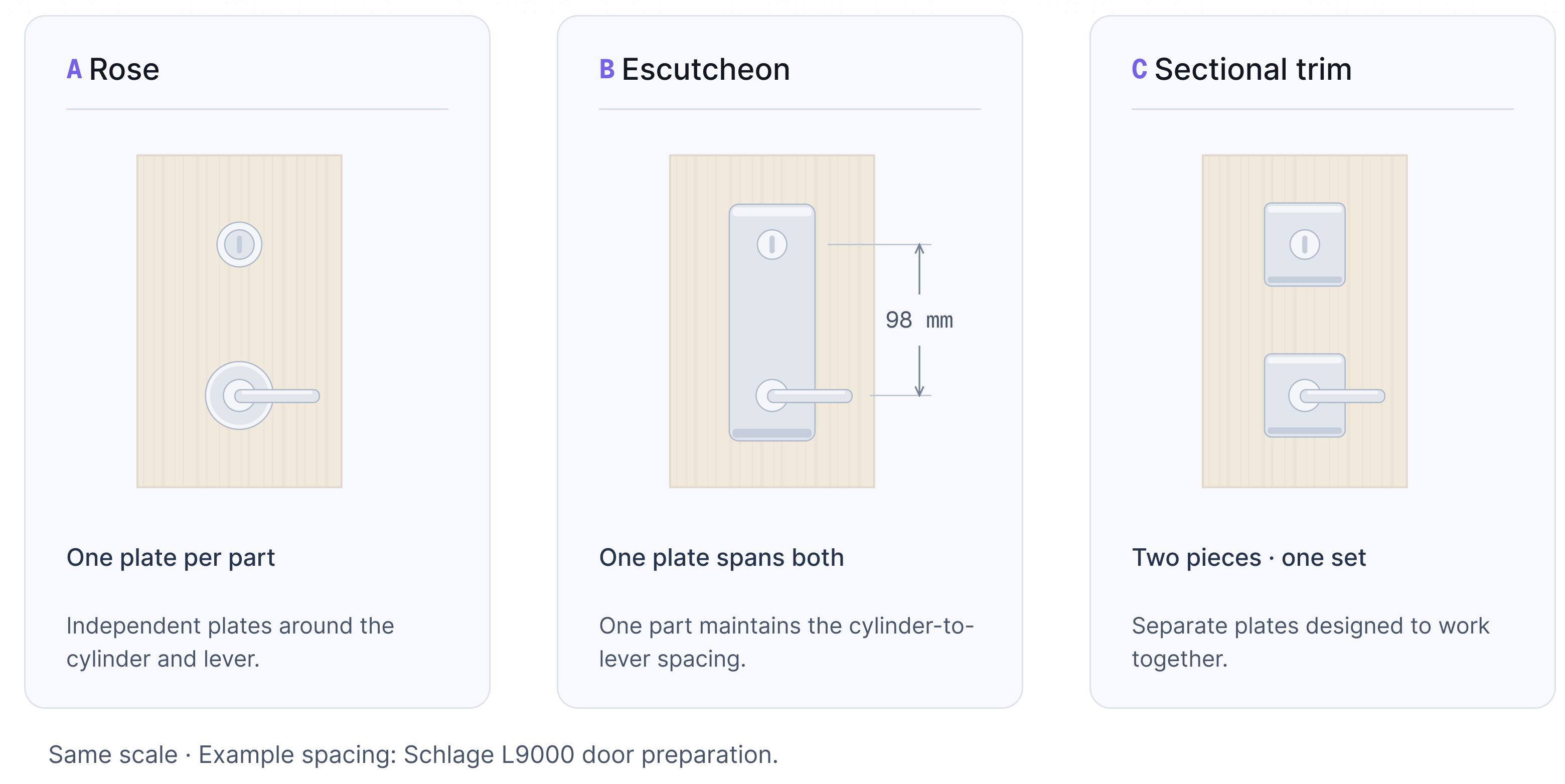
A , by contrast, is a small independent plate, usually circular, that surrounds one part and covers nothing else. An is a long plate spanning the handle and whatever sits above it, holding both in one register. is the option in between: separate pieces, designed as a set.
So the three words aren't three styles. They say how many of the lock case's centers a single plate has to meet. A rose meets one, because it only surrounds the handle, which is why a rose-trimmed lock needs a separate part around the cylinder and another around the .
Schlage organizes its own door preparation documents on exactly this distinction. The L-Series template index has three columns, Rose Trim, Escutcheon Trim and HSLR Trim, and every lock function, meaning every way a lock can behave on each face of the door, gets a different template number from one column to the next. Some functions carry a dash in the Escutcheon column: for those, no escutcheon exists.
If trim were cosmetic, one template would do, and there'd be no gaps.
Protecting the cylinder, where the standard asks for it
In Europe the plate is armor, and it's graded for it. BS EN 1906, the British and European standard for lever handles and knob furniture, carries a security digit with four burglary-resistance grades. Yale summarizes what it asks for: resistance to drilling, "close fitting plates or escutcheons to help protect the lock and support the cylinder", resistance to being pulled off from outside, and cylinder projection held to a maximum of 3 mm (Yale, Lever Handles EN standards).
Two verbs there are worth slowing down for. Protect: the plate stands between the cylinder and a drill. Support: it holds the cylinder against being levered. And the 3 mm limit is the whole anti-snap argument compressed into one dimension. Snapping a cylinder means breaking it in two by gripping whatever sticks out, so a cylinder sitting flush gives you nothing to grip.
In one of the two big standards traditions, then, trim is explicitly protective hardware with grades attached. The received idea of a decorative plate doesn't survive a single standard.
Housing the electronics, because there was nowhere else
Here's the inversion, and it follows directly from what was cut into the door.
A bored door has two holes and no volume. A mortise pocket buys a slot an inch wide and four and a half inches deep inside the door, which is why a mortise case can hold dozens of mechanical functions. Two bores don't buy anything of the kind. So when electronics turned up, needing room for a battery, a board, a radio and a motor, there was exactly one place left: the face of the door.
The thick housing on an American front door isn't a design failure. It's the only real estate available. And the part that inherited the work was the plate, because the plate was already there, already clamped by the through bolts, already covering the hole.
The earlier jobs carry on. The plate still has to hide the carpentry and hold the lock onto the door. It still has to line up with the mechanism, but now it also has to hold a keypad, a reader, an antenna, indicators and batteries in place: the same job, with many more components. Protecting the cylinder is the job that really changes, because many electronic locks have no cylinder left to protect. What the plate protects now is the electronics.
| Trim | What it covers | What it has to align | Where it runs out |
|---|---|---|---|
| Rose | one hole, one part | nothing beyond its own part | it cannot span to a cylinder or a turn, so those need plates of their own |
| Escutcheon | a whole region of the door face | every part it carries, at a fixed spacing | it needs door to sit on, and a bore at a 70 mm backset does not leave much |
| Sectional | two regions, separately | each piece to its own part, and both to each other by design | the gap between the pieces shows every hole it does not reach |
| Electronic plate | the carpentry, plus whatever the last lock left behind | the bore, the bolts, and the components inside itself | batteries and a motor set a depth nobody can style away |
Covering the last lock's holes, without running off the edge
The last column of the table above points to two constraints. Both come up when you fit an electronic lock to a door that already carried an ordinary one.
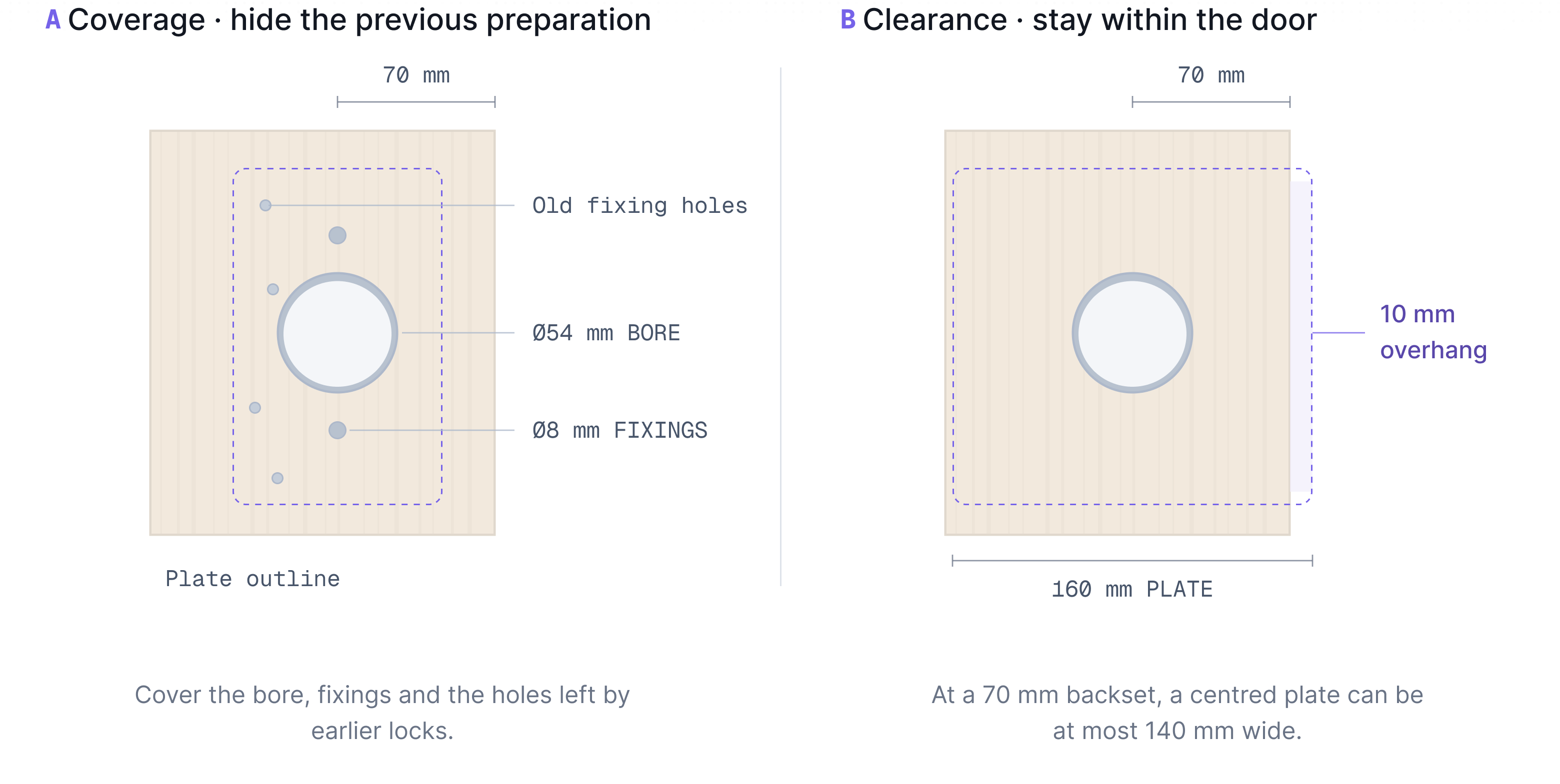
It has to cover what the last installer did, not just what this lock needs. A door that has carried two or three locks collects screw holes, and a plate that stops short of them puts them on display. That's most of the reason retrofit escutcheons look oversized: the size is a concealment requirement, not a styling choice.
And it can't grow past the of the door. At a 2-3/4 inch (70 mm) , the bore sits 70 mm from the edge of the , so a plate centered on that bore has 70 mm of door to work with on that side. A plate wider than about 140 mm has nowhere to go. The same arithmetic runs vertically against whatever sits above: a , a second bore, a light.
Which is why "will this smart lock fit my door" is a question about the plate at least as often as it's a question about the bolt.
Carrying the decoration, the one job everybody already knew about
That leaves the job everybody credits it with, and it's a real one: the plate is the only part of the lock you ever see. So it's the plate that carries the finish, the styling, and everything you pick off a catalog.
That job got heavier once the plate became the case. Since everything that matters is inside it, a whole product line can differentiate on the face without touching the mechanism. These aren't different locks: they're the same mechanism wearing a different front.
Same lock, a different face
Three pairs, three brands, and three different reasons for the split: the finish of the plate, the reader embedded in it, and the kind of keypad set into it.


Schlage's Camelot and Century are the mechanical tradition carried into electronics: two rows in the catalog, one lock, a different decorative plate. Ultraloq's Bolt Fingerprint and Bolt NFC differ by what's inside the plate, a sensor against an antenna. Yale's Assure Lock 2 is sold with a keypad or with a touchscreen, which turns the face into a box you tick.
Multiply the axes and the numbers get silly. Schlage's L Series has 67 mechanical functions and shows eighteen decorative lever styles in one collection alone (L Series overview). Function times handle style times trim family runs to thousands of orderable part numbers, all of them the same case in the same pocket.
Which gives you the practical question when you're comparing two listings: are you looking at two mechanisms, or at one mechanism photographed twice?
What the thickness of a plate tells you
All of these jobs are readable on the door, and the simplest clue is thickness.
A thick plate tells you the electronics are on the face. A thin plate tells you they went somewhere else, and there's a whole family of locks to show it: put the electronics inside a replaceable cylinder body instead, and the door keeps its mechanical furniture, unchanged.
Nothing on the face
The electronics went into the cylinder body, or onto the turn behind it. The trim on these doors is whatever was already there.
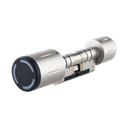


It's also why European doors so rarely wear the American housing: where the cylinder is a replaceable component, the electronics have somewhere else to live.
And an identical mechanism behind two different faces tells you the catalog is selling you a finish.