What is a platform, and why does it matter as much as the brand?
Two locks from the same manufacturer may not be able to do the same things, and two locks from different brands may be driven in exactly the same way. What decides is the software platform behind them.
Ask somebody which lock they have and you'll generally get a model and a brand. Ask what a piece of software can do with that lock, and those two facts turn out to be nowhere near enough. One is missing: the platform that defines and manages the accesses.
DeviceDB, whose job is answering exactly that kind of question, calls that platform a . It's a software platform that can create an access on a device, and it usually handles a great deal: storing the rights, issuing and revoking , keeping the access log, and exposing what an integration is allowed to touch. The lock is where the access is exercised. The provider is where it exists.
A brand can have several platforms, and a platform can serve several brands
The mapping between a brand and a platform is neither direct nor one-to-one.
Some manufacturers run several platforms. Salto runs, among others, Salto KS, Salto Space and Salto Homelok, and documents KS and Space as two separate systems with two separate manuals: KS is a cloud-born platform, while the Space system overview describes an on-premise platform, with offline locks updated through cards and portable programmers. The brand logo is the same, but the ecosystems differ and so do their capabilities. Knowing that a building is fitted with Salto tells you about the metal, and not enough to know what you can actually do.
It runs the other way too. One platform can serve many brands. Some white-label platforms sit behind dozens of brands whose hardware is nearly identical: the name on the box changes, the accounts, the app and what other software can do with it do not. Two locks with different logos can be the same device as far as software is concerned, and two locks with the same logo can have nothing in common.
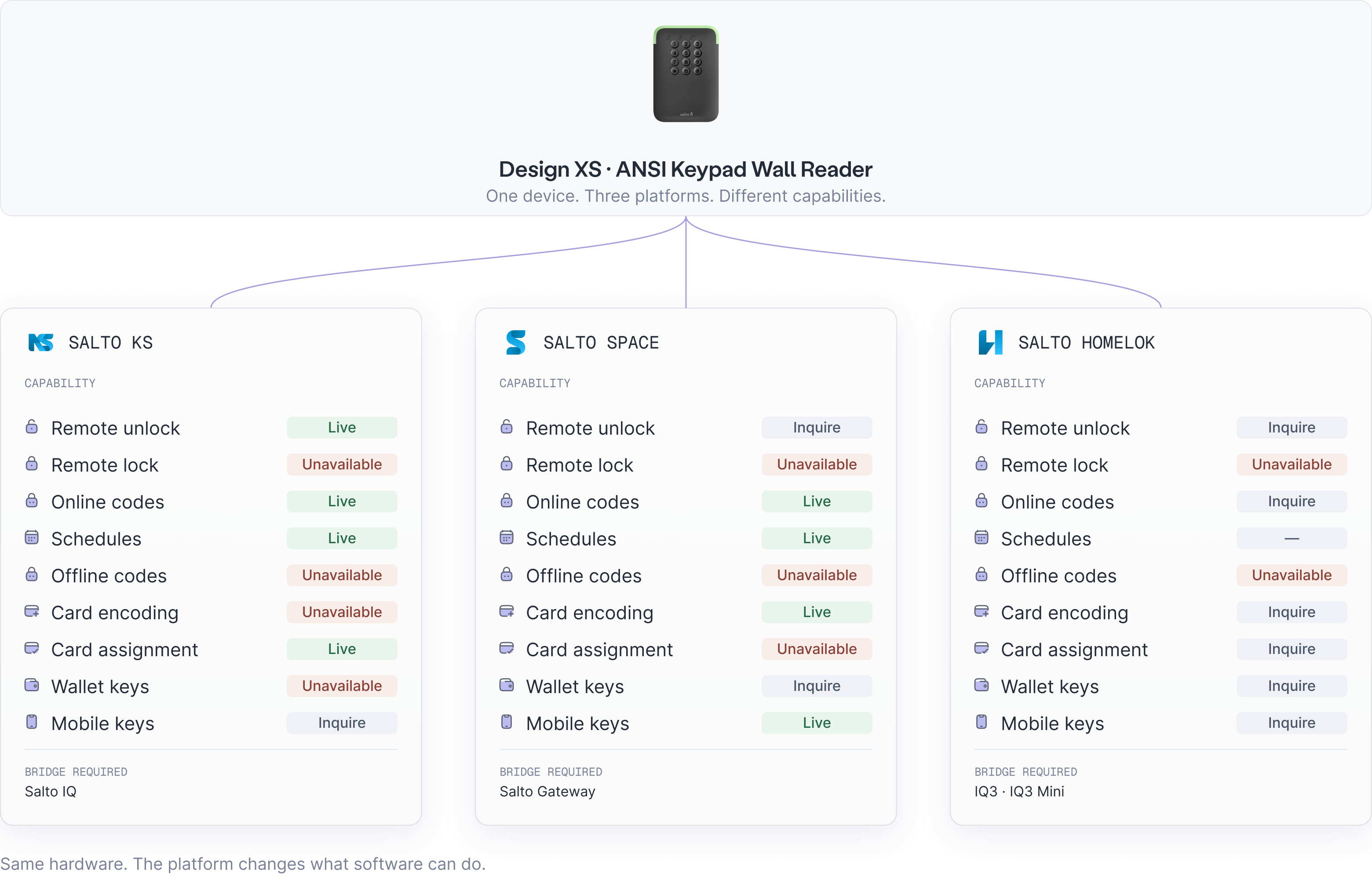
Depending on the platform, the same locks stop doing the same things
Take a lock and move it, hypothetically, from one platform to another. The metal is identical: same , same motor, same keypad. And yet, surprising as it sounds, a great many things can change. Who can hold an access, and how many people at once. Whether a code can start next Friday and stop on Sunday. In some cases an event log is available and in others it isn't. What happens when the building loses its internet connection can differ too.
That's why DeviceDB attaches providers to every device model, and why the device pages on this site let you switch from one to another: the same hardware really is a different object depending on the platform behind it.
| The manufacturer | The provider | |
|---|---|---|
| What it names | Who designed and sells the hardware | The platform where the accesses exist |
| Where you see it | On the hardware itself, in the catalog | In the app, in the API, on the software invoice |
| What it decides | Bolt, motor, keypad, finish, mounting | Accounts, credentials, schedules, log, and what other software can do |
| How many per device | Exactly one | One or several, and it can change over the device's life |
| The question it answers | What is fitted to the door? | What can software do with it? |
A lock never changes manufacturer. It can change provider, and when it does, it becomes a different device to every piece of software that talks to it.
A lock with no connection at all still has a platform
A provider is the platform that can create an access, not necessarily the one that talks to the lock itself.
A hotel lock with no connection of any kind does have a provider: the property's access system, which decides who may open that door and writes that decision onto the cards. The platform never talks to the lock, and it is still where the access exists. How a platform controls a lock it never contacts is the subject of another article.
One manufacturer in DeviceDB
Salto hardware spans battery cylinders, deadbolts and the bridges that connect locks to a platform. Which platform stands behind each model is exactly what the logo cannot tell you.


