English
Is there any logic in how Yale names its models?
YRD226-HA2-619 looks like a serial number somebody let a printer choose. Is there a system in there, and does any of it tell you something you cannot see by looking at the door?
A Yale lock's model number reads like a warehouse code. It is closer to a filled-in order form, and the useful accident is that Yale publishes the blank form a few pages away from the products. Once you have seen the blank, the code stops being a name and becomes a row of answers, one per column.
Eight of those answers describe metal that was cut in a factory and will never change. One describes a card that anybody can pull out of the lock and swap, and that one field is the only part of the string carrying a date.
Yale prints the blank form
The nexTouch commercial catalog runs a page headed "BUILD YOUR ORDER STRING",
with the columns named across the top and Yale's own worked example filled in
underneath: AU, NTB, 610, NR, 626, 1-3/4", 1803-53L, 694, 497
(Yale nexTouch Keypad Locks catalog,
copyright 2016 to 2018, Yale Security, Inc.).
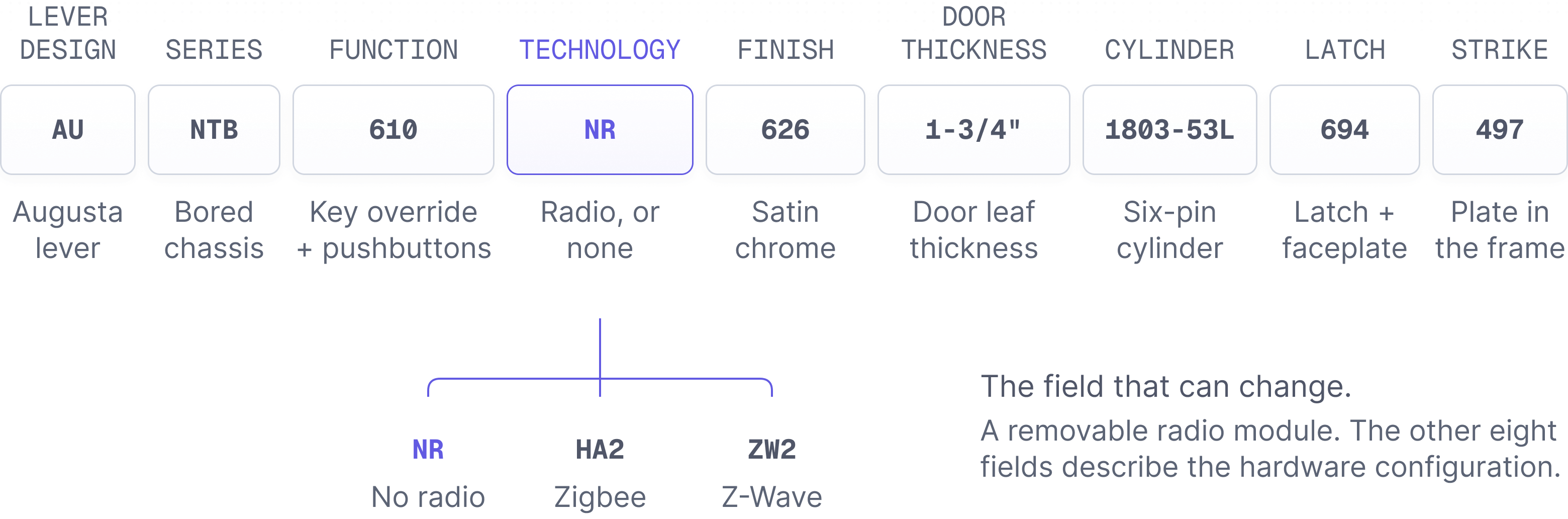
Read across and the lock assembles itself: an Augusta on a nexTouch , key override with a pushbutton keypad, no radio, satin chrome, for a 1-3/4 inch door, a six-pin cylinder, a 694 on a 2-3/4 inch backset with a 1/2 inch throw, and an ANSI .
What makes the string worth reading is that its columns are not asking the same kind of question.
Four codes for two questions
On the bored lock, the Function column offers 610, 620, 630 and 640, and the catalog spells each one out: 610 is "Key override, pushbutton keypad", 620 "Key override, capacitive touchscreen", 630 "No key override, pushbutton keypad", 640 "No key override, capacitive touchscreen".
That is not a ladder. It is a two by two. Two independent yes or no decisions, whether a mechanical key can still turn the lock and whether the digits are pressed or touched, compressed into a single digit. A 640 is not more lock than a 610, it is a different pair of answers, which is also why pushbutton and touchscreen are two products rather than two finishes.
626 is the standard's word. BSP is Yale's.
The Finish column looks like the least interesting one in the string, and it is the only one Yale does not own. The catalog heads it "ANSI/BHMA Code / Finish Description", which is an admission: 626 is Satin Chrome Plated because ANSI/BHMA A156.18, the trade's materials and finishes standard (a retailer's guide to it), says so, and not because Yale decided. Yale cannot renumber it and neither can Schlage.
The column is also bilingual. Before the current standard there was the older US system, and the trade never stopped speaking it, so Yale's condensed catalog prints a three-column table: "ANSI/BHMA Code", "Finish Description", "US Code". 626 sits beside US26D, 619 beside US15, 605 beside US3 (Yale Condensed Catalog). Two numbers, one finish, and the trade will hand you either.
Codes the standard defines, with the legacy US code Yale still prints
- 605US3Bright Brass
- 609US5Antique Brass
- 613EUS10BPDark Oxidized Satin Bronze
- 619US15Satin Nickel
- 620US15AAntique Nickel
- 625US26Bright Chrome
- 626US26DSatin Chrome
- 630US32DSatin Stainless
Codes with no ANSI/BHMA number, which stop at the edge of the price book
- P05Lifetime Brass
- BSPBlack Suede
- GMGun Metal
- TBTextured Black
- WHTWhite
- BLKBlack
Codes taken from Yale's Condensed Catalog and from the Yale Home Finishes page of Residential Price Book Volume 41. The swatches are approximations, since a flat fill cannot show a plated metal, and the three near-identical blacks in the lower group are not an error.
Now look at what happens when the standard runs out of words. On the same
catalog page, beside the three-column table, sits a second and much smaller one
headed just "Finish Code / Description". It has two rows, GM Gun Metal and
TB Textured Black, and no ANSI/BHMA column at all, because there is no number
to put in it. The residential book does the same thing on its "Yale Home
Finishes" page, where Polished Brass is printed as "US3 (605)" and Black Suede
is printed as "BSP", full stop
(Residential Price Book Volume 41, effective January 15, 2023).
So the field is shared vocabulary right up to the point where Yale wants a color
the standard has no word for, and then it mints one. The gap is not that the
standard lacks blacks: the nexTouch catalog lists a flat black as 676 under
its "ANSI/BHMA Code" heading. It is that BSP black suede, TB textured black and BLK
black are three more blacks Yale wanted and named itself, and a competitor's
counter will recognize none of the three.
There is a smaller lesson under the larger one. Even where the number is standard, the words Yale wraps around it drift: 605 is "Bright Brass" in the condensed catalog, "Bright Brass, Clear Coated" in the nexTouch catalog and "Polished Brass" in the residential book. 613E is paired with US10BP in the commercial document and with 10BE in the residential one. Three names, one number, and the number is the part that holds.
The radio column names a card in a slot
The Technology column has exactly three values in that catalog, and Yale's wording for the first one is worth keeping:
NR, "Keypad only, no radio"HA2, "Zigbee wireless communication"ZW2, "Z-Wave wireless communication"
NR is a catalog code whose entire content is an absence. The other two name a
part, and the part is removable. Yale's installation sheet for the Zigbee one
opens on a warning rather than a step: "the batteries must be removed prior to
removing and/or inserting the network module"
(Yale ZigBee Module, Installation and Programming Instructions, P/N AYR202-ZB-INSTAL-FUL Rev C, copyright 2017).
The radio sits in the battery compartment, on a card, behind the cover a
resident already opens twice a year. Yale's own term for it is "network module".
The retail box is printed AYR202-ZB-HA; the model on the board inside is
YRMZB2. Neither of those strings is the one in the lock's part number.
So one column of the model ID describes an accessory. The identical lock body
ships as -NR, -HA2 or -ZW2, and an -NR lock becomes an -HA2 lock in
the time it takes to change the batteries. Anyone building a catalog of models has
to rule on whether that is three models or one model in three configurations,
and the part number is precisely the wrong place to look for the answer.
The suffix is a date stamp
Because the radio is a component with its own certification, the suffix moves whenever the component does, and certification records are dated. A lock called YRD226 carries two Zigbee certificates four years apart.
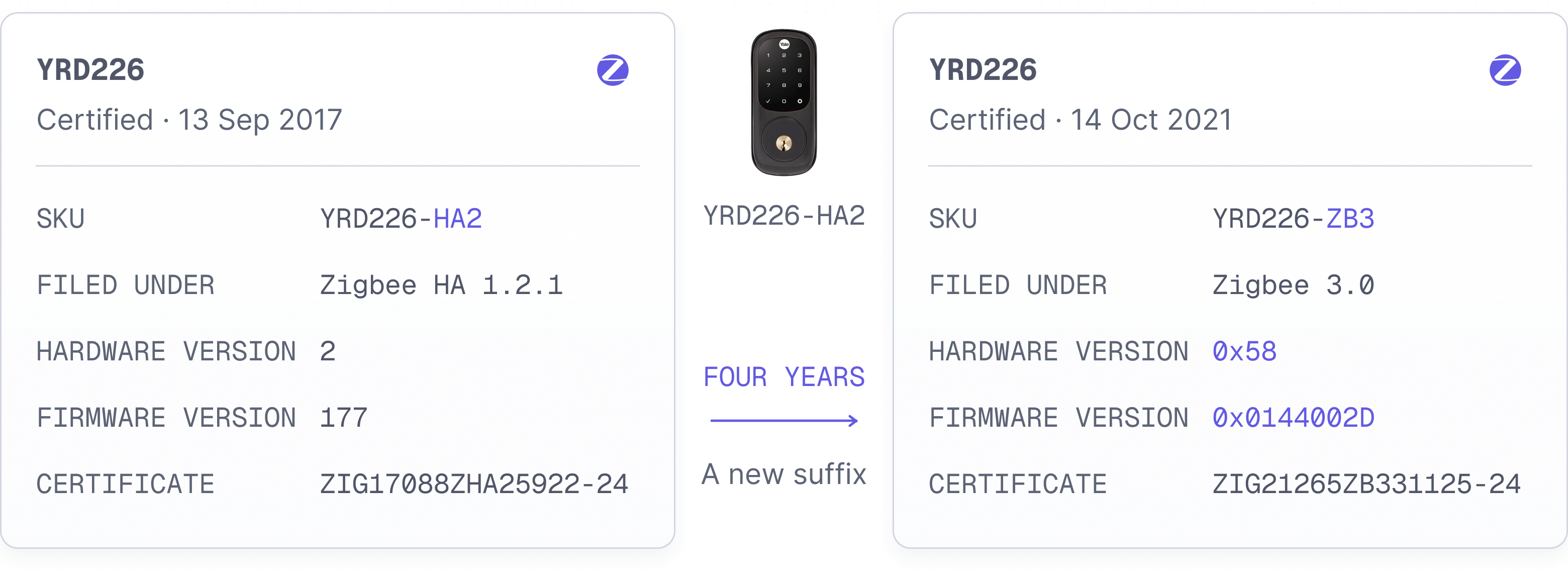
The 2017 record is filed under Zigbee Home Automation, specification version
1.2.1, hardware version 2, firmware version 177
(CSA certification, YRD226-HA2).
The 2021 record carries the Zigbee 3.0 badge, hardware version 0x58 and
firmware 0x0144002D
(CSA certification, YRD226-ZB3).
A hardware version that goes from 2 to 0x58 is not an over-the-air update. It points to
a different board answering to the same product name, and the two-character
suffix is the only thing in the catalog that distinguishes them.
| Code | Radio | What the record says | How you get it |
|---|---|---|---|
| NR | None | Keypad only, no radio, in Yale's own catalog wording | Nothing to install; the bay ships empty |
| HA2 | Zigbee | Zigbee Home Automation 1.2.1, certified September 2017 | A card, sold separately as AYR202-ZB-HA |
| ZB3 | Zigbee | Filed under Zigbee 3.0, certified October 2021 | Not sold as a separate module by Yale today |
| ZW2 | Z-Wave | Z-Wave wireless communication, per the same catalog page | A card; Yale lists AYR-MOD-ZW2-USA and AYR202-ZWV-USA |
| ZW3 | Z-Wave | Z-Wave Plus version 2 and S2 security, per installers; Yale's 2021 announcement names the 700 series | A card, AYR-MOD-ZW3, through distribution |
| BLE | Bluetooth | Named in Yale's own module compatibility list, YRD410-BLE through YRD450-BLE | Built in; the module bay stays free for a second radio |
| WF1 | Wi-Fi | Named by the module part number itself | A card, R-AYR-MOD-WF1-USA |
Seven codes, three different kinds of evidence behind them. The Zigbee generations come from certification records, the Z-Wave and Wi-Fi module names from Yale's store, and the link between the ZW3 code and the 700 series only from installers comparing notes.
Two honesty notes on that table. The ZW3 row rests on the
zwave-js project's discussion of the module,
where users report it as a 700 series radio offering Z-Wave Plus version 2 and
S2 security against the earlier module's version 1 and S0. That is installers
comparing notes:
Yale's own 2021 announcement
names the 700 series chip and S2, but never prints the code ZW3. And the code
space is not one clean namespace: Yale's
store lists the first-generation Assure module as AYR202-ZWV-USA and the
Assure Lock 2 module as AYR-MOD-ZW2-USA
(Yale smart modules), so the
module's part number and the lock's suffix use different codes for the same
radio.
The form outlives the company that printed it
Here is where two documents about one lock disagree, and the disagreement is the finding.
The nexTouch catalog that prints the order string is stamped, page after page,
"Copyright 2016-2018, Yale Security, Inc., an ASSA ABLOY Group company". The
Zigbee certificate for NTB620-HA2, a lock from that very catalog, certified in
September 2017, names the manufacturer as
Fortune Brands Global Plumbing Group LLC.
Same lock, same year, two different owners on two official records.
The catalog has the owner right. In June 2023, settling a Department of Justice antitrust suit over its purchase of Spectrum's hardware division, ASSA ABLOY divested "Emtek and the Smart Residential business, including Yale and August residential smart locks" to Fortune Brands for 800 million dollars (DWM; ASSA ABLOY's own announcement puts it as "the divestment of Emtek and the Smart Residential business in the U.S. and Canada"). nexTouch is a commercial lock and was not part of that sale: it stayed with ASSA ABLOY, which now sells it as ASSA ABLOY ACCENTRA. But certification databases show the holder as it stands now against the date the product was certified, so the manufacturer field was rewritten under a 2017 date and the catalog PDF, frozen in 2018, was not.
The part number was never touched. NTB620-HA2 meant a nexTouch bored
lever with a key override, a touchscreen keypad and a Zigbee card in 2017 and it means the same
thing today, through a divestiture and a change of brand. That stability is
exactly why a device catalog keys on model identifiers rather than on brands:
the logo tells you who the product wants to be, not who owns it.
Everything except the radio was settled in a factory
The order string is generous about the door and silent about the software. It names the handle, the chassis, the function, the finish in the trade's own vocabulary, and which radio Yale intended to put in the bay. It does not name which platform can issue a credential to the lock, whether the radio in the bay is still the one printed on the label, or who the manufacturer will be next year.
Which leaves a decent rule of thumb for reading any of these codes. Everything except the radio field is a decision made in a factory. The radio field is a decision made in a battery compartment, and it is the one meant to be changed.